
Alma Adams, Democratic Candidate for NC’s 12th Congressional District
Special | 15m 19sVideo has Closed Captions
An interview with Alma Adams, Democratic candidate for NC’s 12th Congressional District (2026).
Alma Adams is running as a Democrat for NC’s 12th Congressional District. She discusses her 2026 campaign with PBS NC’s Kelly McCullen. This interview was recorded on September 9, 2026.
Problems playing video? | Closed Captioning Feedback
Problems playing video? | Closed Captioning Feedback
State Lines is a local public television program presented by PBS NC
Alma Adams, Democratic Candidate for NC’s 12th Congressional District
Special | 15m 19sVideo has Closed Captions
Alma Adams is running as a Democrat for NC’s 12th Congressional District. She discusses her 2026 campaign with PBS NC’s Kelly McCullen. This interview was recorded on September 9, 2026.
Problems playing video? | Closed Captioning Feedback
Where to Watch State Lines
State Lines is available to stream on pbs.org and the PBS app.
Providing Support for PBS.org
Learn Moreabout PBS online sponsorshipMore from This Collection
During major election cycles, PBS North Carolina's public affairs team sits down for in-depth conversations with candidates running for elected office in North Carolina. PBS North Carolina has invited major party candidates to a one-on-one interview with State Lines host and executive producer Kelly McCullen. Interviews are scheduled throughout the summer and early fall.
 New
NewNC Judicial Candidates Forum: NC Court of Appeals Judge Seats 2 & 3
Video has Closed Captions
Meet candidates for the NC Court of Appeals Judge Seats 2 and 3. (26m 46s)
 New
NewCandidates for NC Court of Appeals Judge Seat 3: Craig Collins (R) & Christine Marie Walczyk (D)
Video has Closed Captions
Meet the Republican and Democratic candidates for the NC Court of Appeals Judge Seat 3. (13m 7s)
 New
NewCandidate for NC Court of Appeals Judge Seat 2: Tobias Hampson (D)
Video has Closed Captions
Meet the Democratic candidate for the NC Court of Appeals Judge Seat 2. (12m 57s)
Candidates for NC Supreme Court Associate Justice Seat 1: Anita Earls (D) & Sarah Stevens (R)
Video has Closed Captions
Meet the Democratic and Republican candidates for the NC Supreme Court Associate Justice Seat 1. (12m 38s)
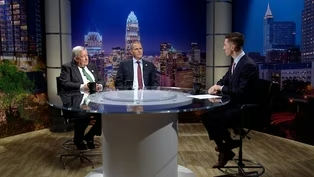
Candidates for NC Court of Appeals Judge Seat 1: John Arrowood (D) & Michael Byrne (R)
Video has Closed Captions
Meet the Democratic and Republican candidates for the NC Court of Appeals Judge Seat 1. (11m 54s)
Kimberly Hardy, Democratic Candidate for NC’s 7th Congressional District
Video has Closed Captions
An interview with Kimberly Hardy, Democratic candidate for NC’s 7th Congressional District (2026). (14m 16s)
Cyril Jefferson, Democratic Candidate for NC’s 6th Congressional District
Video has Closed Captions
An interview with Cyril Jefferson, Democratic candidate for NC’s 6th Congressional District (2026). (13m 42s)
Addison McDowell, Republican Candidate for NC’s 6th Congressional District
Video has Closed Captions
An interview with Addison McDowell, Republican candidate for NC’s 6th Congressional District (2026). (14m 11s)
Jamie Ager, Democratic Candidate for NC’s 11th Congressional District
Video has Closed Captions
An interview with Jamie Ager, Democratic candidate for NC’s 11th Congressional District (2026). (14m)
Tim Moore, Republican Candidate for NC’s 14th Congressional District
Video has Closed Captions
An interview with Tim Moore, Republican candidate for NC’s 14th Congressional District (2026). (14m 46s)
Mark Harris, Republican Candidate for NC’s 8th Congressional District
Video has Closed Captions
An interview with Mark Harris, Republican candidate for NC’s 8th Congressional District (2026). (15m 27s)
Lakesha Womack, Democratic Candidate for NC’s 14th Congressional District
Video has Closed Captions
An interview with Lakesha Womack, Democratic candidate for NC’s 14th Congressional District (2026). (14m 56s)
Providing Support for PBS.org
Learn Moreabout PBS online sponsorship- Incumbent Representative Alma Adams of the 12th Congressional District in North Carolina joins us for this candidate discussion.
Representative, thanks for making time for us.
- Absolutely, thank you for the invitation.
I'm happy to be with you.
- Well, you know, these districts have changed in realistic mathematical terms in some ways, but the population is coming in here and it's growing by leaps and bounds.
And from where you're from, it's growing.
There are a lot of new voters out there who might wanna know more about you and what you stand for as you represent them in Congress.
Tell us about yourself.
- Well, I am a mother, I'm a grandmother, I'm a great-grandmother as a matter of fact right now, but I have been in elected office for a while and I'm a retired educator.
I am a public servant.
I believe service is the rent we pay.
I've served on the school board, I've served on city council, state government, and now at the federal level, I have been an advocate for working families in every office that I've served, whether it's been city council or school board or state house.
My focus, however, in the Congress now is on my four H's, healthcare, housing, higher education, and hunger.
All those things are really important to the district.
And for me, I think it's important to know what your folks need and to go about helping resolve some of the issues so that people can live a good quality of life.
So I'm clearly about trying to make life better for people because I do believe that there are some basic things that people need.
And as a member of Congress, I have a responsibility to make sure that it happens for people.
- How do you get Congress, particularly congressional Republicans in that majority, to listen to you?
The four H's won't change regardless of the inflation or Iran or the Israeli-US relation, any tariffs, anything.
How do you keep the focus there and how do you get people to listen to you when there's so many other headlines grabbing our attention?
It seems almost every 12 hours, much less 24 hours.
- Well, listen, I think we are more alike than we are different.
And I think the issues are pretty similar regardless.
As far as I'm concerned, there are really no blue issues and red issues.
Education should not be a partisan issue.
Neither should hunger.
Neither should housing.
All of those things are, as far as I'm concerned, basic needs that people have.
And so if you're in a red district or a blue district, I think the people are talking about the same thing.
They can't afford to live.
They can't afford to pay for their food.
Many of them don't have food to eat.
We have a lot of people who are homeless.
We have a lot of folks who are food insecure, especially in this 12th district.
And a lot of those folks are children.
So I just think that people listen to you because they have similar circumstances in their districts as well.
This is the same process that I use in working across the aisle.
I think that's important.
When we think about it, we have to, your legislation, if you've got bills, they've got to get to committee, they've got to get out of committee, they've got to get to the floor.
But more than that, I think we have to continue to ensure that the people we work with understand not only who we're working for, but what our needs are.
This is why everybody has a, some of the districts are very similar, but a lot of them are very different.
- Walk me through that public education platform, some school districts released some academic achievement.
Not a bad year for many schools in North Carolina, but you've got some federal funding changes and the state's always, you're a part of budget processes.
You know how expensive a huge percentage of the budget, state budget education is.
Why is it so elusive to get public education where everyone can be happy?
- Well, I am a big supporter of public education.
My children went to public schools, I went to public schools, my grandchildren went to public schools as well.
85, 90% of the kids are gonna be going to public schools.
Public schools are open for all students.
We are required in public education to address the needs of all students.
And of course, when you look at some of the other things that we are facing now, where kids maybe are not going to public schools, sometimes the borders are different.
And that to me is a problem.
I just don't believe, I think we have to support public education.
I don't think we have supported public education the way we should have and the way we need to.
And a lot of children are being left behind as a result because members who serve in elected office and hold the public purse want to do other things and take away from public education.
And I've always fought against that.
And I'll continue to because our greatest investment, as far as I'm concerned, is in education.
It is the pathway to opportunity for each person.
So it doesn't matter what your zip code is, where you live, how much money's in your household.
You should be able to get a good public education and you've got to fund it.
- What's missing in public education policy, especially from the congressional level?
If you could get one thing accomplished the next two years, this next term, what would you tell leadership to focus on?
- Well, first, let me just say, having been a teacher and I haven't been in public teaching, I haven't taught in public schools, but I've taught students who are going into public education and who are going to be teachers.
And we are losing many of our educators and people who would go into education because they're not making the money.
I mean, you've got to have the resources to be able to live.
So I would say, listen, we need to make sure that our teachers are paid and that they are paid well because North Carolina right now is not at the very bottom, but we're pretty doggone close.
And I was in a hearing on, not a hearing, but a political kind of session yesterday.
And we had some of our local state elected officials who serve in the General Assembly and they were talking about the raises that, and I appreciate that.
I think we need to do that.
When I was in the General Assembly, we continued to do it, but that has been very slow and we've lost a lot of teachers.
Things are just very different now.
They're buying their own supplies in many cases and they have, well, I won't say that they necessarily, I think we have discipline problems everywhere, but it's been very slow putting the funding in public education.
And I just think that we've got to do better because we're losing good people.
We've also got to, I think, reward our career teachers, teachers who've been there a while.
It's my understanding that the raises that they have put in for doing this past General Assembly probably is going to impact to a greater degree the new teachers coming in.
And that's fine.
We do need new teachers coming in, but we also need to retain those who've stayed and who've done well and who've helped to build the system.
- Yeah.
- Let's shift to healthcare.
Republicans and Democratic candidates I'm meeting are all talking healthcare.
Like I said, different solutions to the same challenge.
I think everyone sees pricing and affordability and access.
Some Democratic candidates are supporting Medicare for All, which is a takeover, I guess, of the healthcare system.
Some say strengthen the Affordable Care Act or Obamacare.
What needs to be done with US healthcare, if anything?
- Well, I think we need to do both of those things.
I think Obamacare, as we know it, has actually helped a lot of people who never had an opportunity to even see a doctor.
I think if you're ill, you should be able to see a doctor.
And as a matter of fact, if you're not ill, it's prevented kinds of things.
And that's important, because if you can prevent things from happening, in other words, you have someone keeping up with your progress, then you can kind of be detached from having problems if you look at those things and get your pre-screenings and all those things early.
But I think healthcare is a basic human right.
I, but my opponent doesn't think that, but I do.
Healthcare, and I didn't have healthcare growing up, okay?
I had a sister a couple of years older than I, who she's deceased now, died at 26 years old from sickle cell anemia.
We got our healthcare from the emergency room.
That should not be the case for anyone.
If you're healthy, you wanna stay healthy, so you should have a doctor.
If you're sick, you should be able to see a doctor.
But I do think that there was a lot of value in Obamacare, but I also believe that we should have Medicare for all, or some sense of that.
We can call it something else.
It doesn't matter to me, but we need to make provisions so that everyone will have an opportunity to be seen by a doctor if they need to.
And that's not the case right now.
We have thousands of people right here in this district who now, as a result of what this big, big, beautifully ugly bill did, so many people now don't even have an opportunity to even get healthcare.
They've lost their healthcare.
The healthcare that they had has increased drastically, and people cannot afford it.
So in other words, you can't afford to get sick.
That should not be, in the richest country in the world, this should not be.
- The one huge international issue facing Congress and the executive branches of the Iranian conflict.
What would you do about Iran?
Do we get out?
Do we fight to win, declare victory, and leave?
There's a host of options here.
- Well, I think we need to end this war as quickly as possible.
This president has put us in a situation where Iran has enriched themselves.
They've gotten a sweeter deal than we had previously made with them under President Obama.
The war just continues to threaten the lives of people who are serving our country, our veterans, our people who are there, our young men and women who are fighting, and many of them don't even understand why.
So I think this war threatens the lives of those who are serving our country.
It threatens the stability of our economy.
When you think about it, when I talk to, I sit on the Ag Committee as well as Education, and the farmers are having a difficult time, everybody is.
So the war, it's made us less safe, less stable.
It's made us spend money that we don't have on a conflict that nobody asked for, and most people don't even understand.
- You mentioned the farmers, and when I hear farmers, a lot of these conversations, people are wanting to talk about tariffs.
What are tariffs' role in the US economy as federal policy?
Is it a broad stroke, no tariffs, full free trade, or isolated niche applications of tariff to protect some industries?
- Well, listen, I think we need to end them.
Laws are not made -- I tell people, you know, executive orders, EO, EAST, whatever they wanna call them, they're not made at 1600 Pennsylvania Avenue, they're made in the halls of Congress.
We did not vote for this.
The president did not, he disregards and disrespects the Congress, I believe.
So when we take back Congress, and we're gonna do that, one of our first actions will be to end these tariffs that this president has unconstitutionally imposed on our citizens.
And we've made enemies out of our friends and friends out of our enemy.
I mean, it's just ridiculous.
The tariffs, when you think about it, cost-wise, they're projected to have cost the state of North Carolina, just our state, almost $2 billion.
There's no authority that this president has to unilaterally wreck our country's economy.
But he's enriching himself, he's enriching his friends and his allies.
And, you know, the government, when you think about the companies and the businesses and so forth that incurred these tariffs, they got a refund.
For the millions of Americans who had to pay those tariffs, we didn't get one.
So I think our priority as Congress needs to be, in this next session, we've got to bail out the American people who bore the brunt of these tariffs.
We've got to correct a lot of the corruption that has occurred in this administration.
So that's what I believe, and I believe that's the route we're gonna take when we take this Congress back.
- Voters, of course, in the 12th District might wanna learn more about you.
And there's people all around America and the world that would see this interview.
How can people learn more about you as the representative and your platform and your campaign here in 2026?
- Well, they can go to almaadamsforcongress.com or they can follow me on Instagram, Facebook, or Alma Adams for Congress.
If they are interested in, we do a newsletter, Adams Alert, to try to let folks know not only what I'm doing, but what we're doing in terms of some of these issues that they are confronted with.
And so I'm happy to talk to folks.
I meet with a lot of people.
I'm very, very involved and present in this community.
I'm gonna continue to do that.
I appreciate the opportunity to serve.
Service is the rent we pay for living on God's earth.
And so I've tried to keep my rent fully paid up and I paid some rent for some other folks too, and I don't mind.
- Representative Alma Adams running for Congress in the 12th U.S.
Congressional District as the Democratic nominee and the incumbent.
Thank you so much for your time and be safe out there on the campaign trail.
- Yes, sir.
Thank you very much and you have a wonderful day.
- Thank you.
(upbeat music)
 New Episode
- News and Public Affairs

Top journalists deliver compelling original analysis of the hour's headlines.

- News and Public Affairs

FRONTLINE is investigative journalism that questions, explains and changes our world.
 New Season


 New Episode

 New Episode



Support for PBS provided by:
State Lines is a local public television program presented by PBS NC