
Candidate for NC Court of Appeals Judge Seat 2: Tobias Hampson (D)
Special | 12m 57sVideo has Closed Captions
Meet the Democratic candidate for the NC Court of Appeals Judge Seat 2.
Tobias Hampson (Democrat) discusses his background and why he’s running for the NC Court of Appeals Judge Seat 2 with PBS NC’s Kelly McCullen. The 2026 NC Judicial Candidates Forum is made possible by a partnership between PBS North Carolina and the North Carolina Bar Association.
Problems playing video? | Closed Captioning Feedback
Problems playing video? | Closed Captioning Feedback
State Lines is a local public television program presented by PBS NC
Candidate for NC Court of Appeals Judge Seat 2: Tobias Hampson (D)
Special | 12m 57sVideo has Closed Captions
Tobias Hampson (Democrat) discusses his background and why he’s running for the NC Court of Appeals Judge Seat 2 with PBS NC’s Kelly McCullen. The 2026 NC Judicial Candidates Forum is made possible by a partnership between PBS North Carolina and the North Carolina Bar Association.
Problems playing video? | Closed Captioning Feedback
Where to Watch State Lines
State Lines is available to stream on pbs.org and the PBS app.
Providing Support for PBS.org
Learn Moreabout PBS online sponsorshipMore from This Collection
During major election cycles, PBS North Carolina's public affairs team sits down for in-depth conversations with candidates running for elected office in North Carolina. PBS North Carolina has invited major party candidates to a one-on-one interview with State Lines host and executive producer Kelly McCullen. Interviews are scheduled throughout the summer and early fall.
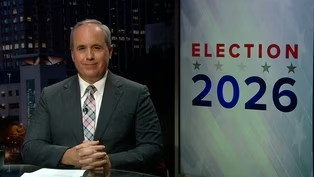 New
NewNC Judicial Candidates Forum: NC Court of Appeals Judge Seats 2 & 3
Video has Closed Captions
Meet candidates for the NC Court of Appeals Judge Seats 2 and 3. (26m 46s)
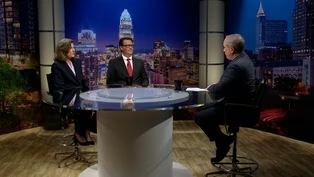 New
NewCandidates for NC Court of Appeals Judge Seat 3: Craig Collins (R) & Christine Marie Walczyk (D)
Video has Closed Captions
Meet the Republican and Democratic candidates for the NC Court of Appeals Judge Seat 3. (13m 7s)
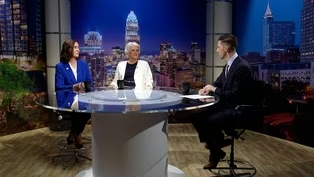
Candidates for NC Supreme Court Associate Justice Seat 1: Anita Earls (D) & Sarah Stevens (R)
Video has Closed Captions
Meet the Democratic and Republican candidates for the NC Supreme Court Associate Justice Seat 1. (12m 38s)
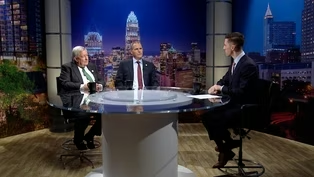
Candidates for NC Court of Appeals Judge Seat 1: John Arrowood (D) & Michael Byrne (R)
Video has Closed Captions
Meet the Democratic and Republican candidates for the NC Court of Appeals Judge Seat 1. (11m 54s)
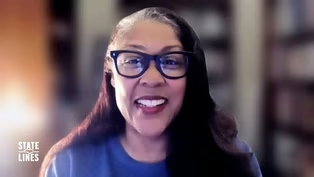
Kimberly Hardy, Democratic Candidate for NC’s 7th Congressional District
Video has Closed Captions
An interview with Kimberly Hardy, Democratic candidate for NC’s 7th Congressional District (2026). (14m 16s)
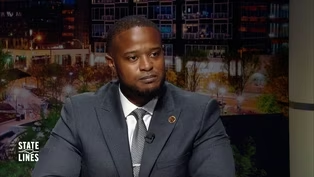
Cyril Jefferson, Democratic Candidate for NC’s 6th Congressional District
Video has Closed Captions
An interview with Cyril Jefferson, Democratic candidate for NC’s 6th Congressional District (2026). (13m 42s)
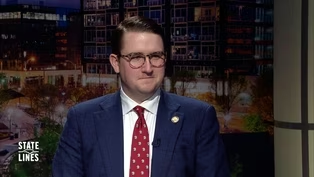
Addison McDowell, Republican Candidate for NC’s 6th Congressional District
Video has Closed Captions
An interview with Addison McDowell, Republican candidate for NC’s 6th Congressional District (2026). (14m 11s)
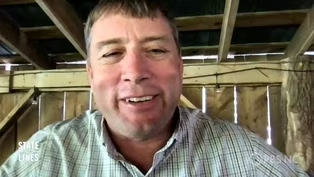
Jamie Ager, Democratic Candidate for NC’s 11th Congressional District
Video has Closed Captions
An interview with Jamie Ager, Democratic candidate for NC’s 11th Congressional District (2026). (14m)
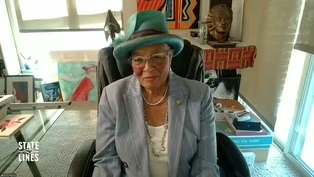
Alma Adams, Democratic Candidate for NC’s 12th Congressional District
Video has Closed Captions
An interview with Alma Adams, Democratic candidate for NC’s 12th Congressional District (2026). (15m 19s)
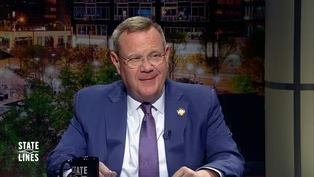
Tim Moore, Republican Candidate for NC’s 14th Congressional District
Video has Closed Captions
An interview with Tim Moore, Republican candidate for NC’s 14th Congressional District (2026). (14m 46s)
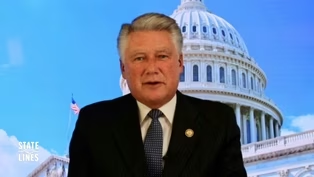
Mark Harris, Republican Candidate for NC’s 8th Congressional District
Video has Closed Captions
An interview with Mark Harris, Republican candidate for NC’s 8th Congressional District (2026). (15m 27s)
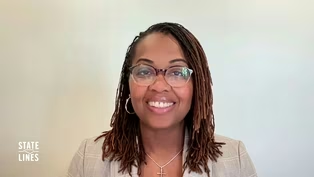
Lakesha Womack, Democratic Candidate for NC’s 14th Congressional District
Video has Closed Captions
An interview with Lakesha Womack, Democratic candidate for NC’s 14th Congressional District (2026). (14m 56s)
Providing Support for PBS.org
Learn Moreabout PBS online sponsorship- The 2026 Judicial Candidates Forum is made possible by a partnership between PBS North Carolina and the North Carolina Bar Association.
♪ - Joining us is one of the nominees for the North Carolina Court of Appeals in seat two.
It's Democratic candidate Tobias "Toby" Hampson.
That's how the name will be printed on the ballot.
Republican candidate George Cooper Bell, supposed to be here but had a scheduling conflict.
But thank you, Judge Hampson, for sitting down with us for this brief conversation about yourself and your campaign.
- Well, thank you.
I'm looking forward to it.
- You're the incumbent on the Court of Appeals.
That's what most folks will know.
They'll know that about you.
But what is it about Judge Hampson that prepared you for the Court of Appeals but also prepares you to stay if the voters keep you there?
- Well, you know, I grew up as a lawyer, kind of in the North Carolina Court of Appeals.
I served as a law clerk for three judges as my first job right out of law school.
I clerked for Eddie Green, Wanda Bryant and Bob Hunter.
Mountain Bob, if you know the difference.
Where I really started to really learn and appreciate the work of the Court of Appeals.
It really is the workhorse of the North Carolina appellate courts.
You know, most cases that come up on appeal end in the North Carolina Court of Appeals.
They don't necessarily go up to the state supreme court.
But after clerking at the court, I went into private practice in Raleigh where I really focused my career on handling appeals in the North Carolina Court of Appeals and North Carolina State Supreme Court.
You know, I'm certified as a specialist in handling appeals by the North Carolina State Bar.
During my time in practice, I think I handle just about every kind of case that the North Carolina Court of Appeals hears.
Everything from representing parents whose parental rights were at risk and needed appointed attorneys to representing injured workers, injured children, small businesses, even municipalities in appeals to the North Carolina Court of Appeals.
So I think I really brought a lot of hands on Court of Appeals experience when I was first elected in 2018.
Since I've been on the court, I've authored over 400 majority opinions, most of which are unanimous, most of which are bipartisan.
So I'm really proud of the work that I've done on the Court of Appeals.
I really love the work of the Court of Appeals.
- You know, we know Supreme Court.
We know that those justices, they seem to have strong political opinions at times in different states.
And, you know, it's all about the headlines.
But down at that appeals court level, it too is partisan.
There's Democrat, Republicans running.
But why is it the workhorse?
And why doesn't partisanship squeeze into the process?
- You know, I feel really fortunate that at the Court of Appeals, we've been able to maintain a really high degree of collegiality, even in the midst of partisan times, partisan elections.
And I think a lot of that is because we have to get the work done.
You know, we don't have the luxury of packing up and going home without passing a budget, say.
We have to get cases decided for the people of North Carolina.
And a lot of those issues are issues that impact more of the day-to-day lives of North Carolina.
So certainly we hear criminal justice cases, criminal cases and appeals from DUIs to first degree murder, on the civil side, the whole gamut.
So a lot of times we are able to work together and find a level of consensus on the courts in order to get that decision out for the people of North Carolina.
- Take me back to eighth grade, you know, civics lesson.
Supreme Court, we know what they do.
Lower Court, Superior District Court, you know, you face the judge with all your problems at the local level.
But what do you actually do in the Court of Appeals?
What is its core function as you see it?
- Yeah, the core function of the Court of Appeals is to ensure that the law is being applied consistently and fairly in all 100 counties in North Carolina so that everybody is getting a fair shake.
Right.
We're looking to see if the law was properly interpreted and applied in people's cases according to the facts of that case.
So we're really just looking to see if any mistakes were made as a matter of law in the trial court.
- So I had a case not go my way.
I think something at the county court level was not right.
Then we would go to the appeals court.
- In almost all cases.
Your appeal right of appeal is to the North Carolina Court of Appeals.
That's right.
- What are the two most important qualities you think should reside within a judge on that Court of Appeals?
Don't be biased by any means, but there there has to be others there that you admire something about.
What two things do you admire most?
- I admire thoughtfulness in a judge.
A judge that's going to treat the both parties with respect, treat both arguments with respect and a level of seriousness and thoughtfulness.
I don't want to sound too much like Ted Lasso, but this may be more curious than judgmental as they approach their role in a case.
But the second quality I look for is someone that's willing to make a hard decision and make a hard principle decision based on the law and the facts before them.
So those are two qualities I really, really admire.
- This is a one on one.
It's a little bit different than having an opponent sitting across from you.
But I'll say as a judge coming in, you're a human being.
Are there cases that any judge goes into thinking they might know how they're going to judge beforehand?
How do you suppress that to be or do you suppress the idea that you have an opinion and go neutral into everything you hear?
- Well, I think each one of us brings our own experience and background.
Again, that's one of the beautiful things about the Court of Appeals is we all have different experiences that we've had in practice or as trial judges or as different kinds of lawyers that we bring to the bench.
So I think we all we bring that experience and knowledge to the bench.
But I think because of that experience and knowledge, a lot of times we're able to come in with a more open mind to hear those cases and weigh the arguments.
And certainly for me, having been on the other side of that podium, making those arguments, you know, it's really important to me to treat all the parties that come before us with a high level of respect, both between the bench, but also between bench and bar and approach those cases seriously and fairly.
- When you're sitting on this panel here with these three judge panels, you know, it sounds very, very fancy in front of our stories that we do.
But when you're hearing a case, is it three judges or however many judges are assigned and you go to your own offices, you come out with three distinct opinions or do you collaborate with each other and try to reach consensus as a unit of the judiciary?
- No.
So what happens is after we hear the argument as the three judges, we go into conference, you go into a conference room and we sit down and we kind of give our preliminary votes the way we think the case should be decided.
The case is then assigned to one of the judges to author.
The judge will author that opinion and circulate a draft to the other judges.
And we can either concur in the opinion.
We can always suggest revisions or edits or we could write a separate concurrence saying I agree with the result, but I don't agree with how you get there.
- How independent is the judiciary in North Carolina now top to bottom now that we have a few cycles in of partisanship?
I would say overt public partisanship being injected into the races.
- You know, I think it's a little bit of a tough question to answer.
I think on a day to day basis in the courts, I think our courts remain highly independent.
You know, I certainly think what we're seeing at the trial court level, the court of appeals level, and frankly, even at the state Supreme Court level, I think we see the cases where there's a lot of division, but there are cases where even that court is able to decide cases in unanimous fashion or with a bipartisan majority.
So I think there is a high level of independence on the court.
I think we do have to be wary of that independence being eroded because of partisanship being injected.
I think we do need courts that are willing to stand up to the other two political branches of government and serve as a check and balance on those.
And I think when we do that, that's how we help maintain and restore public confidence in our judiciary, which is really where we draw the source of our power.
- You know, we've had some other interviewed, recorded interviews for this campaign, but I have noticed judges, every judge has said they respect, they want to uphold the Constitution of the state and of the United States.
But there's different ways in the way they see, they interpret and uphold the standards of the Constitution.
How do you view the Constitution?
- Yeah, well, you know, the Constitution, both state and federal, to me is it really provides the fundamental basis, the underlying foundation for everything we do as judiciary, everything we do as democracy, everything we do as a government.
And for me, you know, it's funny, just thinking about another forum where I was asked, somebody said, well, what's your position on flock cameras?
And of course, I can't take a position on flock cameras because those are exactly the kinds of issues that are going to come before our courts potentially down the road.
But I thought to myself, you know, the question was, what did the framers think about flock cameras?
And I said, well, you know, framers wouldn't have even thought about flock cameras, you know, and license plate readers.
They wouldn't have even thought about license plates.
But the sort of the brilliance and the resilience of our Constitution is it's given us those foundational blocks that we can build from, that we can use to interpret into modern situations with evolving technology, evolving understanding of society, evolving understanding of what it means to take part in society.
And so that's how I kind of view the Constitution.
You always go back to the basics of the Constitution, but you can apply it in a modern world in a way that makes sense in real lives.
- So you think that the Constitution can breathe just a bit, can be modernized in thought using the standards?
Because we've had judges say what's printed is what you follow.
- Well, and you know, there's probably not a judge out there that doesn't consider themselves an originalist really at the end of the day.
But I think it is true that our job as judges is to take those foundational principles and apply them in a modern world.
- I have to ask you, who are some of your judicial heroes?
People you've looked up to either in myth or in history or contemporary?
- You know, I of course look very much up to the judges that I clerked for, mentored me, Judge Green, Judge Bryant, Judge Hunter and so many other judges on our state appellate courts.
But one kind of maybe mythical hero, not mythical, he was real, but one real hero, I always think back to Chief Justice John Marshall on our United States Supreme Court.
And part of that is because he became Chief Justice at a really hyper-partisan time in our country's history.
You know, he was a Federalist appointed against the Jeffersonian Republicans, right?
That was Marbury v. Madison.
And the thing that I admire about that is he was able to build so much consensus on the court and create a court that established public trust in our United States Supreme Court, strengthened the underpinnings of our United States Constitution and did it in a manner that showed judicial restraint while also judicial authority.
- Is it fair to attack a court when it doesn't rule in the way that you think politically?
Because we see both sides doing it.
Republicans and Democrats both attack higher courts.
It doesn't go their way, pack the court and get rid of it.
- You know, I think it's fair to criticize judicial decisions and criticize courts.
I think it's absolutely fair.
Sometimes the manner of criticism and the individual criticisms may be unfair.
But I do not believe our work is above scrutiny.
- If folks want to learn more about your campaign, how can they do that online or through newsletters or what?
Do you have an easy way to reach you?
- Yes.
You can reach me through my website at JudgeTobyHampson.com.
You can also find me on social media.
I'm on Instagram, Facebook, TikTok these days.
So there are lots of ways you can reach us.
- What is the role of a judge on social media?
I have to ask that because you're a public figure, but also you have to be very guarded, I would think.
- A little bit.
You know, one of the things I've enjoyed doing, I enjoy cooking.
And so I've got a few posts where I'm basically cooking dinner for the family or cooking a meal, but also talking a little bit about the courts.
- So on the ballot, Tobias Toby Hampson, the Democratic incumbent in this case for the Court of Appeals will be seat two on the ballot.
I always appreciate any candidate willing to drive out to sit in our studio for a conversation.
And I thank you.
I appreciate all the time you've given us.
- Well, thank you.
I appreciate it.
- Good luck on the trail.
- Thank you.
- The 2026 Judicial Candidates Forum is made possible by a partnership between PBS North Carolina and the North Carolina Bar Association.
♪
 New Episode
- News and Public Affairs

Top journalists deliver compelling original analysis of the hour's headlines.
 New Episode
- News and Public Affairs

Today's top journalists discuss Washington's current political events and public affairs.
 New Season
 New Episode
 New Episode
 New Episode
 New Episode
 New Episode
 New Episode

 New Episode
 New Episode
Support for PBS provided by:
State Lines is a local public television program presented by PBS NC