
Kimberly Hardy, Democratic Candidate for NC’s 7th Congressional District
Special | 14m 16sVideo has Closed Captions
An interview with Kimberly Hardy, Democratic candidate for NC’s 7th Congressional District (2026).
Kimberly Hardy is running as a Democrat for NC’s 7th Congressional District. She discusses her 2026 campaign with PBS NC’s Kelly McCullen. This interview was recorded on September 18, 2026.
Problems playing video? | Closed Captioning Feedback
Problems playing video? | Closed Captioning Feedback
State Lines is a local public television program presented by PBS NC
Kimberly Hardy, Democratic Candidate for NC’s 7th Congressional District
Special | 14m 16sVideo has Closed Captions
Kimberly Hardy is running as a Democrat for NC’s 7th Congressional District. She discusses her 2026 campaign with PBS NC’s Kelly McCullen. This interview was recorded on September 18, 2026.
Problems playing video? | Closed Captioning Feedback
Where to Watch State Lines
State Lines is available to stream on pbs.org and the PBS app.
Providing Support for PBS.org
Learn Moreabout PBS online sponsorshipMore from This Collection
During major election cycles, PBS North Carolina's public affairs team sits down for in-depth conversations with candidates running for elected office in North Carolina. PBS North Carolina has invited major party candidates to a one-on-one interview with State Lines host and executive producer Kelly McCullen. Interviews are scheduled throughout the summer and early fall.
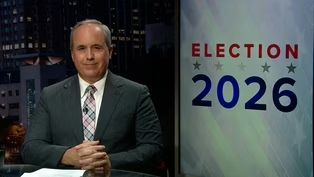
NC Judicial Candidates Forum: NC Court of Appeals Judge Seats 2 & 3
Video has Closed Captions
Meet candidates for the NC Court of Appeals Judge Seats 2 and 3. (26m 46s)
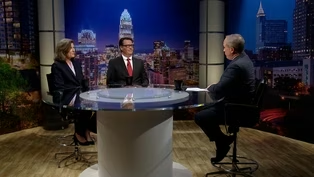
Candidates for NC Court of Appeals Judge Seat 3: Craig Collins (R) & Christine Marie Walczyk (D)
Video has Closed Captions
Meet the Republican and Democratic candidates for the NC Court of Appeals Judge Seat 3. (13m 7s)
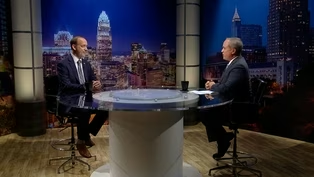
Candidate for NC Court of Appeals Judge Seat 2: Tobias Hampson (D)
Video has Closed Captions
Meet the Democratic candidate for the NC Court of Appeals Judge Seat 2. (12m 57s)
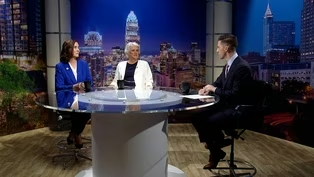
Candidates for NC Supreme Court Associate Justice Seat 1: Anita Earls (D) & Sarah Stevens (R)
Video has Closed Captions
Meet the Democratic and Republican candidates for the NC Supreme Court Associate Justice Seat 1. (12m 38s)
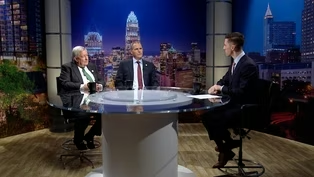
Candidates for NC Court of Appeals Judge Seat 1: John Arrowood (D) & Michael Byrne (R)
Video has Closed Captions
Meet the Democratic and Republican candidates for the NC Court of Appeals Judge Seat 1. (11m 54s)
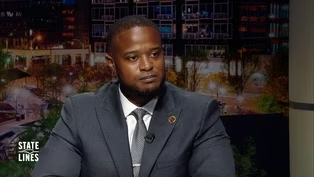
Cyril Jefferson, Democratic Candidate for NC’s 6th Congressional District
Video has Closed Captions
An interview with Cyril Jefferson, Democratic candidate for NC’s 6th Congressional District (2026). (13m 42s)
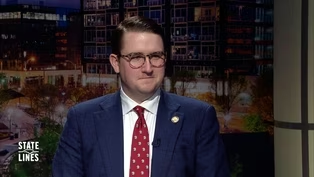
Addison McDowell, Republican Candidate for NC’s 6th Congressional District
Video has Closed Captions
An interview with Addison McDowell, Republican candidate for NC’s 6th Congressional District (2026). (14m 11s)
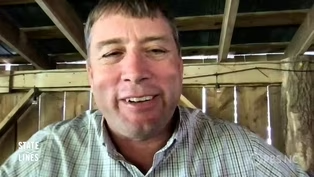
Jamie Ager, Democratic Candidate for NC’s 11th Congressional District
Video has Closed Captions
An interview with Jamie Ager, Democratic candidate for NC’s 11th Congressional District (2026). (14m)
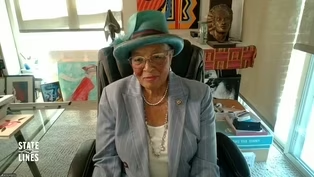
Alma Adams, Democratic Candidate for NC’s 12th Congressional District
Video has Closed Captions
An interview with Alma Adams, Democratic candidate for NC’s 12th Congressional District (2026). (15m 19s)
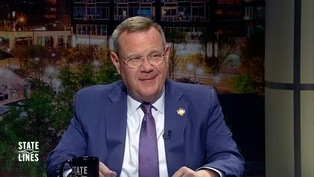
Tim Moore, Republican Candidate for NC’s 14th Congressional District
Video has Closed Captions
An interview with Tim Moore, Republican candidate for NC’s 14th Congressional District (2026). (14m 46s)
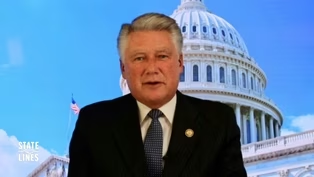
Mark Harris, Republican Candidate for NC’s 8th Congressional District
Video has Closed Captions
An interview with Mark Harris, Republican candidate for NC’s 8th Congressional District (2026). (15m 27s)
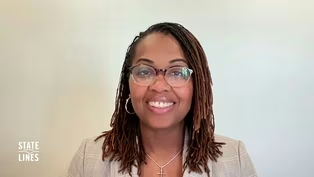
Lakesha Womack, Democratic Candidate for NC’s 14th Congressional District
Video has Closed Captions
An interview with Lakesha Womack, Democratic candidate for NC’s 14th Congressional District (2026). (14m 56s)
Providing Support for PBS.org
Learn Moreabout PBS online sponsorship- We're joined by Dr.
Kimberly Hardy, the Democratic nominee running in the US Congressional District Number Seven in North Carolina.
Dr.
Hardy, thanks for stopping by for an interview with us.
- Thanks so much for having me.
I'm really looking forward to it.
- Well, the great thing about an interview we share online is not only do District Seven voters get to learn about you, but there are people across the state and maybe America who want to know more about this race.
Who is Dr.
Kimberly Hardy and why is 2026 the year that you think you should be in Congress?
- Well, so I am a mom and I'm a social worker.
I'm actually now a social work professor in the UNC system.
And before I was a university professor, I was a school social worker.
And I worked in a lot of under-resourced urban schools in various states around the country, which gave me an opportunity to see what it's like when families and children, teachers and administrators, are struggling because of budget cuts or policy issues that don't take the lived experience of these folks into consideration, never come and ask what their thoughts and feelings are.
And that is actually happening here in North Carolina as well.
But on top of that, being a social worker means I'm a professional problem solver.
And so I understand how to come to the table with folks from different backgrounds and different professional orientations to say, "Listen, here's what the issue is.
How can each of our perspectives come together to create the best possible outcome for everybody involved?"
And you realize that there will be compromise, and there's nothing wrong with that, though it seems like that's not everyone's favorite thing to do anymore.
But I'm also, like I said, a mom.
And so I understand what it means to be a single mom having a child and having to make sure that all of your child's needs are met.
And we've been very blessed and a wonderful school system and things like that.
But what about those children for whom that's not the reality?
And so I wanted to get into this race because there are things that we can do at the federal level to help ensure that our school's public education period is better taken care of.
But there are other issues as well.
We'd like to say our campaign rests on a three-legged stool of deserving better jobs, better schools, and better healthcare.
And so I've seen enough of that now in my time as second vice chair for the North Carolina Democratic Party.
I'm actually in my second term in that, which means I've actually had the chance to go around the state and see that so many of the issues that are in my district are affecting us statewide as well.
- How possible is compromise in Congress right now?
Whether you win or not, if you go to Congress in January, is it realistic to expect wide scale bipartisanship going forward with the way the political climate is in Washington DC?
- I think that's the whole caveat, the way the political climate is.
I think well-intentioned people who really do care about the constituencies that they're running to represent are invested in compromise.
And we just did some polling for our race a couple of weeks ago through public policy polling, and it shows that we have 12% Republican support in the district already.
And that's before we've even, our commercials aired or anything, which tells you that people are looking for someone who's just going to solve the problems, answer the questions, give them a fair shot.
And so I think people on the ground see it as possible to work together.
If you elect the right representatives, the people who are invested in that on both sides of the aisle, compromise is possible.
- Where do you see the role of federal government in education to make education better for the Seventh District and for all of North Carolina?
Of course, it's a state issue with most of the state budget, a majority going to it.
You could have run for the legislature, but you see a congressional approach is best.
How do you get it done and what do you really want to see done when you get to DC?
- One of the things I want to see from a federal level is, unfortunately, the Department of Education has been sort of picked apart and different agency responsibilities have been thrown about across federal government, which is something supported repeatedly by my opponent.
I do not think that that makes the most sense at all.
I think we should put the Department of Education back together and let those education leaders be the ones to tell us what of those programs might need some support or restructuring, but this, ostensibly dismantling of public education at the federal level makes no sense at all.
And why do I want it to happen at the federal level?
Because there are things that the federal level can do that the state level cannot do and the state is requiring is, excuse me, waiting on the federal legislature to do things.
So for example, funding.
We are, according to all of the data, we are 49th or 50th in the country in spending for our students.
My child, my son graduated high school, and his school had never gone on a field trip because his principal said they couldn't afford the bus.
Now, my son is gonna be fine.
I can take him anywhere he wants to go, but again, that's not, I'm not okay when I'm okay.
I'm okay when all of the parents and all of the children get the opportunity to go and experience things that your typical, you know, school classroom can do.
Those are dollars that need to come from the federal government down to the states and hope that our state partners will allocate those resources equitably.
There's all sorts of changes now around the deprofessionalization of certain professions, mine included.
Social work, education, and nursing are somehow no longer considered professional degrees, which limits the amount of funding that folks can get if they're going to pursue their undergraduate or graduate degrees for those professions.
Not for nothing, those are women dominated professions, which is a little suspect to me.
But there are things that we can do at the federal level to help with education and we work in partnership with our state and local education leaders as well to get the job done.
It's possible.
You just have to care about it.
- As a candidate, of course, you go out there and try to convince voters to vote for you based on what you would like to do in DC, but it's a two-way street with communication.
What are the Seventh District voters telling you they want?
Is it as much education as you would like to push or are there other issues out there that your voters are saying, "We got your back, but you need to look over here first."
- Oh, yeah.
There are a lot of issues, and I know that because I actually show up in my district a lot.
So I live in this district, of course, but in all eight counties, I did two, twice now, in the year that we've been running for the seat, I've done eight county in eight-day tours that were town halls designed to listen to the people of the district.
And there are a lot of issues that they are concerned about.
Everything from immigration to healthcare.
My district has an increasing number of seniors who are in our area, for example.
And so the eradication of the Medicare Part D subsidies that Donald Trump wants to do in January that my opponent actually supports is going to make their prescription medications cost a ton more than they can afford.
I also happen to live in essentially Fort Bragg, North Carolina.
And so I have heard from a lot of veterans who are really, really struggling with everything from discontinuity of care because they've had five different primary care physicians in five months or not being able to get the care they actually need because the VA has only authorized certain procedures to get done.
You also have folks who are trying really, really hard to get to their 100% disability so that they can get access to all of the resources they were promised when they signed up.
This is personal for me because all of the men in my family were in the military.
My older brother was stationed at, he was stationed at Fort Bragg in the 82nd, and my younger brother and my father were both in the Marine Corps at Marine Corps base Quantico, and my father actually served in Camp Lejeune, which he won't let me say is Camp Lejeune because it was Lejeune when he was there.
So, but you know, it matters to me that these folks who were promised so much when they signed up are given the things that they were promised now that they really need them.
So there are a host of issues I've heard across this district.
- Dr.
Hardy, there are a lot of promises made to a lot of constituent groups and this country is now $40 trillion in actual debt and running, what, a multi-trillion dollar annual deficit.
So yes, older people have been promised a lot.
We have consumed a lot as a society.
I won't, it's a loaded question to say how do you pay for it all, but what does this country face when the solution is more tax cuts if you're Republican, tax credits if you're a Democrat, more services, and we're just not closer to balancing a budget or doing what anyone, Republican or Democrat, says is fiscally responsible.
Seems like we've never paired the issue with the price tag.
- Right, and I have a solution to paying for a lot of these things, which is to tax the wealthiest 1%.
On the second $1 million and above with an increasing amount of tax rate for those millions.
You get to live in a country that makes it possible for you to become a millionaire and a billionaire many times over and you have employees who are barely getting by.
I think that is unconscionable and it should be a wealth tax and not an income tax because that's a way that a lot of these wealthy folks get out of paying for that.
Mark Zuckerberg, for example, famously takes a $1 salary.
So an income tax increase on him isn't going to do anything.
I also believe in giving some tax relief to folks who make under a certain threshold.
So for example, if you make less than $100,000, I think the first, say, $20,000 of your salary should be income tax-free.
This doesn't have to go on at infinitum, but it does have to go on long enough for the billions in wealth taxes that would come into the economy federally so that we can pay for all of these programs.
That'll give us an opportunity to reset the priorities and work with the budget that will actually cover a lot of these issues.
So there is a way to pay for it.
It's not that we lack a way, it's that we lack a will.
- What other parts of the affordability agenda have your attention as a candidate?
We've talked about Medicare, which we'll lump in Medicaid with that.
The VA is gonna be important in your district, but what else is out there?
We can talk gas prices.
We can talk housing.
Take one and run with it.
- Yes.
Yep.
And we could go on and on, right?
And I mean, so for example, did you see recently that the cost of a gallon of diesel fuel is now over $6?
And that is a real challenge for anyone who has a diesel vehicle, but in particular, our farmers.
My district has a ton of farmland and these tractors are not, you know, run by solar power.
They need the fuel and the cost of this has gone up through no fault of their own.
It's costing some folks their actual family livelihoods in the farms, and they've had some of these farms for generations, and now they're looking at having to sell it or to sell off parts of it just to break even.
I think that is absolutely avoidable once we get rid of these tariffs and we end this war that nobody asked for in Iran.
So yes, the cost of gas for everyone writ large, but that diesel fuel increase has been particularly challenging.
And then the cost of food.
So for example, my campaign believes that service starts when you see a need.
And so we've been able to do three grocery giveaways to folks in three of our counties, Bladen, Columbus, and Robeson.
And we were able to give food to 75 families, real, really good food, like fresh foods, and that was wonderful, but it's sad when you have folks who are waiting in line for two hours, and when you open the door, it's gone in 10 minutes.
Like that tells you how big the need is.
And so the cost of groceries, the cost of fuel, the cost of transportation, the cost of housing, all of these things have gone up.
These are problems that were created by people and they can be solved by people.
So when I get there, I will.
- Yeah, and the environment and green policies are part of your platform.
You're certainly proud of that.
So get it, diesel prices need to come down.
It makes the trucks and the trains and everything run a lot more efficiently from a financial standpoint and could lower prices.
How do we balance being smart and green conscious, but we still, you may disagree, do we need petroleum products or do we not to lower prices in the upcoming economy?
- I think what makes it, I don't think we need to get rid of petroleum, right?
So that doesn't, we don't have to do that.
I don't think it has to be an all or nothing.
And sometimes that's the argument that people make when they want to scare you into staying on their side of an issue, whichever side of it is, right?
I don't think that we need to do that.
What I do think is that we need balance, and what I also think is that we need competition.
And so we have to do, and regulation!
Because Duke Energy is making a ton of money in profits right now.
And it's kind of because they're not the only game in town, but they're a pretty big game in town, right?
And so I think if we do things like smart investment in wind and solar, then that really helps.
If you can do tax credits for folks who decide to get greener homes with solar panels and things like that, there's ways to make our energy cleaner, more efficient, more affordable, and have more opportunity and diversity across the platforms such that we're not beholden to oil for every single thing.
- Dr.
Hardy, the last question will be the easiest.
If people out there in this digital world, great digital world of ours, want to learn more about you or your campaign, how can they find you online, outside of this interview?
- Right, so I can say one thing before I say that.
I really need people to hear this.
The change that you're looking for really is possible.
And for those folks who say, "I don't want to vote for her.
She's a Democrat," I want you to hear me clearly.
I do not need you to be a Democrat.
I just need you to believe in one.
And if you think that you might, please visit my website, kimberlyhardyforcongress.com.
- Very well said.
Easily said and easy to remember.
Seventh Congressional District candidate, Dr.
Kimberly Hardy, the Democrat in this race.
Thank you so much for your time and stay safe out there on the campaign trail.
- I appreciate it.
Thank you.
- Take care.
[bright dramatic music]
 New Episode
- News and Public Affairs

Top journalists deliver compelling original analysis of the hour's headlines.
 New Episode
- News and Public Affairs

FRONTLINE is investigative journalism that questions, explains and changes our world.




 New Episode

 New Episode


 New Episode
Support for PBS provided by:
State Lines is a local public television program presented by PBS NC