
Ashley Bell, Democratic Candidate for NC’s 10th Congressional District
Special | 13m 32sVideo has Closed Captions
An interview with Ashley Bell, Democratic candidate for NC’s 10th Congressional District (2026).
Ashley Bell, Democratic candidate for NC’s 10th Congressional District, discusses her 2026 campaign with PBS NC’s Kelly McCullen. This interview was recorded on August 10, 2026.
Problems playing video? | Closed Captioning Feedback
Problems playing video? | Closed Captioning Feedback
State Lines is a local public television program presented by PBS NC
Ashley Bell, Democratic Candidate for NC’s 10th Congressional District
Special | 13m 32sVideo has Closed Captions
Ashley Bell, Democratic candidate for NC’s 10th Congressional District, discusses her 2026 campaign with PBS NC’s Kelly McCullen. This interview was recorded on August 10, 2026.
Problems playing video? | Closed Captioning Feedback
Where to Watch State Lines
State Lines is available to stream on pbs.org and the PBS app.
Providing Support for PBS.org
Learn Moreabout PBS online sponsorshipMore from This Collection
During major election cycles, PBS North Carolina's public affairs team sits down for in-depth conversations with candidates running for elected office in North Carolina. PBS North Carolina has invited major party candidates to a one-on-one interview with State Lines host and executive producer Kelly McCullen. Interviews are scheduled throughout the summer and early fall.
NC Judicial Candidates Forum: NC Court of Appeals Judge Seats 2 & 3
Video has Closed Captions
Meet candidates for the NC Court of Appeals Judge Seats 2 and 3. (26m 46s)
Candidates for NC Court of Appeals Judge Seat 3: Craig Collins (R) & Christine Marie Walczyk (D)
Video has Closed Captions
Meet the Republican and Democratic candidates for the NC Court of Appeals Judge Seat 3. (13m 7s)
Candidate for NC Court of Appeals Judge Seat 2: Tobias Hampson (D)
Video has Closed Captions
Meet the Democratic candidate for the NC Court of Appeals Judge Seat 2. (12m 57s)
Candidates for NC Supreme Court Associate Justice Seat 1: Anita Earls (D) & Sarah Stevens (R)
Video has Closed Captions
Meet the Democratic and Republican candidates for the NC Supreme Court Associate Justice Seat 1. (12m 38s)
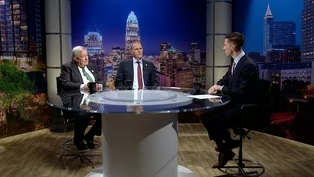
Candidates for NC Court of Appeals Judge Seat 1: John Arrowood (D) & Michael Byrne (R)
Video has Closed Captions
Meet the Democratic and Republican candidates for the NC Court of Appeals Judge Seat 1. (11m 54s)
Kimberly Hardy, Democratic Candidate for NC’s 7th Congressional District
Video has Closed Captions
An interview with Kimberly Hardy, Democratic candidate for NC’s 7th Congressional District (2026). (14m 16s)
Cyril Jefferson, Democratic Candidate for NC’s 6th Congressional District
Video has Closed Captions
An interview with Cyril Jefferson, Democratic candidate for NC’s 6th Congressional District (2026). (13m 42s)
Addison McDowell, Republican Candidate for NC’s 6th Congressional District
Video has Closed Captions
An interview with Addison McDowell, Republican candidate for NC’s 6th Congressional District (2026). (14m 11s)
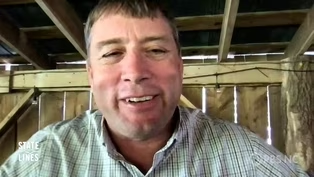
Jamie Ager, Democratic Candidate for NC’s 11th Congressional District
Video has Closed Captions
An interview with Jamie Ager, Democratic candidate for NC’s 11th Congressional District (2026). (14m)
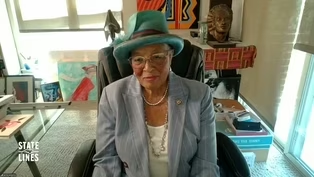
Alma Adams, Democratic Candidate for NC’s 12th Congressional District
Video has Closed Captions
An interview with Alma Adams, Democratic candidate for NC’s 12th Congressional District (2026). (15m 19s)
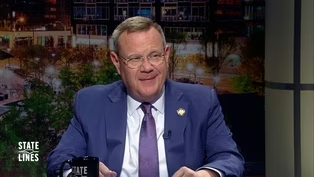
Tim Moore, Republican Candidate for NC’s 14th Congressional District
Video has Closed Captions
An interview with Tim Moore, Republican candidate for NC’s 14th Congressional District (2026). (14m 46s)
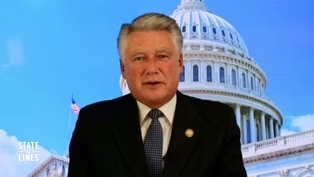
Mark Harris, Republican Candidate for NC’s 8th Congressional District
Video has Closed Captions
An interview with Mark Harris, Republican candidate for NC’s 8th Congressional District (2026). (15m 27s)
Providing Support for PBS.org
Learn Moreabout PBS online sponsorship- We're joined by Ashley Bell, 10th U.S.
Congressional District candidate, a Democrat, challenging the incumbent Representative Pat Harrigan.
Ashley, great to have you on the set today.
- Thanks for having me.
I'm happy to be here.
- Well, since you're running, I have to ask, tell us about you, your background.
Why does it make you prepared for U.S.
Congress if you're elected?
- So I am a physician associate.
I've been a PA for 15 years.
I'm a graduate of Wake Forest School of Medicine in Winston-Salem, and I'm also a professor.
So I've been teaching PA students for the last seven or eight years, and I still practice clinically as a physician assistant.
And through my work as a PA, I've done a lot of leadership work in my profession.
I've done a lot of going to Capitol Hill and talking to congressmen and their staff.
And you know, really, when the Dobbs decision came down and Roe v. Wade was overturned, I just kind of decided that I needed to do more than just write prescriptions.
So it kind of snowballed from there.
- What kind of decision and thinking goes into running for U.S.
House, particularly against -- you know, going against an incumbent who has proven that they can win in that district?
- Well, I think it really is just a question of leadership and who's going to really represent the people.
You know, my opinion is that he doesn't -- Pat Harrigan doesn't really represent the people of the 10th District.
He's not from North Carolina at all.
He's from California.
The only reason he ended up in North Carolina was he got stationed in Fayetteville several years ago.
And so I think people are really hungry for change and real representation, and that's what I'm going to be offering them.
- Now ideologically, Republicans have their traditional -- they have their traditional Republican establishment, that libertarian, MAGA.
Now on the left, if you want to call it the Democratic Party, it has traditional Democrats.
There's the left.
Then there's these Democratic Socialists.
Where do you fall in all those brands?
- So I consider myself a progressive Democrat.
I wouldn't say I am centrist or establishment, but I also am not a socialist.
I feel like just me calling myself a progressive Democrat is as far as I want to take it, and that gets what people really need as far as representation.
And that's pretty much, you know, as far as I want to go.
- Now your platform, top priority, you say, is restoring democracy.
What do you mean by that?
What needs to be actually restored?
- So our country is just in a time of lawlessness, where the people at the top, who have a lot of money and a lot of power, are able to do pretty much whatever they want.
And that's just not acceptable.
That's not how we do things in America, and we need to restore the rule of law.
But also, unfortunately, there's been a lot of separation between people who have a lot of power and a lot of money and the rest of us who are working every day just to support ourselves and our families.
And so we really need to transfer the power back to where it belongs, which is with the people like us.
- Are you seeing that as because Republicans are in charge in D.C.
right now, or are you laying that at the feet of the Democratic Party as well, in terms of power and elitism out of Washington, D.C.?
- Yeah, I think both parties really have a hand in this.
I think that the Republicans really took a chance and ran with it, and the Democrats really didn't do anything to stop them.
And that's why I think it's necessary that we really get some Democrats back in Congress, back in office, who actually will stand up and say, "This is wrong, and we need to fix it," and instead of just talk about it, actually do something about it.
- Should they fix it and set a new baseline for civic engagement, or should Democrats just take the ball, if they get it, and run in the direction they want to go in and take power?
- Well, I think that, you know, working together is necessary for the health and the success of the country.
Having said that, I do also think that there's really only one political party in the country right now that is actually standing up for people and doing what's right, and that's the Democratic Party.
- You come from health care as part of your plank about affordable health care, or maybe health care for all, universal health care, I guess the term.
What's the state of health care in the 10th Congressional District?
- Well, it's pretty similar to where it is everywhere else, so it's kind of a mess.
So people have trouble getting appointments in a timely manner.
People have trouble paying for them.
People have trouble with their insurance.
We've had a lot of people who have lost insurance in the last year because of the cuts to the ACA subsidies.
And so, people are, unfortunately, going back to the emergency room for care, which is what we saw before the ACA came into effect.
And it's just not an effective or—an effective way to get care, and it's done a lot of damage to the health of our citizens.
- What would you propose doing?
- I would propose that we have a Medicare for all system.
I think health care is a right.
It should be free for anybody to seek health care anytime that they have a problem.
And people shouldn't have to be worrying about the bills that they're going to have to pay, like if they have an emergency, they shouldn't have to be worrying about an ambulance bill that they're going to have to pay, or they shouldn't have to be worried about an ER bill, or even just being able to pay their primary care provider.
Those are things that we shouldn't have to worry about in this country in the year 2026.
- Now, you're training the next generation of health care professionals.
I'm going to go back to the Medicare for all.
I don't know much about medicine, but I do know doctors don't like Medicare's reimbursement rates, and it's not worth it to many of them to even accept it.
If you're training the next batch of great leaders, but you say Medicare for all, how do we pay them and have a robust health care system?
- Well, so the reimbursement rates are set into law.
And so I think that is one place to start, is to actually get reasonable reimbursement rates.
A lot of doctors, physicians, PAs, MPs don't want to take Medicaid.
They don't want to take private insurance.
Private insurance specifically because it is such a pain, first of all, to get credentialed and even get paid by them, that once you actually get the reimbursement, it's just not even worth taking, having gone through all that process.
And then half the time, they don't cover what they need to cover, and you have to fight them for everything.
And anybody who's dealt with insurance knows this, because pretty much everybody's had one of those kinds of issues.
- What keeps your students coming back to enter that field?
Because you're an inspiration to them if you're teaching them.
They're still coming in, but what are they saying to you?
- Well, I think people get into the field just because they really want to help people.
Like, they see a need.
There's obviously a need for healthcare providers everywhere.
And they really just want to fill that.
It's kind of a calling, but it's also, you know, something that, you know, we work really hard towards for a lot of years.
And so, I think, unfortunately, a lot of people get into medicine thinking, "Oh, I'm just going to be able to help people and do all of that."
And then they realize that there's a whole lot more to it that you might not want to deal with.
- Well, we've covered healthcare.
Let's move to the next plank down.
You said affordability, economic relief, big items for the constituents of -- what would be your constituents of the 10th Congressional District.
How do you make things more affordable?
How do you bring economic relief in this climate?
- Well, for one thing, I think that there's a lot of decisions that have been made by the administration that have put a lot of people in really economic jeopardy.
So the tariffs that were, you know, completely unnecessary and have damaged our relationships with other trade partners.
We have gas prices that are going through the roof because we have an unnecessary war in Iran.
And so, really, this just stems from bad policy decisions.
And so, I think we need to roll back those decisions.
I also think that increasing the minimum wage to keep up with inflation would also help that.
- Money out of politics, you say it doesn't belong, at least big money in politics.
Equal voices and equal votes for the voters.
How do you do that?
When you get elected into Congress, I'm going to say you're probably going to raise a lot of money, or people are going to at least want to give you a lot of money.
- Well, hopefully.
[laughs] - How do you balance the pressure that if you don't take the money, your opponents certainly would?
- Yeah.
Fundraising is always -- it's always a challenge.
And unfortunately, there's a lot of special interest groups.
And really, people who are leaders need to make the decision that they're serving the people and not corporations or special interests.
And until we get a majority of people that are willing to do that in Congress, then we're going to have trouble getting money out of politics.
But I do think that it needs to happen.
Ever since Citizens United came down, there's just been an influx of money coming from all directions that you're not really even sure where it's coming from a lot of times.
And unfortunately, that influences decisions, and it shouldn't.
- You said you've testified or at least gone and spoken to Congress, senators and House members as a person, a professional in the medical industry.
Did you feel like you were heard when you went, or did you feel you were drowned out by those "corporate interests"?
- I think most of the time, I felt like I was drowned out.
You know, each member kind of has their own projects that they like to focus on.
And I think health care is such a huge issue.
It's so complicated, and it is just so massive that a lot of members of Congress are kind of scared of it.
And so that's why we really need people who know health care and who know medicine in Congress to actually fix these problems.
- I did see where you have called for not the abolishment of ICE.
I want to be clear.
You said replace the immigration, federal immigration agency and immigration laws.
Well, replace it for us.
What does it look like compared to what we have now in the country, versus reforming ICE and making it, you know, act under different policies or priorities?
- Well, I have actually called for the abolishment of ICE as it is.
- So you did call for the abolishment.
OK.
- I did.
Yes.
I've been very -- I've been pretty clear about that.
What we have now is essentially a secret police that is killing people in the streets.
And they have no training.
They are -- they don't seem to be accountable to anybody or anything, and that's just not acceptable.
We do need immigration reform, but we don't need it the way that it's being done.
We need strong borders.
We need to fix the process by which people can actually become citizens of this country or be here legally, because right now it's not attainable.
And if we can fix that, then we'll fix the immigration issues.
- On the immigration issue, there's one thing about having an open border versus a closed border versus controlled access.
But does everyone who doesn't live in America, do they have a right to come knock on the door and ask to be let in?
And should they be let in if they simply knock?
- Well, if they have a good reason for being in America, they should be given the chance.
But we also do have to keep in mind that there are people who want to get into America that shouldn't be here, that are dangerous.
That's not everybody, though.
And I think there seems to be a general feeling from a lot of people, especially on the other side of the aisle, that everybody who is not in America currently shouldn't be here.
And that's not how our country was founded.
We're a nation of immigrants, and people all over the world have something to offer.
And if they are law-abiding and they are going to be here for a good reason and they can go through the process, then they should be able to have the chance to come here.
- We've done a couple top issues.
Do you have another one that maybe I haven't asked you about that's important to you?
- Yeah.
So, I'm really focused also on anti-corruption.
I think there's a lot of corruption, obviously, in our government right now.
And it gets talked about, but then gets kind of swept under the rug.
And so it's really important to me that we address those issues ASAP, as soon as we get the new Congress in, because if we don't, then they'll just happen again, and they'll keep happening.
And we can't fix the issues in this country unless we get the corruption fixed.
- If you can win in November, as you're working hard to do, would it mean the voters have changed their minds in a majority sense to turn out a Republican for a progressive Democrat?
Why should, let's just say it, conservative Republican voters look at Ashley Bell, you, and say, "Let's give her a chance"?
- Well, I think that, you know, really none of my policies are radical.
And, you know, certainly the extremes on the right side of the aisle would want to frame it that way.
But, really, none of my policies are radical.
I just want people to have health care and be able to eat and have only one job and have that be enough to sustain one's needs.
And I think that's just the basic, like, bottom line for everybody in America.
And so, it really doesn't matter what party you're coming from.
I think my policies are kind of common sense.
And, you know, everybody can relate to them.
- How do people learn more about your campaign, your issues, your platform, website?
- I have a website.
It's AB4, the number four, ab4nc.com.
You can go on there and learn about me, the issues.
You can sign up to volunteer.
You can donate.
So, that's really the best place to learn about me.
I'm also on all the social media under Ashley Bell for Congress.
- And there it is, folks.
Thank you so much, Ashley Bell, Democrat, challenging Representative Pat Harrigan in the 10th U.S.
Congressional District, up in that triad area, I guess is the best way to put it.
Thank you so much, Ashley, for being on.
Good luck.
Be safe on the campaign trail.
- Thank you.
♪
 New Episode
- News and Public Affairs

Top journalists deliver compelling original analysis of the hour's headlines.
 New Episode
- News and Public Affairs

Today's top journalists discuss Washington's current political events and public affairs.
 New Episode
 New Episode
 New Episode
 New Episode
 New Episode


 New Episode
 New Episode

Support for PBS provided by:
State Lines is a local public television program presented by PBS NC