
Don Davis, Democratic Candidate for NC’s 1st Congressional District
Special | 14m 22sVideo has Closed Captions
An interview with Don Davis, Democratic Candidate for NC’s 1st Congressional District (2026).
Don Davis, Democratic Candidate for NC’s 1st Congressional District, discusses his 2026 campaign with PBS NC’s Kelly McCullen. This interview was recorded on August 25, 2026.
Problems playing video? | Closed Captioning Feedback
Problems playing video? | Closed Captioning Feedback
State Lines is a local public television program presented by PBS NC
Don Davis, Democratic Candidate for NC’s 1st Congressional District
Special | 14m 22sVideo has Closed Captions
Don Davis, Democratic Candidate for NC’s 1st Congressional District, discusses his 2026 campaign with PBS NC’s Kelly McCullen. This interview was recorded on August 25, 2026.
Problems playing video? | Closed Captioning Feedback
Where to Watch State Lines
State Lines is available to stream on pbs.org and the PBS app.
Providing Support for PBS.org
Learn Moreabout PBS online sponsorshipMore from This Collection
During major election cycles, PBS North Carolina's public affairs team sits down for in-depth conversations with candidates running for elected office in North Carolina. PBS North Carolina has invited major party candidates to a one-on-one interview with State Lines host and executive producer Kelly McCullen. Interviews are scheduled throughout the summer and early fall.
NC Judicial Candidates Forum: NC Court of Appeals Judge Seats 2 & 3
Video has Closed Captions
Meet candidates for the NC Court of Appeals Judge Seats 2 and 3. (26m 46s)
Candidates for NC Court of Appeals Judge Seat 3: Craig Collins (R) & Christine Marie Walczyk (D)
Video has Closed Captions
Meet the Republican and Democratic candidates for the NC Court of Appeals Judge Seat 3. (13m 7s)
Candidate for NC Court of Appeals Judge Seat 2: Tobias Hampson (D)
Video has Closed Captions
Meet the Democratic candidate for the NC Court of Appeals Judge Seat 2. (12m 57s)
Candidates for NC Supreme Court Associate Justice Seat 1: Anita Earls (D) & Sarah Stevens (R)
Video has Closed Captions
Meet the Democratic and Republican candidates for the NC Supreme Court Associate Justice Seat 1. (12m 38s)
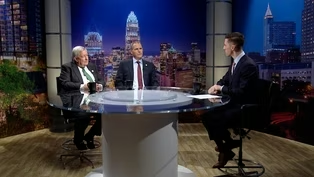
Candidates for NC Court of Appeals Judge Seat 1: John Arrowood (D) & Michael Byrne (R)
Video has Closed Captions
Meet the Democratic and Republican candidates for the NC Court of Appeals Judge Seat 1. (11m 54s)
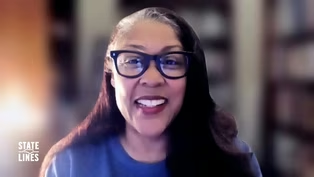
Kimberly Hardy, Democratic Candidate for NC’s 7th Congressional District
Video has Closed Captions
An interview with Kimberly Hardy, Democratic candidate for NC’s 7th Congressional District (2026). (14m 16s)
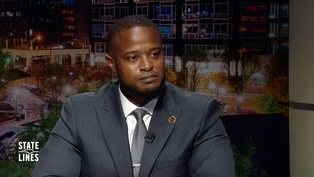
Cyril Jefferson, Democratic Candidate for NC’s 6th Congressional District
Video has Closed Captions
An interview with Cyril Jefferson, Democratic candidate for NC’s 6th Congressional District (2026). (13m 42s)
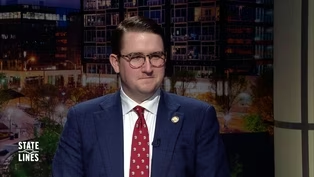
Addison McDowell, Republican Candidate for NC’s 6th Congressional District
Video has Closed Captions
An interview with Addison McDowell, Republican candidate for NC’s 6th Congressional District (2026). (14m 11s)
Jamie Ager, Democratic Candidate for NC’s 11th Congressional District
Video has Closed Captions
An interview with Jamie Ager, Democratic candidate for NC’s 11th Congressional District (2026). (14m)
Alma Adams, Democratic Candidate for NC’s 12th Congressional District
Video has Closed Captions
An interview with Alma Adams, Democratic candidate for NC’s 12th Congressional District (2026). (15m 19s)
Tim Moore, Republican Candidate for NC’s 14th Congressional District
Video has Closed Captions
An interview with Tim Moore, Republican candidate for NC’s 14th Congressional District (2026). (14m 46s)
Mark Harris, Republican Candidate for NC’s 8th Congressional District
Video has Closed Captions
An interview with Mark Harris, Republican candidate for NC’s 8th Congressional District (2026). (15m 27s)
Providing Support for PBS.org
Learn Moreabout PBS online sponsorship- We're joined by Representative Don Davis, the Democrat incumbent in the first congressional district in North Carolina, being challenged on the Republican side by Laurie Buckhout.
But Congressman, you're here for this interview.
Good to have you.
Thanks for accepting our invitation.
- Thank you.
- Well, this is an old district that's yet quite new.
New voters are in there that might not know Don Davis, and nationally, people may want to know more about Don Davis.
So I know you came from the state Senate before going to D.C., but tell us about your background.
- Hey, I was born and raised in Snow Hill, North Carolina, small town, rural, eastern North Carolina.
And I spent a lot of time with my grandmother.
My mom was young at the time, and I just learned so many important life lessons.
She taught us the importance of faith early on in life, the value of education, good work ethics, and also what I think are just good moral values.
And she said, "Always look, baby, at the good in people.
There's some good in everybody."
So these are what I think are just good Eastern North Carolina lessons.
And no matter where I've been in life, eventually went to Irving, Texas after my mom was transferred from IBM.
She was working with IBM, and we moved to Irving and went on to the Air Force Academy, graduated from the Air Force Academy, eventually made my way back home to East Carolina University, where I served as an assistant professor of aerospace studies, teaching national security affairs, military history, served as the commandant of the cadets, the training officer.
And from there, I ran for mayor of my hometown because I was just wanting to make a difference.
I remember as a kid, there was a pothole in the road.
We would ride our bikes over to jump wheelies, and I came back in my adult life, and that pothole was still there.
So I ran for office, and, yes, we were determined to fill that pothole.
So I was reelected as mayor, went on to the state Senate, served 12 years, six terms, and now honored to be able to represent Eastern North Carolina and North Carolina's 1st Congressional District.
But to be clear, there's a lot of potholes that are still out there that I believe we have to roll up our sleeves and fill.
- I'm looking at your background, as well as other Democratic and Republican candidates who are seeking office in this cycle in North Carolina on a bipartisan basis.
More than one of you are military veterans.
So some of you come out as Democrats, some come out on the other side.
But what is it about military service that prepares you for public service and makes you want to continue public service when you've already done so much publicly?
- When I think about my days at the Air Force Academy, there were so many lessons on leadership.
And one of the fundamental lessons on leadership was taking care of people.
So for me, when I was able to make my way back home to Eastern North Carolina, this was not a matter of coming back just to live, but it was about coming back to make a difference and to actually get back to a community that poured so much into me.
And a lot of these fundamentals, again, we learned in leadership labs, seminars, I'm held speaking to great national leaders.
And it was just an experience that truly, I believe, has made me even better of a person.
And it's allowed me to not only come back, make an impact, but make a meaningful impact with our families here in the East.
And yes, that's my priority, our families, and making sure that we continue to put Eastern North Carolina first.
- These elections these recent years have gotten so heavily partisan, I don't have to tell you that.
I mean, redistricting has affected you to put more Republican voters in.
Now on the Republican side, we have social conservatives, your libertarians, your MAGA, and then they gang up and call a few of them rhinos.
And then on the Democratic side now, there's the traditional Democrat, the conservative Democrat, and now Democratic socialists are trying to step in there and kind of grab some of that brand.
You of all people, what type of Democrat are you?
Because you're not running away from being a member of the party, but you're running in a very close race.
- I believe in capitalism.
I also believe that we need laws, and I believe that - I don't try to be extreme by the stretch of the wildest imagination.
I believe it's important to show up to work, to show up to Washington, D.C., to solve problems, not to create new problems.
I believe truly that we need laws.
I believe we should support law enforcement.
Fundamentally, people in communities want to feel safe at home.
And I'm saying all of this to say, you know, when I think Halifax, North Carolina, and the role that we played in coining our state's motto, "First in Freedom," making a pathway to the Declaration of Independence.
You don't have a country if you're unwilling to serve.
You don't have a country if you don't have just caring individuals who want the best for their community, that are striving every single day, you know, for the best, for the greater good.
And I'm saying all this to say I am proud to be an American.
- Well, let's dive into some of these issues.
Every candidate has affordability on their website, making things cost less.
It's inflationary out there, Representative.
In case you didn't know that, how do you make things more affordable in an open, free-market economy where prices rise and fall?
- Yeah, there are concrete things that we can do to impact and influence affordability.
This is not just a buzzword.
You know, when I think about right now, our farmers, a lot of our farmers are taken under the chin because of trade policies.
That can actually make a difference.
When we look at what's taking place across the globe with the conflict in Iran, these decisions, these are policy decisions that are impacting American families, people right here in the eastern North Carolina.
So many have shared with me the real impact they're feeling from prices at the pump, prices, you know, farmers dealing with fertilizer, input costs.
All this is real.
And I want to be clear, this is highly driven and influenced by members of Congress, those who trust the whole public office.
And, you know, I would love to see more oversight, members engaging more in these topics when we talk about trade, when we talk about conflict.
To be clear, I support President Trump's early decision when we talk about Iran.
But as this becomes a prolonged conflict, you have to bring Congress into the fold.
We have to be able to make decisions, whether it comes back to a supplemental package, making sure that we're replenishing our stockpile.
You have to be involved in these conversations.
So oversight matters.
When I think about housing, you know, decisions that we're making, the 21st Century Road to Housing Act, I mean, that is directly impacting affordability of housing, putting the American dream of owning a home and being able to live back within reach for people, and especially those in Eastern North Carolina.
Part of this, too, is bringing more good-paying jobs into the East for our young people and young professionals.
We're moving up and down the district, working on all fronts, dealing from Seymour Johnson Air Force Base, making sure those squadrons are intact, over 1,000 jobs impacted there, to looking at Cherry Point these days, you know, with the F-35 program, Tacomo, the Navy coming in, another 1,000 jobs, FRC East, looking at the Northeastern part of the state.
We already know over 1,000 North Carolinians are going into this shipyard.
We're having to ramp up our efforts because of China.
So we need to capitalize from that pipeline.
Elizabeth City State University, you know, looking at, it's a four-year aviation sciences program that's getting wonderful reviews nationally.
We have to support our young people.
And it's important that we are out there leading the way so that you can see good-paying jobs.
The issue at the core, when you talk about affordability inflation, is when your salary or your wages are not able to keep up with your expenses.
Too many people, when you add up the price of the pump, the price of groceries, the price of child care, the price of mortgages, the price of you get sick, you need prescription medication, it's outpacing our income.
So fundamentally, we're looking at all fronts.
Even when I talk about fixing health care, it's important that we are doing everything we can to make sure that health care is accessible, that it's affordable, and we're talking quality health care.
That's why all these issues are important to engage on, you know, when we talk about making sure that there's good regulatory balance and measured approaches, making a pathway to prescription medication.
These are things that we are working on.
I've been working on and will continue to work on and make sure that we're keeping the American dream within reach right here in eastern North Carolina, and we're putting our families first in all of this.
I could go on on that question, but I know you may have other questions.
- You've answered every question on the list.
Let's go back to tariffs, and we'll kind of bulletproof, go down this bullet point by bullet point.
On tariffs, what should be U.S.
policy toward trade and tariffs?
The Trump administration wanted more of a blanket approach at times.
Some are free traders all the way.
I can't tell which party stands for what anymore.
I grew up, it was almost flip-flopped in terms of trade policy.
Set it straight.
- I believe it's an important one for Congress to engage much more than what we're seeing today in the space when we talk about trade policies.
That's number one.
I believe that fundamentally when this comes back to Congress and Congress plays and engages more that the deliberative nature of Congress actually will then allow us to get to better places on trade policy.
You really have to, from my experiences, look at each individual scenario to see where it actually makes sense or not.
But overwhelmingly, what we know is people are greatly concerned, industry is greatly concerned, and you're not going to get industry to make significant investments if they're uncertain and there's not predictability.
So what I think is really important is making sure that we are sending signals and supporting policies that actually embrace predictability, certainty.
To me, I believe that is essential in all of this.
And meanwhile, when we think of, especially on the agriculture front, so many farmers have said to me, "I can't continue to take it under the chin."
This is now a matter of survivability.
We take heart agriculture here in Eastern North Carolina.
But this is a matter of when you've seen in the past year 15,000 farming operations across the nation to close, this is survivability now.
So what I tend to hear from, especially our farmers, they're not looking for handouts, they're just looking for market access.
They're trying to actually get their products out into the market, and obviously trade can have a tremendous impact on that.
- I'm from Eastern North Carolina originally, and there's a lot of hogs and turkeys there.
What about cattle and this idea of importing beef from Argentina as part of a temporary cost-cutting measure?
I know the farmers, I don't know how much cattle is up in your district, but there's gotta be some.
- Well, I can tell you we definitely lead the way with tobacco, sweet potatoes.
Cotton is really important for us too, and we got to get the Buy an American Cotton Act through.
We gotta get a farm bill.
All of these issues and matters are greatly important, and obviously what is key in all of this is making sure that, as I'll talk about the Buy an American Cotton Act, is that we're incentivizing America and that we're pushing America product and helping to get our product out into the market.
- This is Representative Don Davis.
He is the Democratic incumbent in the 1st Congressional District.
Representative, it's always good to see you.
We don't speak very often by interview, but at least every two years.
Stay busy and stay safe on the campaign trail.
By the way, how can voters and anyone watching this interview not only get in touch with your campaign, but learn more about Don Davis for Congress?
- Please, if you're listening out there, we're building a great coalition, Republicans, Democrats, unaffiliated, all coming together to put Eastern North Carolina first.
If you wanna be a part of that and learn more about what we're doing, please visit us at www.votedondavis.com.
- Representative, thank you so much for your time.
- Thank you.
♪
 New Episode
- News and Public Affairs

Top journalists deliver compelling original analysis of the hour's headlines.
 New Episode
- News and Public Affairs

Today's top journalists discuss Washington's current political events and public affairs.
 New Episode
 New Episode

 New Episode


 New Episode
 New Episode

Support for PBS provided by:
State Lines is a local public television program presented by PBS NC