
Jack Codiga, Republican Candidate for NC’s 12th Congressional District
Special | 14m 52sVideo has Closed Captions
An interview with Jack Codiga, Republican candidate for NC’s 12th Congressional District (2026).
Jack Codiga, Republican candidate for NC’s 12th Congressional District, discusses his 2026 campaign with PBS NC’s Kelly McCullen. This interview was recorded on August 10, 2026.
Problems playing video? | Closed Captioning Feedback
Problems playing video? | Closed Captioning Feedback
State Lines is a local public television program presented by PBS NC
Jack Codiga, Republican Candidate for NC’s 12th Congressional District
Special | 14m 52sVideo has Closed Captions
Jack Codiga, Republican candidate for NC’s 12th Congressional District, discusses his 2026 campaign with PBS NC’s Kelly McCullen. This interview was recorded on August 10, 2026.
Problems playing video? | Closed Captioning Feedback
Where to Watch State Lines
State Lines is available to stream on pbs.org and the PBS app.
Providing Support for PBS.org
Learn Moreabout PBS online sponsorshipMore from This Collection
During major election cycles, PBS North Carolina's public affairs team sits down for in-depth conversations with candidates running for elected office in North Carolina. PBS North Carolina has invited major party candidates to a one-on-one interview with State Lines host and executive producer Kelly McCullen. Interviews are scheduled throughout the summer and early fall.
NC Judicial Candidates Forum: NC Court of Appeals Judge Seats 2 & 3
Video has Closed Captions
Meet candidates for the NC Court of Appeals Judge Seats 2 and 3. (26m 46s)
Candidates for NC Court of Appeals Judge Seat 3: Craig Collins (R) & Christine Marie Walczyk (D)
Video has Closed Captions
Meet the Republican and Democratic candidates for the NC Court of Appeals Judge Seat 3. (13m 7s)
Candidate for NC Court of Appeals Judge Seat 2: Tobias Hampson (D)
Video has Closed Captions
Meet the Democratic candidate for the NC Court of Appeals Judge Seat 2. (12m 57s)
Candidates for NC Supreme Court Associate Justice Seat 1: Anita Earls (D) & Sarah Stevens (R)
Video has Closed Captions
Meet the Democratic and Republican candidates for the NC Supreme Court Associate Justice Seat 1. (12m 38s)
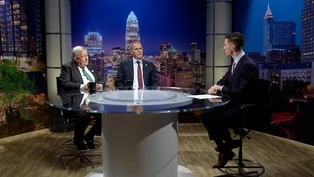
Candidates for NC Court of Appeals Judge Seat 1: John Arrowood (D) & Michael Byrne (R)
Video has Closed Captions
Meet the Democratic and Republican candidates for the NC Court of Appeals Judge Seat 1. (11m 54s)
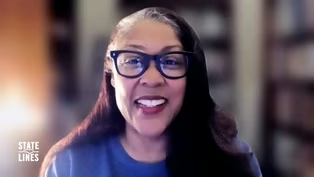
Kimberly Hardy, Democratic Candidate for NC’s 7th Congressional District
Video has Closed Captions
An interview with Kimberly Hardy, Democratic candidate for NC’s 7th Congressional District (2026). (14m 16s)
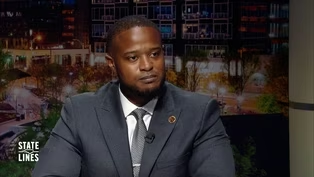
Cyril Jefferson, Democratic Candidate for NC’s 6th Congressional District
Video has Closed Captions
An interview with Cyril Jefferson, Democratic candidate for NC’s 6th Congressional District (2026). (13m 42s)
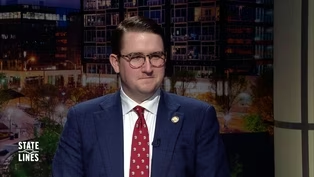
Addison McDowell, Republican Candidate for NC’s 6th Congressional District
Video has Closed Captions
An interview with Addison McDowell, Republican candidate for NC’s 6th Congressional District (2026). (14m 11s)
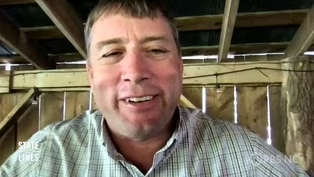
Jamie Ager, Democratic Candidate for NC’s 11th Congressional District
Video has Closed Captions
An interview with Jamie Ager, Democratic candidate for NC’s 11th Congressional District (2026). (14m)
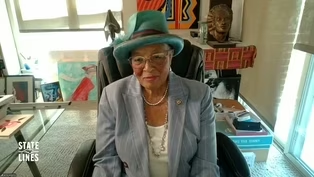
Alma Adams, Democratic Candidate for NC’s 12th Congressional District
Video has Closed Captions
An interview with Alma Adams, Democratic candidate for NC’s 12th Congressional District (2026). (15m 19s)
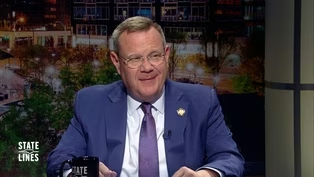
Tim Moore, Republican Candidate for NC’s 14th Congressional District
Video has Closed Captions
An interview with Tim Moore, Republican candidate for NC’s 14th Congressional District (2026). (14m 46s)
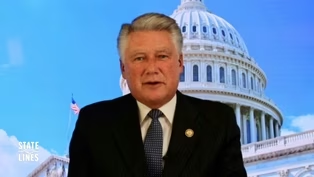
Mark Harris, Republican Candidate for NC’s 8th Congressional District
Video has Closed Captions
An interview with Mark Harris, Republican candidate for NC’s 8th Congressional District (2026). (15m 27s)
Providing Support for PBS.org
Learn Moreabout PBS online sponsorship- Jack Codiga is running in District 12 for the US House seat currently held by the incumbent Alma Adams from the Republican ticket.
By the way, Mr Codiga, thanks for joining us.
- Thanks for having me, Kelly.
- Gotta ask the most basic question first.
Why are you running?
What's your background?
Three things actually.
Why are you ready for US Congress?
I'm running because our representatives do not serve us.
Life gets worse and so my platform is focused on accountability, affordability, public safety, freedom, getting to the heart of the issues, not just making promises that that don't work.
I work in finance and because of that background that I have, I understand how money works and how the economy works.
I believe that's a big reason why.
Life how life used to be much more affordable basics of life.
And but more than anything, it's this idea of how can we get it to our representatives serve us?
- I looked at your launch video of what six seven months ago.
You know very well edited, but you dialed right in on the affordability issue and you said you want to fix the US currency.
You want to tie money to either dollar to gold or silver.
Are you talking about the gold standard?
Or how else would you fix the currency?
And I guess by byproduct inflation and the high prices of everything.
- Sure, sure, the - yes, something like that.
We have to have a vision to have currency that can't just be devalued.
Today, a house in Charlotte is in the low 400 thousands.
At the start of 2000 in our country, it was kind of the low of the mid 100s.
Has a house really gotten that much more valuable?
No.
Currency has lost value.
And what happens when when these prices get inflated, it gets distributed unevenly, and that's why there are so many Americans so many Charlotteans that feel like they're left behind.
51% of people in Charlotte cannot afford housing.
That is, Charlotte is not a small place, and that is representative of the country.
But to solve it, we can't just pass bills that make it easier to get grants or incentivize cities and states to have better zoning.
Those can be good steps.
That's actually what passed in Congress a couple weeks ago called the US Road, the Housing Act.
But you have to have a vision of having a currency that cannot just be devalued.
And that's what we have with our fiat system.
So I'm very much against that.
And me working in finance, having that front row seat to to what happens when a currency gets devalued makes me very passionate about running and running for a federal position to solve it.
- Is this the biggest issue for you in your campaign?
There are several issues out there, but that was the one you went to first.
- Yeah, yeah, that is.
That is where kind of in my heart or in my head I should say I go first because that's what I've been around and that's what I've studied in school, studied real estate and finance and I work in real estate finance and I've done that for seven years.
And so that's kind of where my head goes.
And that's what's made me really passionate about running for a federal level.
But when we kind of sat back and just kind of made sure that the campaign that I'm running and my team were doing, it has the most passion, the truth behind it.
That's how we ended up with, I hate politics, but it matters.
And so the most important issue to us is that feeling that we all have is that our system does not represent us.
And I believe that solutions like affordability, like public safety and freedom and anything else that gets solved first needs to be solved.
We first need to solve the fact that we have so many people that do not feel represented until that changes, until I would argue we have a system.
I believe it's important if you had a primary election before any federal race, you would have more honest politicians 'cause they'd enforce honesty.
Until we have systemic changes like that, it makes having all these other solutions viable.
- I'm hearing this from both parties, candidates and challengers in both parties, Democratic candidates saying the people aren't being represented.
Now Republicans like you say the establishment doesn't represent us.
How do we parse that partisanship?
You have to vote Republican, Democrat or third party.
But if the challengers are all saying who's in DC isn't working, what do we do as voters?
- Well, I like to say this before I'm a Republican, I'm an American.
And before those people talking about Democrats, they probably say they're American.
And most Americans say they're American before a political party.
If you look just at voter registration, the amount of independents the unaffiliated that's bigger than our parties.
So how do you fix that?
Well, you need Republicans and Democrats across the board, even people that are sitting in those seats right now to recognize that we need to make changes that are best not just for our party, but for our country.
And the traction that we're able to get because that is how we speak, that is what we believe.
And that's what we're going for.
We've been able to resonate with people that typical Republicans cannot because the message is not the Democrats have done this, so you need a Republican.
It's deeper than that.
- I do wanna ask you about that.
Republicans right now in the era of Donald Trump have about three or four different flavors of Republican.
You've got your traditional establishment Republican, you have your old school social conservative, you've got your Thomas Massey, Rand Paul type libertarian flavored Republican, and you have MAGA.
And I guess you've got RINO.
I don't know what that means, but you've gotta fall somewhere in there.
Which is it?
- I don't need to box myself in there.
I'll say American.
- You're gonna go American first.
All right, I hear you.
Well, you did say something in your video.
All people have inherent value.
You say that as part of one of your scripts in your launch video.
All people are flawed, all people have inherent value.
If Americans of all stripes would just agree on those two principles, we could make the country better.
There's no way to policy make that.
Why say it and what do you mean when you say it?
- What do you mean there's no way to policy?
- That's how people think about each other.
Can you make policy that makes Americans think everybody has value, but yet we're all flawed?
We're used to throwing sticks and stones at each other in DC now on our cable news outlets.
- Well, I would say you can policy that, and it's not necessarily, it's not you write that in the law and that's everything.
No, it's if we look at our founding, you look at the civil liberties granted to us, that is based on the fact that we all have inherent value.
That is written in the preamble of the constitution that's said by our founders in the Revolutionary War.
And so because of that principle, then the policies follow, then those follow.
And then the idea that all people are inherently flawed, what comes there is checks and balances.
So what that does not allow is the kind of trust me politics that we're used to.
The fact that we've been used to getting spied on, really with our phones, and kind of, "Oh, well, we can kind of trust this company.
"They're American."
No, we know that if there are vulnerabilities, they'll likely be exploited.
There's power and money at stake.
So you have to have structures in place.
So I actually like to have that be my foundation for my beliefs and for my policies, I should say.
And so talking through financial issues and what you do with the money, or even policies maybe that I've been, it hasn't been my expertise working in finance that I've been engrossed in day to day, but I can understand where I should land on a certain topic based on those principles.
And luckily for us as Americans, that is ingrained in our DNA.
So we don't have to recreate the wheel.
We just have to look back at what made this country great with reverence and get back to that.
- So we clearly have identified your top issue is the devaluation of the US currency, printing money, the fiat argument.
Take us down issues two and three.
You say policies right now are weakening America.
Go down beneath the inflation.
What else is out there hurting our country in your opinion?
- Yeah, yeah.
I think something that doesn't get talked about as much as it should is we are, obviously we are doing this video, we're doing this interview over video, and technology is great, it's amazing.
There's so many uses for it.
But we're getting to a point that since we don't have great guardrails on our data and with AI coming up, it's how do you handle that?
So an issue that we've talked about some and there have kind of been flock cameras, maybe you've kind of followed that, Kelly.
A lot of people are talking about these private company that is essentially spying on us and it's using, usually it's public funds to do that.
It's how do you have guardrails to not have that be an issue after 100,000 of those have been put up, right?
So I think digital age, if you wanna call it maybe a digital bill of rights or just saying, you know, just look at the words of the bill of rights and I think that should work.
I believe that you have to get to a point to get to a point where you can make sure to fix the currency problem correctly.
You have to make America as productive as possible.
And there are a lot of roadblocks just in our day to day.
People love to talk about how expensive healthcare is and a big solution that a lot of both sides of the aisle and definitely an incumbent talk about is, hey, you have to have more money to put towards these, have bigger systems so people can have healthcare.
But I think it's pretty crazy that I can't go and get a bill.
I can't be told what it's going to cost and we've stripped all incentives out of healthcare.
So we have to make our country productive.
We have to make sure that people's rights are protected.
And I believe it's awfully important that we recognize a lot of this just comes from being an American, historically being an American.
And we can go down the list.
You can talk about how do you solve immigration to make sure we have a just system for our country and make sure that we're taking care of people that want to come to this country as well.
You can kind of go down the list kind of based on the principles that I've set out.
- Very quickly, we only have a few minutes left.
Immigration policy in the US right now as it's being implemented, are you supportive of that?
Does it need to be changed, reformed, swapped out?
How do you see that?
- Well, right now the border is more or less closed for people coming here illegally.
I think that is a positive.
I think it's also important to point out that our legal immigration system is a mess as well.
So we have to have a streamlined process where people can come here and they can assimilate.
I believe that people should come here, want to be Americans.
I think that work visas, I think that you can make the argument, but there has to be a level of people coming here to want to be Americans.
And I also empathize with a lot of the people that are here illegally, that came here illegally, and essentially are a subclass of people in our system.
But we also know that if we allow too many people to come in and not accept what makes America great, and there's those two things that we laid out, that all people have inherent value, and that we have to have checks and balances, then we have to figure that out.
So immigration system, there's a lot of work to do.
You have to figure out how many people are in our country before you can implement systems where you can figure out, okay, how do we make it so people can assimilate?
I don't necessarily think everyone should be here, have people reapply for welfare, 'cause some people have concerns that that system is being used.
So I'm going a lot of different directions here, Kelly.
The short answer is immigration is not a simple system, and we have to make sure that it is just to our country and the people that are here and want to come in.
- Final question, we have one minute left.
If you win this race, voters would have decided to turn out a long-time incumbent state servant in Alma Adams.
Why would Charlotte voters in that area, why should they take a chance on Jack Codiga?
- They should take a chance on me because I'm being truthful, first and foremost.
Go to IHatePolitics.com.
You can check me out, you can look at my platform.
You can see I'm telling you what I believe and what those implications are.
I believe the biggest issue that we have is that feeling that our representatives do not serve us.
And if we look at the policies that Alma Adams puts forth, it's almost kind of a one-to-one to the system.
Where it's really nice bill titles, really big promises, but over time in the 12 years she's been in Congress, well, the system hasn't really performed.
So I think ultimately, somebody who might not have voted for Republican before, maybe hasn't even voted in this election, I believe they will vote for me if they feel like, well, Jack is different than other politicians.
And I know that it's not that everyone needs Jack Codiga to serve them, but they need more honest politicians.
And that's what I'm striving for with every person I talk to.
And every day I'm doing this.
- Mr.
Codiga, thank you so much for your time.
That website, one more time, we gotta go.
- IHatePolitics.com.
- Jack Codiga, Republican candidate, 12th US Congressional District, down around that Charlotte area.
Mr.
Codiga, be safe on the campaign trail.
Good luck.
- Thanks, Kelly.
♪
 New Episode
- News and Public Affairs

Top journalists deliver compelling original analysis of the hour's headlines.
 New Episode
- News and Public Affairs

Today's top journalists discuss Washington's current political events and public affairs.
 New Episode
 New Episode
 New Episode
 New Episode
 New Episode


 New Episode
 New Episode

Support for PBS provided by:
State Lines is a local public television program presented by PBS NC