
Mahesh Ganorkar, Republican Candidate for NC’s 4th Congressional District
Special | 14m 55sVideo has Closed Captions
An interview with Mahesh Ganorkar, Republican Candidate for NC’s 4th Congressional District (2026).
Mahesh Ganorkar, Republican Candidate for NC’s 4th Congressional District, discusses his 2026 campaign with PBS NC’s Kelly McCullen. This interview was recorded on August 17, 2026.
Problems playing video? | Closed Captioning Feedback
Problems playing video? | Closed Captioning Feedback
State Lines is a local public television program presented by PBS NC
Mahesh Ganorkar, Republican Candidate for NC’s 4th Congressional District
Special | 14m 55sVideo has Closed Captions
Mahesh Ganorkar, Republican Candidate for NC’s 4th Congressional District, discusses his 2026 campaign with PBS NC’s Kelly McCullen. This interview was recorded on August 17, 2026.
Problems playing video? | Closed Captioning Feedback
Where to Watch State Lines
State Lines is available to stream on pbs.org and the PBS app.
Providing Support for PBS.org
Learn Moreabout PBS online sponsorshipMore from This Collection
During major election cycles, PBS North Carolina's public affairs team sits down for in-depth conversations with candidates running for elected office in North Carolina. PBS North Carolina has invited major party candidates to a one-on-one interview with State Lines host and executive producer Kelly McCullen. Interviews are scheduled throughout the summer and early fall.
NC Judicial Candidates Forum: NC Court of Appeals Judge Seats 2 & 3
Video has Closed Captions
Meet candidates for the NC Court of Appeals Judge Seats 2 and 3. (26m 46s)
Candidates for NC Court of Appeals Judge Seat 3: Craig Collins (R) & Christine Marie Walczyk (D)
Video has Closed Captions
Meet the Republican and Democratic candidates for the NC Court of Appeals Judge Seat 3. (13m 7s)
Candidate for NC Court of Appeals Judge Seat 2: Tobias Hampson (D)
Video has Closed Captions
Meet the Democratic candidate for the NC Court of Appeals Judge Seat 2. (12m 57s)

Candidates for NC Supreme Court Associate Justice Seat 1: Anita Earls (D) & Sarah Stevens (R)
Video has Closed Captions
Meet the Democratic and Republican candidates for the NC Supreme Court Associate Justice Seat 1. (12m 38s)

Candidates for NC Court of Appeals Judge Seat 1: John Arrowood (D) & Michael Byrne (R)
Video has Closed Captions
Meet the Democratic and Republican candidates for the NC Court of Appeals Judge Seat 1. (11m 54s)
Kimberly Hardy, Democratic Candidate for NC’s 7th Congressional District
Video has Closed Captions
An interview with Kimberly Hardy, Democratic candidate for NC’s 7th Congressional District (2026). (14m 16s)
Cyril Jefferson, Democratic Candidate for NC’s 6th Congressional District
Video has Closed Captions
An interview with Cyril Jefferson, Democratic candidate for NC’s 6th Congressional District (2026). (13m 42s)
Addison McDowell, Republican Candidate for NC’s 6th Congressional District
Video has Closed Captions
An interview with Addison McDowell, Republican candidate for NC’s 6th Congressional District (2026). (14m 11s)
Jamie Ager, Democratic Candidate for NC’s 11th Congressional District
Video has Closed Captions
An interview with Jamie Ager, Democratic candidate for NC’s 11th Congressional District (2026). (14m)
Alma Adams, Democratic Candidate for NC’s 12th Congressional District
Video has Closed Captions
An interview with Alma Adams, Democratic candidate for NC’s 12th Congressional District (2026). (15m 19s)
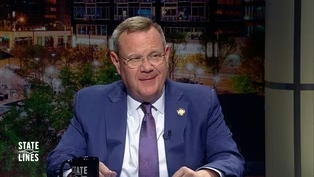
Tim Moore, Republican Candidate for NC’s 14th Congressional District
Video has Closed Captions
An interview with Tim Moore, Republican candidate for NC’s 14th Congressional District (2026). (14m 46s)
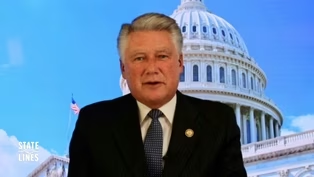
Mark Harris, Republican Candidate for NC’s 8th Congressional District
Video has Closed Captions
An interview with Mark Harris, Republican candidate for NC’s 8th Congressional District (2026). (15m 27s)
Providing Support for PBS.org
Learn Moreabout PBS online sponsorship- We're joined by Mahesh Gunorkar, the Republican in the 4th Congressional District, challenging incumbent representative and Democrat Valerie Foushee.
You go by Max.
Max, thank you for being on the show.
- Thank you, sir.
Thank you for having me.
- Well, you're running for office.
Tell us about yourself.
Why are you running?
- I'm running because when I came to this country, I saw the opportunities that this country offers.
And I see that North Carolina's 4th District can have those opportunities.
It's that someone's got to do it.
Someone has the vision to do it.
And when I see the 4th District, all I see is opportunities all around us.
There are untapped potentials that we can tap into and grow the pie, take the district international.
To give you an example, why don't we have export zones in District 4, where we can have small manufacturers here and have them do joint ventures with small entrepreneurs abroad?
We have RDU, the airport.
It's connected to Europe.
What more would you ask for?
We can bring in tourism here.
Think about the kids in the black school districts.
I call it zip code segregation, because these kids—we have ended segregation in this country.
But these kids, for unfortunate reasons of where they were born or where they live, are basically in a school district where they cannot grow from there.
What I would like to see is have opportunities for everyone, from kids in the school, give them vocational training.
If we have manufacturers who come to the export zones here, they can have jobs locally.
- You like apprenticeship programs.
Factory comes.
A big business comes to your district.
- Yes, sir.
- Have the schools feed that if they need that many workers.
- Exactly.
And what do we do to bring businesses here?
- What do you do?
- We give them tax breaks.
My idea is that if they get to export to other countries, all the income they bring in from export business is theirs to keep tax-free.
Let's put the money back in the business.
Let's grow it.
- Let's talk about educational freedom.
You said you want school opportunity for all children, regardless of zip code.
That's easy said.
Would you publicly fund each student with a voucher that they take to a public school or a private school?
Or would you expand private schooling, leave public schools alone?
I mean, as a congressman, there's only so much you could do, but what do you see as— - I know.
I know.
I'm not getting into the 10th Amendment.
I know education is a 10th Amendment issue, but we can use the muscle of federal dollars to free up students here.
And by that, I mean let's give them scholarship vouchers.
Let's privatize education for a moment, because I'm not saying this because I'm saying it.
I have actually seen it.
India privatized education.
And guess what?
There were more schools.
Construction went up.
Automobile industry went up because they needed more buses.
Uniforms are mandatory there.
So the textile industry picked up.
Of course, education industry picked up.
They needed more teachers.
So now you have all over growth.
What I have noticed in this country is education is tied to real estate, and we need to decouple that.
When we decouple that, we are freeing everyone.
I know I'm taking a stance against some big, powerful people, but I am running in this district because I want to work for people.
When you notice something, look all over the country.
When people run, either on the Republican side or the Democrat side, you will notice one thing.
They run based on the fact that they want to win.
- Most candidates do run to win.
- What's in it for me?
Am I going to win?
Why don't we for a moment think, "I'm running for the people"?
Let's give them a different perspective.
Because when we don't challenge one side or the other, what we are doing is, "These are your people.
Keep them the way you want.
We are not even going to touch them."
- I ask this of candidates.
There are several types of Republicans.
Conservative, there's libertarians, there's social conservatives, there's MAGA.
And now there's Republicans that are called RINOs.
They're not Republican enough.
Where do you fit into this?
I see the "don't tread on me" flag.
- Yes, sir.
I am a Tea Party patriot.
Way back when the Tea Party movement started, that's when I jumped in the movement.
Because there are five things we really want.
Lower taxes, lower regulations, personal responsibility, freedom for all, and the biggest thing is to keep the American dream alive.
These are the things that we really want to focus on.
That's what I want to focus on.
RINOs, yeah, we fought them.
MAGA, yes, they are there.
Some of them have gone extreme right-wing.
That's okay.
But can we focus for once on the people itself?
And that's where I come in.
- Healthcare affordability is part of your platform.
- Yes, sir.
- Affordability, there's accessibility.
And you're a Tea Party patriot, circa 2011.
What do you do about healthcare access?
- Well, I have, again, a very different plan than what we are used to here.
When you look at the state and federal funding, we are spending about anywhere between $3 to $5 trillion on healthcare.
So, believe it or not, we already have socialized medicine.
What can we do to really help people?
And this is where my plan comes in.
If we take that money and provide insurance vouchers, where people can go get insurance from all over the country, let there be competition, we cut waste, fraud, and abuse that's associated with any government program.
When we do that, the patient can really keep the doctor he or she wants.
- The left would say, "Great idea, but take that $3 to $5 trillion, let's give it to the government, eliminate private insurance."
What happens if that happens?
- No, sir.
No, sir.
I have seen time and time again that privatization works.
When you put government leviathan in place—and when I speak, I speak from my personal experience—I have seen what happens when government gets big.
Now you start putting departments on top of department and on top of departments.
What happens is now you're spending money without getting results for the people who we promised would get the results.
- I didn't see this on your platform.
You say legal and illegal immigrants should be carrying health insurance.
- No, sir.
No, sir.
- They should carry their own?
- Well, if they're coming here legally— - Legally?
—as a visitor or as an employee, when you are going to board a plane to come to the U.S., you better have insurance on you.
- From home?
- From home.
Those who are coming illegally, well, number one, we need to tighten the border.
And thanks to President Trump, he has done that.
But if they are here illegally, we need to start charging it back to their countries.
You take them back, or if they are here illegally, you know, we cannot deny health care by law, but let's hold their governments accountable for the medical bills.
- Of all the interviews I've done with candidates, you talk about insurance freedom, and it's not just health care insurance freedom.
You were talking about insurance freedom.
Explain what that policy is.
It is unique.
And all these interviews we've done, I've never heard this.
- Right, exactly.
And that's what I was talking about, that we are already spending so much money on Medicaid, Medicaid and health care, $3 trillion to $5 trillion.
We still can use that money, and probably far less than that, to provide insurance vouchers directly to the people.
We still have to encourage employers to provide insurance.
We have that.
It works good.
The poor people don't have that.
They go through a system where they're middlemen, taking up the chunk of money allotted for the people.
And that's where my plan comes in, that if they have the insurance vouchers, they are free to buy that insurance from anywhere in the country.
- Federal policy tariffs, this administration, the Trump administration, using them widely.
Congress, some Congress members say it's a congressional duty, not an executive branch duty.
Where do you stand on tariffs?
Blanket bad policy, or are they needed in certain sectors?
- I have never been a fan of tariffs.
Why, again, speak from my personal experience.
Tariffs is what killed India.
When I was growing up, anything we imported was heavily taxed.
What happens is the people end up paying those things.
I am not in favor of tariffs at all.
I was never in favor of tariffs.
I am not in favor of protectionism either.
I would take a different stand on that with President Trump.
I did not like it, and I would not support it.
- Immigration, you call for labor exchanges where foreign workers can come seasonally, that you use the word seasonally, as needed.
Walk us through that.
It seems like a policy you could propose in D.C.
- Of course I can.
- How would it work?
- All we have to do is, we look at construction industry, we look at agriculture, we look at other manufacturing, hospitality.
All of them want workers.
Why don't we bring workers through a seasonal exchange where we have checked out who they are before they come to the country.
When they get here, they come through the labor exchange.
- But visas are out there.
You can get your visa and come over and work.
- That could work.
That could work.
But then people overstay visas.
And this is my plan.
When they come through labor exchange, and now we have a farmer who needs 10 workers, he comes to the exchange, gets those 10 workers, takes them back, I mean, takes them to the farm.
When they are done, he reports back to the exchange that here are the guys, I'm done with it, they are yours, either to send them back or if someone else wants it, let them go there.
- Centralize that.
Affordability for the working family.
How do you make things affordable from Washington, D.C.?
- Yes, sir.
Number one, we need to cut taxes.
Energy taxes.
I am not -- I've never been a big fan of taxes, to be honest with you.
Because, like, again, I said, speak from experience.
Taxes is what kill India.
- But the spending is the problem in America.
According to both -- candidates on both sides say we're $40 trillion in debt and we have a deficit.
If you cut taxes, are we still spurring the economy?
- Why don't we cut spending, too?
Like I talked about, the $3 to $5 trillion that we spend on health care, why not cut there?
There are plenty of programs to cut.
But what happens is, when everyone goes there -- and that's where my tea party starts speaking -- everyone goes there and looks at it, what's in it for me?
No one thinks about what's in it for my people in the district.
No one thinks about what's going to happen to the next generation.
This kind of debt is unsustainable and a welfare state will not sustain.
Again, seen it before.
We have to cut spending in every corner we can.
- How do we make everyday prices lower?
Is it because of the federal -- - I would, number one, take off the gasoline tax.
That's the biggest, you know, element that starts building up - - Gas tax.
- Gas tax.
- What's next?- - We got to take -- federal income taxes should be low.
I mean, when you look at any kind of tax, you put people money in people's -- you put money in people's pocket, and you will see the growth ground up.
And that's how I see things, that when we take all the taxes combined, we are paying way more than what we actually sign off on the income tax papers.
We are paying property taxes.
We are paying sales taxes.
We are paying -- you name it.
When we are buying goods, we are paying taxes on that.
When you are importing goods, you are paying taxes on that.
When you add up all the taxes, obviously, the cost of living is going to go up, because the corporations who are collecting those taxes are basically doing government's job.
- We've covered a lot of topics.
- Thank you, sir.
- This is Mahesh Ganorkar.
He goes by Max.
He'll be on the ballot in the fourth congressional district, Republican candidate challenging representative Valerie Foushee.
Sir, thank you for this time and for explaining your plan for us.
- Thank you, sir.
Thank you.
♪
 New Episode
- News and Public Affairs

Top journalists deliver compelling original analysis of the hour's headlines.
 New Episode
- News and Public Affairs

Today's top journalists discuss Washington's current political events and public affairs.

 New Episode
 New Episode
 New Episode
 New Episode


 New Episode
 New Episode

Support for PBS provided by:
State Lines is a local public television program presented by PBS NC