
Pat Harrigan, Republican Candidate for NC’s 10th Congressional District
Special | 15m 31sVideo has Closed Captions
An interview with Pat Harrigan, Republican candidate for NC’s 10th Congressional District (2026).
Pat Harrigan, Republican candidate for NC’s 10th Congressional District, discusses his 2026 campaign with PBS NC’s Kelly McCullen. This interview was recorded on August 12, 2026.
Problems playing video? | Closed Captioning Feedback
Problems playing video? | Closed Captioning Feedback
State Lines is a local public television program presented by PBS NC
Pat Harrigan, Republican Candidate for NC’s 10th Congressional District
Special | 15m 31sVideo has Closed Captions
Pat Harrigan, Republican candidate for NC’s 10th Congressional District, discusses his 2026 campaign with PBS NC’s Kelly McCullen. This interview was recorded on August 12, 2026.
Problems playing video? | Closed Captioning Feedback
Where to Watch State Lines
State Lines is available to stream on pbs.org and the PBS app.
Providing Support for PBS.org
Learn Moreabout PBS online sponsorshipMore from This Collection
During major election cycles, PBS North Carolina's public affairs team sits down for in-depth conversations with candidates running for elected office in North Carolina. PBS North Carolina has invited major party candidates to a one-on-one interview with State Lines host and executive producer Kelly McCullen. Interviews are scheduled throughout the summer and early fall.
NC Judicial Candidates Forum: NC Court of Appeals Judge Seats 2 & 3
Video has Closed Captions
Meet candidates for the NC Court of Appeals Judge Seats 2 and 3. (26m 46s)
Candidates for NC Court of Appeals Judge Seat 3: Craig Collins (R) & Christine Marie Walczyk (D)
Video has Closed Captions
Meet the Republican and Democratic candidates for the NC Court of Appeals Judge Seat 3. (13m 7s)

Candidate for NC Court of Appeals Judge Seat 2: Tobias Hampson (D)
Video has Closed Captions
Meet the Democratic candidate for the NC Court of Appeals Judge Seat 2. (12m 57s)

Candidates for NC Supreme Court Associate Justice Seat 1: Anita Earls (D) & Sarah Stevens (R)
Video has Closed Captions
Meet the Democratic and Republican candidates for the NC Supreme Court Associate Justice Seat 1. (12m 38s)

Candidates for NC Court of Appeals Judge Seat 1: John Arrowood (D) & Michael Byrne (R)
Video has Closed Captions
Meet the Democratic and Republican candidates for the NC Court of Appeals Judge Seat 1. (11m 54s)
Kimberly Hardy, Democratic Candidate for NC’s 7th Congressional District
Video has Closed Captions
An interview with Kimberly Hardy, Democratic candidate for NC’s 7th Congressional District (2026). (14m 16s)
Cyril Jefferson, Democratic Candidate for NC’s 6th Congressional District
Video has Closed Captions
An interview with Cyril Jefferson, Democratic candidate for NC’s 6th Congressional District (2026). (13m 42s)
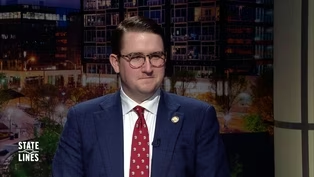
Addison McDowell, Republican Candidate for NC’s 6th Congressional District
Video has Closed Captions
An interview with Addison McDowell, Republican candidate for NC’s 6th Congressional District (2026). (14m 11s)
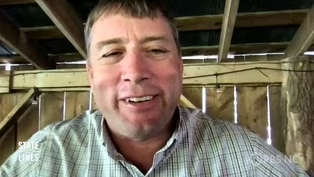
Jamie Ager, Democratic Candidate for NC’s 11th Congressional District
Video has Closed Captions
An interview with Jamie Ager, Democratic candidate for NC’s 11th Congressional District (2026). (14m)
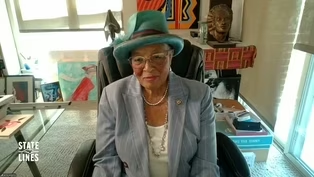
Alma Adams, Democratic Candidate for NC’s 12th Congressional District
Video has Closed Captions
An interview with Alma Adams, Democratic candidate for NC’s 12th Congressional District (2026). (15m 19s)
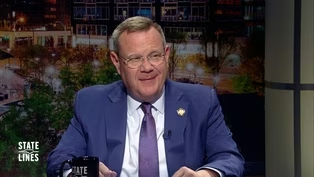
Tim Moore, Republican Candidate for NC’s 14th Congressional District
Video has Closed Captions
An interview with Tim Moore, Republican candidate for NC’s 14th Congressional District (2026). (14m 46s)
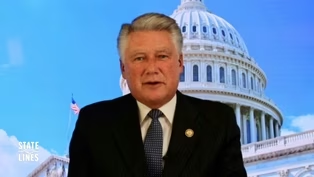
Mark Harris, Republican Candidate for NC’s 8th Congressional District
Video has Closed Captions
An interview with Mark Harris, Republican candidate for NC’s 8th Congressional District (2026). (15m 27s)
Providing Support for PBS.org
Learn Moreabout PBS online sponsorship- We're joined by Representative Pat Harrigan, the Republican candidate, also the incumbent representative from the 10th US Congressional District in North Carolina.
I guess up around that Hickory area.
Is that right, representative?
- That's exactly right.
We're right on Lake Hickory.
We love it.
- It's nice country up there.
I have to say we're asking all the candidates in the major parties for interviews and you are not the first military veteran that -- Democrats and Republicans -- who are seeking office.
And I'm looking at your biography.
It's special forces.
I think Green Beret.
What is it about the military that either makes you want to go into politics or when you're in politics, you bring that military training and strategies and tactics and thinking to DC?
- I think it's exactly what you said, right?
You have a unique perspective and set of expertise that lends you when you're in Washington to be able to understand the consequences of the decisions that we're actually making.
The more veterans that we actually have in Congress, whether they're Republicans or whether they're Democrats, we end up with better quality decisions.
I think if you look back to our history in the years after World War Two in the 50s in the 60s in the 70s, our members of Congress who were veterans were 60% 70% even 80% of Congress were veterans just three cycles ago.
So six years ago that number went down to 9%.
You wonder why we're not making great decisions up in Washington.
It's got because we got a bunch of people that don't know the consequences, the practical consequences of the decisions that we are making because they cannot actually, you know, they cannot extrapolate those decisions from discussions and how it looks on paper to how that actually translates out into the real world for people.
And so one of my passions again, regardless of party, is just getting more veterans into Congress because one of the things.
That veterans do is we agree on the solutions we might disagree on the solutions, but we absolutely agree on the problems we do not waste time talking about whether the sky is green in the grass is blue.
We all know that the sky is blue in the grass is green and that's a great place to start from.
When solving our nation's problems, - You've been up there a couple of years now in DC.
We can watch international national cable news.
I think those platforms have a reason to tell you issues the way they want to tell you those issues.
Let's be honest about that.
How is what we see on TV on cable news international news?
How's it different than what's actually going on in DC?
Or are they expressing it accurately?
- Well, you know there's a difference in my opinion between international news and cable news and we do all of it, right?
We do BBC.
We've even done some Al Jazeera and we certainly do Fox.
We do CNN.
We you know we do.
We do all the things and everything in between what I what I would tell you is that the international news is more or less in my experience.
More kind of down the middle, right?
Foreign audiences want to actually get the ground truth of what's going on in DC without the spin as much as possible, so I actually really enjoy doing international news.
Here domestically, obviously Fox is on one side and then you got CNN it's on the other and they both make points, but I think what's lost on both sides is the wisdom and experience of the audience and the discernment to be able to really get to what is the absolute truth of the particular circumstance and I think that's something that's gotten lost in our media landscape today.
I try to call things down the middle, not as a Republican, not as a Democrat, but really just as an American.
Because at the end of the day I serve on the Armed Services Committee.
That really should be a nonpartisan exercise.
Certainly there are partisan elements to anything that goes on in Washington DC, but I think what my constituents are looking for is balls and strikes, and I try to call those balls and strikes to the best of my ability and the best of my experience.
As that informs my perspective on what's best to do moving forward for our country.
- Yeah, Mr.
Harrigan, this is the point of these whole interviews.
Talk to you about you who is Pat Harrigan?
Why do you want to be a leader?
I looked at your platform.
It reads like a solid conservative platform by any measure.
Secure borders, family values, protections, lower costs for families, defense and military readiness.
Whenever you click, I see a policy position on your website.
However, do you have a priority of those lists 1,2,3,4 that that you see is most important?
I won't say the least important, but most important to very important to very important and on down the list.
- Well, look, there's the here and now, and then there's the big picture perspective and when you're in Congress, you're really sitting on the Board of Directors for the country, and so as a member of the Board of Directors for the country, you have to be concerned about the entire aperture of things that both challenge our country and things that are also opportunities for our country.
I ran for Congress coming out of that military special forces background.
Somebody that started a business out of my double wide trailer that my wife and I had when we were in the military growing that business and then getting really frustrated with the fall of Afghanistan, which is really what spurred me to get into Congress.
I was like good grief guys.
We are throwing the game here.
We are absolutely portraying American weakness on the world stage, and when we do that from a structural perspective we unleash evil around the world and we have to understand that our adversaries have been on the march.
Structurally, that's still my biggest concern.
I think we're moving towards a world that has far more risk moving forward than the risk that we have, you know, the reduced risk that in large part we've been able to enjoy certainly since the end of the Cold War.
Over the last generation, but in the here and now I think there's no question affordability is the name of the game.
The state of the economy is always going to predicate what drives election cycles every two years.
Every four years, whether it's something for Congress, whether it's something for the executive branch that's always going to predicate the foundation of the back and forth that exists during the election season.
And I think we certainly all understand and look somebody that came from a double wide trailer.
I'm not sure that I could do today what I was able to do 10 years ago.
Moving from that double wide trailer to the very large manufacturing facility that we've had being able to do that without bank loans.
It's just a very different environment today and so in my here and now I'm very, very focused on how expensive is it for the middle class simply to breathe.
- Why are things so expensive in this country right now?
Some say more government spending would help make things more affordable.
There's a whole other side that says the more money the government prints and deficit spending you cause inflation makes prices rise.
How caught our congressmen and senators in trying to solve the problem without making it worse?
- I think that's a great encapsulation of the problem set that exists, right?
I think that anybody who's being true to the principles of economics can understand that when you print more money, you devalue the money that you have.
That's why the dollar doesn't go as far today as it did 10 years ago as it did.
60 years ago it's inflation, so when the government does spend more money and look both parties are responsible for this, I mean, we had historic spending underneath the Biden ministration, particularly in the response to the into the COVID crisis and then we've also continued that historic spending underneath the Trump administration.
So I think that's a big part of the problem that we're facing.
So neither party is actually solving this problem, but I do think that some of the work that we have done, particularly with the Working Families Tax Cuts Act last last July is actually transformational for the middle class.
Because what we did is we came in and we said look, we're not going to have any tax on tips were not going to have any tax on overtime.
We're not going to tax your Social Security.
Well, we are, but we're providing a deducted deductionion offset that we're not going to pay tax on Social Security, which is great.
We increased the child tax credit.
We provided tax relief for almost every single level of American middle class experience, and that estimated average tax cut was almost $4000 just this year.
So I think that's incredibly helpful in terms of recharging the middle class and taking some of that burden off of the middle class, which has certainly fallen on the middle class over the last 10 years.
And in many ways, I think unnecessarily.
- For the next two years, if you're reelected, what do you see?
Where does work need to continue with federal policy for budget to?
I don't get too far.
If we can talk border security, we can talk military readiness, but let's start with the finances of this country.
They're saying Social Security is going to run out of the trust fund, and you're going to have to start pay as you go on that.
You know the dollar and inflation continues no matter who's the president.
What are we looking at, the next 2 to 5 years in this country?
- Well, the rate at which we're spending money is unsustainable.
I can tell you that just straight off the top.
We're about to cross $40 trillion worth of sovereign debt public debt this year and about a month and that is moving at an unsustainable rate.
Our deficit is growing at about $2 trillion a year, and that's just not going to work.
I mean, that's undercutting everybody.
And as you see, I think there's people who are paying attention.
There's a very clear striation of the middle class over the last decade.
I mean the rich.
They are becoming wealthier and those in the middle class are kind of falling behind.
I think we need to be honest about that, and we need to look at the baseline economic conditions and say what are we doing from a policy perspective that is either helping correct that or actually continuing to move it in the wrong direction.
And so I the best thing that I can say is that we need to continue setting the conditions for our economy to be successful no matter where you are in that economy.
That does mean a lower tax environment for everybody.
That also does mean that the federal government has to restrain spending, and the real trick with all of this is, hey, Republicans and Democrats.
They both want to fund their priorities, but those priorities cost money.
At what point does the circumstance in the United States get to the point where we actually have to put the fiscal house in order as a extension?
And as a main thrust of the policy that either party is actually trying to get across the finish line right now, neither Republicans nor Democrats are doing that.
- You know, you said that the pull out of Afghanistan is what really puts you on the path of running for office, at least giving it a shot a few years ago.
We're - we're not in Iran, but we're bombing Iran and we're all around Iran.
but we're bombing Iran and we're all around Iran.
What do we do about Iran to either win it, contain it, or pull out of that place and and and see if we can get back to normal?
- Yeah, those are your three options.
And look, Iran's not in a good spot right now.
I think there's no question about that.
We're in this quasi state of neither peace and neither war, and I've long advised the president and the administration, anybody over in the Pentagon that look, we're not going to be able to hash out a deal with these people.
It's not how they work, and I'm frustrated that we didn't understand from the very beginning that that was going to be the case.
If we chose to embark on on this journey, and I'll be the first to tell you that I do think that when we left Afghanistan when Russia invaded Ukraine.
As China is really kind of shaking the and beating the war drums on the Taiwan issue, we really did loose the chains of darkness around the world, and I do believe that whether the president chose to go into Iran.
Back in February or not, I think that this war was inevitable.
Now, what do you do about it?
Given the decisions that have been made?
Well, I'm frustrated because I don't think that we actually conducted this conflict in the right way in order to win, and that's something that as a veteran of the Global War on Terror is a veteran of the Special Forces.
We can not fight wars that we shouldn't fight, but we absolutely have to win the ones that we choose to, and we've burned very precious time and resources over this last six months.
And this whole thing should have been over in less than two months.
We're not good at fighting protracted war, and so I think the options come down to.
You either need to finish it the right way, which means you have to change your targeting and you've got to go after more consequential impacts to the Iranian regime that really put them in a very difficult position.
You have to decide, hey, am I going to continue with the limited resources that I have?
Am I going to continue to pursue red lines that are intolerable to the United States and its Western allies or am I actually going to take care of the 92 million people in my country who are not members of the IRGC we have fundamentally failed to put Iran in the regime inside of that box and that's exactly why we're in the quagmire that we're in today.
And really, the other option is declaring victory and leaving, and I think that there's some very real reasons why that is a valid consideration given what's happened, because we have set the Iranian regime back many years, depending on where you look at it against the initial five objectives that we had going into Iran in the first place.
But what we cannot do is we cannot continue to do what we're doing right now, which is doing just enough not to lose, but not enough to win.
That is how you get into a forever war, and there's not a single global war on terror veteran, and I've not talked to a single constituent that wants to keep doing what we're doing right now.
It makes absolutely no sense, so the administration has to make a decision here and Congress has to hold the administration accountable to that decision.
Trying to get to the very best strategic outcome for the United States of America in the interest of our allies as we possibly can.
- Well, it'd be a tough campaign out there.
A lot of miles, a lot of work.
Representative Pat Harrigan.
I appreciate you taking time for this interview to let the voters get to hear from you get to know a little bit about you because as I say a local region of this state will elect you, but your decisions will affect an entire country.
So to take time with us, we we deeply appreciate it.
Good luck.
Be safe out there and and we'll see after the election, maybe, If you have any way people can look up Pat Harrigan and learn more about you?
- Yeah, Kelly, thanks for having me on the on the program.
I really appreciate what you do.
Yes, everybody can follow me at @RepPatHarrigan across all the socials please please go to our house website harrigan.house.gov.
That's H A R R I G A N. Sign up for our newsletter.
We send out a newsletter every single week.
I do videos almost every week talking about what's going on in Washington DC.
We put that out across our socials.
Please reach out.
We'd love to hear from you, but North Carolina keep doing well.
God bless you.
And thanks again Kelly for having me on the show.
- Representative Pat Harrigan, Republican candidate, the incumbent of that 10th US Congressional District.
Thank you, sir.
Good luck.
♪
 New Episode
- News and Public Affairs

Top journalists deliver compelling original analysis of the hour's headlines.

- News and Public Affairs

FRONTLINE is investigative journalism that questions, explains and changes our world.
 New Episode
 New Episode
 New Episode
 New Episode
 New Episode
 New Episode
 New Episode
 New Episode

Support for PBS provided by:
State Lines is a local public television program presented by PBS NC