
Paul Barringer, Democratic Candidate for NC’s 13th Congressional District
Special | 15m 2sVideo has Closed Captions
An interview with Paul Barringer, Democratic candidate for NC’s 13th Congressional District (2026).
Paul Barringer, Democratic candidate for NC’s 13th Congressional District, discusses his 2026 campaign with PBS NC’s Kelly McCullen. This interview was recorded on August 10, 2026.
Problems playing video? | Closed Captioning Feedback
Problems playing video? | Closed Captioning Feedback
State Lines is a local public television program presented by PBS NC
Paul Barringer, Democratic Candidate for NC’s 13th Congressional District
Special | 15m 2sVideo has Closed Captions
Paul Barringer, Democratic candidate for NC’s 13th Congressional District, discusses his 2026 campaign with PBS NC’s Kelly McCullen. This interview was recorded on August 10, 2026.
Problems playing video? | Closed Captioning Feedback
Where to Watch State Lines
State Lines is available to stream on pbs.org and the PBS app.
Providing Support for PBS.org
Learn Moreabout PBS online sponsorshipMore from This Collection
During major election cycles, PBS North Carolina's public affairs team sits down for in-depth conversations with candidates running for elected office in North Carolina. PBS North Carolina has invited major party candidates to a one-on-one interview with State Lines host and executive producer Kelly McCullen. Interviews are scheduled throughout the summer and early fall.
NC Judicial Candidates Forum: NC Court of Appeals Judge Seats 2 & 3
Video has Closed Captions
Meet candidates for the NC Court of Appeals Judge Seats 2 and 3. (26m 46s)
Candidates for NC Court of Appeals Judge Seat 3: Craig Collins (R) & Christine Marie Walczyk (D)
Video has Closed Captions
Meet the Republican and Democratic candidates for the NC Court of Appeals Judge Seat 3. (13m 7s)
Candidate for NC Court of Appeals Judge Seat 2: Tobias Hampson (D)
Video has Closed Captions
Meet the Democratic candidate for the NC Court of Appeals Judge Seat 2. (12m 57s)
Candidates for NC Supreme Court Associate Justice Seat 1: Anita Earls (D) & Sarah Stevens (R)
Video has Closed Captions
Meet the Democratic and Republican candidates for the NC Supreme Court Associate Justice Seat 1. (12m 38s)
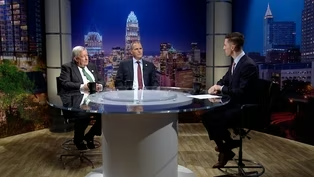
Candidates for NC Court of Appeals Judge Seat 1: John Arrowood (D) & Michael Byrne (R)
Video has Closed Captions
Meet the Democratic and Republican candidates for the NC Court of Appeals Judge Seat 1. (11m 54s)
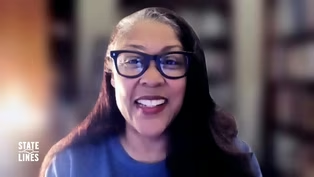
Kimberly Hardy, Democratic Candidate for NC’s 7th Congressional District
Video has Closed Captions
An interview with Kimberly Hardy, Democratic candidate for NC’s 7th Congressional District (2026). (14m 16s)
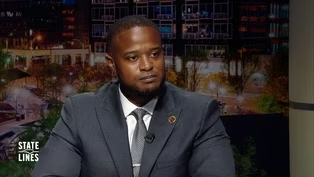
Cyril Jefferson, Democratic Candidate for NC’s 6th Congressional District
Video has Closed Captions
An interview with Cyril Jefferson, Democratic candidate for NC’s 6th Congressional District (2026). (13m 42s)
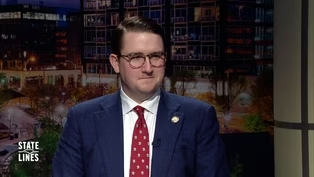
Addison McDowell, Republican Candidate for NC’s 6th Congressional District
Video has Closed Captions
An interview with Addison McDowell, Republican candidate for NC’s 6th Congressional District (2026). (14m 11s)
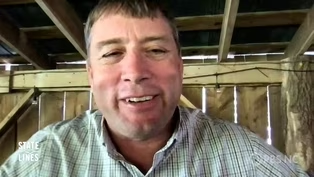
Jamie Ager, Democratic Candidate for NC’s 11th Congressional District
Video has Closed Captions
An interview with Jamie Ager, Democratic candidate for NC’s 11th Congressional District (2026). (14m)
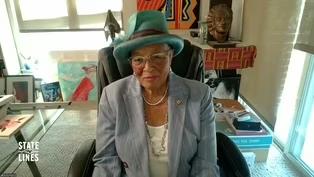
Alma Adams, Democratic Candidate for NC’s 12th Congressional District
Video has Closed Captions
An interview with Alma Adams, Democratic candidate for NC’s 12th Congressional District (2026). (15m 19s)
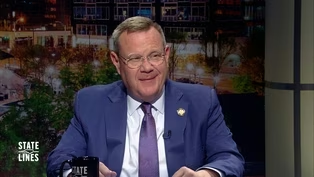
Tim Moore, Republican Candidate for NC’s 14th Congressional District
Video has Closed Captions
An interview with Tim Moore, Republican candidate for NC’s 14th Congressional District (2026). (14m 46s)
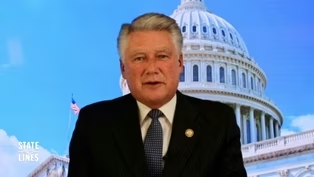
Mark Harris, Republican Candidate for NC’s 8th Congressional District
Video has Closed Captions
An interview with Mark Harris, Republican candidate for NC’s 8th Congressional District (2026). (15m 27s)
Providing Support for PBS.org
Learn Moreabout PBS online sponsorship- Paul Barringer joins us now 13th US congressional district Democratic candidate for house running against GOP representative incumbent Brad Knott.
Mr.
Barringer, thanks for coming on for this interview to discuss you your platform and what you'll do in DC.
- Thank you so much for having me.
It's great to be here.
- What's your background?
I mean, there's the you can see the signs We can see the YouTube videos, but who's Paul Barringer and why does it make you ready to head up to DC and service in Congress?
- Oh, well, my name is Paul Barringer.
Like I said, I'm running as the Democratic candidate in District 13 which is an oddly shaped district that runs all the way from almost from Well from Southern Pines, but Lee County up to the Virginia border So this is a very red and gerrymandered district.
But one that I think we have a real opportunity this year because of all the changes that have happened.
So I'm a lawyer and tree farmer from Sanford.
I live on a farm I grew up on the farm and my family's got deep roots in the ag community there And we're just looking to build connections all around the district and and do what we can in November I think we can flip this district blue.
- You're kind of candidates of both parties are coming on here I do want to ask the Republicans have their you know, Republican establishment They have the Libertarians have MAGA now.
Well, now Democrats have their own intra party discussion between Democratic socialism moderate Democrats liberal Democrats and traditional.
Where do you size and fit into that brand or those brands?
- Well, I'm running right down the middle because I think that's what we need in the country and that's also who I am as a person That's where my politics align.
That's how I see policy.
And again, I think that's what the country needs is coming back to the middle.
I used to be a Republican and now I'm a Democrat.
So regardless of that I really believe in free enterprise the market opportunities for for people to get ahead.
I think a lot of us want the same thing.
Government does have a role to play, and I think we need a lot of things to improve.
But I'm trying to represent that part of the middle that I think has been unrepresented so much and I think we have a real opportunity to in this district to gain support because people do want that.
- What made you leave the Republican Party and go all the way not just unaffiliated but to the Democrats?
- Well, I wanted to make a change, and I felt like we needed a change.
We needed a different kind of representation in Washington and I was fed up with the things that were happening.
As I say I couldn't take the news one more day.
- Was it recently, recent years, long time ago?
- Sure.
It was and you know if Republicans were the party of small government and individual responsibility fiscal responsibility and the Constitution, I think I would still be a Republican.
But that's not the case and we don't have a Republican Party where people are able to speak independently.
And I think people need to speak independently and when I get elected I'll definitely be an independent voice in Congress representing that middle, because I think that's what people are seeking in this district and in many other districts around the country.
- I noticed in your on your website.
You're discussing finding practical solutions using quote quants constitutional principles.
Which solutions and which constitutional principles could you could you work with the most to be most effective?
- Well I think that the founders set up a system that had with three branches of government three co-equal branches of government and each of them should hold the other two branches of government accountable.
I don't think we're seeing that that's the case today.
We have a Republican Congress, which is more like a rubber stamp for the president and as a result, we're seeing impacts on our lives.
One of the key issues for me and for many other candidates this year is affordability.
And affordability is kind of a broad term but underneath the hood of that term are some specific issues that I think are - We're seeing impacts in people's lives as a result of deliberate decisions that the administration has made with support from the Republican Congress.
So in particular on the war which has driven up gas prices as well as input prices for many other things that are affecting prices on on tariffs.
Tariffs are taxes, which are the province of Congress and yet they've inappropriately delegated that authority to the president to make tariffs and even when the Supreme Court has overruled those tariffs they're still in support.
And that in immigration.
We're all paying higher prices particularly for food as a result of the immigration crackdowns, but are making it harder to get labor, especially in the ag sector.
So, we need respect for the Constitution I think really means number one that we have an independent Congress that can function independently and hold the other two branches of government accountable, And I mean to do that when I get elected.
- Let's go back to trade.
I did did notice where you'd written, you know You didn't like blanket tariffs just across the board across the industry, but you didn't seem to oppose targeted tariffs.
Did I read that correctly?
Where do terrorists play a role in our economy?
Protecting American jobs or not at all.
Should it be free market and let the world compete?
- Well, I think there's a it's a balance ultimately.
There there may be a role for tariffs largely I think we're all better off with freer trade.
But there are important sectors where there may need to be government intervention to ensure that those are protected.
I was just reading yesterday about the the rapid advances in technology for battery storage, using salt as opposed to lithium-ion.
Lithium-ion is a rare earth or if the critical ingredients in those batteries rely on China, right and supply chains that China controls.
Whereas salt, table salt which is a key ingredient these new batteries is something that is very common, right?
We everyone has access to table salt and yet are we going to be in a position to scale that new technology?
Or will the Chinese do that?
So I think there's there's there's targeted opportunities for us to support industrial development.
But what I don't like is tariffs in the way that we've seen them over the last year applied willy-nilly and almost with a desire to affect retribution against perceived political enemies.
So if there was going to be tariffs, I think we should be very strategic thoughtful and collaborative and bipartisan about how we develop though that approach.
- There's federal analysts out there, you know, the wonks if you will, say the next presidential administration maybe you if you're in the house, you're going to need to deal with the national debt.
40 trillion dollars at some point Some president and some Congress has to deal with it.
You've written about fiscal responsibility But how do you get that done and get something in federal budget writing?
- Well, well first I'll say as Pete Peterson has said who is a former I think US Commerce Secretary and someone who started an institute focused on the debt, that if you're in a hole first stop digging, right?
So we need to find ways to begin to mitigate those continuing deficits on an ongoing basis.
The things that they're doing right now are not helping, the war in particular which is really unfunded, and they're spending a lot of money on the war in Iran and we're all paying the price for that.
But we need bipartisan support to address the underlying issues of debt spending or the the debt, and ongoing deficits and part of it's structural factors that have you know in different events that occurred over in many years, the Great Recession the wars that have largely not been paid for.
Entitlement spending has a piece of it And interest is a huge part of growing the debt at this point too.
But across all of these we need to find bipartisan ways to address this.
What's unfortunate is what they've done over the last year and a half is only add to the debt, because the big beautiful bill which passed last summer will add an estimated four trillion dollars to the national debt.
And in addition we've seen in the president's five and a half years in office he's presided over the growth of almost a third of the the increase of the national debt since the mid 90s.
And the mid 90s, they briefly got to a period where the deficit was zero and the debt was about five trillion dollars.
It's grown by thirty five trillion dollars over the last thirty years and the president Donald Trump has presided over in five and a half years almost a third of that.
So we need to make changes and the first thing is we have to pay for the things that were that we're spending, and we also need to be thoughtful about we're allocating resources.
- Is it reasonable to ask citizens to cut back on expectations of federal benefits or federal services?
- I mean, I think that you know at the end of the day categorically you can say that 35 trillion dollars has been not paid for over the past 30 years right, because that's how we grew from a national debt of five trillion to a national debt of 40 trillion.
And so You could argue about a lot of other things But but but clearly one thing is true We spent 35 trillion dollars more than we took in, so is the way out of that through austerity or tax increases?
I mean somehow or another if we're ever gonna correct this we're gonna have to have a combination of efficiency in spending and also Revenue increases.
Because there's no other mathematical way out of this.
But the - I think if we work together, we can mitigate the harms and maximize the benefits to people across society and it's very important to me.
I'll say just I've worked in health care for many years - - Go into health care reform because that's a huge government expense potentially and many Democrats are now still pushing for you know Universal access or Medicaid Medicare for all.
- Right, absolutely.
And so I've worked in health care for many years I was a health care lawyer.
I worked in in the corporate world for a long time.
I have a lot of perspectives on On health care.
I'll say around the launch of the Affordable Care Act I did a lot of work with state-based marketplaces that were helping people get enrolled into care.
And I worked directly with those states to get help people get eligibility confirmed and also into their benefits.
And I saw how significant that was in people's lives.
And where you live in a world where health care coverage equals access to care because the price of underlying health care services is so high if you don't have insurance.
It's really hard to get access to care.
So I will say the first thing that we need to do and we think about health care policy is make sure that people have access to coverage.
And then access to care.
So when I get elected, I'll be a vote for reversing the eligibility changes under the big beautiful bill that will result if unchecked in north of 11 million Americans losing Medicaid coverage, including 30,000 people here in District 13.
I will be a vote for continuing the enhanced subsidies under the Affordable Care Act.
Which they shut down the government over last fall and which are resulting in loss of coverage for millions of Americans and affecting much higher premiums for many many millions of Americans as well.
But I'll also be a voice for consideration of alternatives that position us truly to have access to affordable care options for every person, not just affordable at the point of purchase by the individual but affordable for the country as a whole.
When you look at the proportion of government of health care spending that is driven by the government.
It's it's increased by about like by about a hundred percent over the last 50 or 60 years, from approximately a third of total health spending in the 60s.
It was driven by the government to about two-thirds today.
So government has spent a lot.
It already spends a lot.
It doesn't spend efficiently or effectively often.
So I think there's a lot of ways to allocate those resources more effectively.
- Is this your top issue or are there others out there?
- I would say affordability is the top issue and really under affordability is how is what role does the Congress play in addressing those items which the government is doing to drive prices higher particularly the war tariffs and immigration.
So that's first.
The second is health care And how do we make sure that people have access to care while we also explore alternatives the position us to really make care available.
- You said immigration.
What do you do with it?
- Well, I think we need to secure the border and then - It's closed now, they say.
- Exactly but I mean I do think that's the right thing to do But also we need to find pathways for people to come here and work and also we need to find pathways for citizenship This is a country with made of immigrants.
Many people have come here from all over the world for many many many centuries and Immigration is is very positive for our economy.
And I think we need to find pathways to help people work here and and contribute to our economy and if they're willing to do that and pay taxes and be responsible members of society.
Why would we not want them here?
- Israel?
What should be America's role?
with that relationship?
- That's um, I believe in peace and I believe in diplomacy and I believe there has to be respect for human rights and dignity.
I believe we have to have a two-state solution because how else can you approach this?
And I know it's not hard, but those have to be - or it's not easy, I should say, it's very hard.
And they've tried and but then we have to continue to try because that is really the only thing.
And I understand there's a lot of very difficult challenging and almost intractable issues there.
But if we're not striving for peace for justice for human rights and dignity of people and the ability of people to live together I don't know what else we can strive for.
- It's a red district you're running in, by statistic, drawn GOP friendly majorities.
How do you convince Republicans and republican minded independents to cross over, at least in this election and vote for your camp?
- Well, I mean the first thing I'll say is I used to be a Republican and I believe in limited government and low taxes, but fiscal responsibility.
And we need to find ways to work together.
I'm running as a Democrat because the Democratic Party is a big tent.
There's obviously a lot of you know differences of opinion in the Democratic Party, but I will say this that we we have to have the ability to be independent.
And that's why I think it's very hard for Republicans to have an independent mindset, when the president can tell them exactly what to do at any time.
So that's one thing is I have an independent mindset.
I'll continue to have that and if that means standing up to the party bosses that are Democrats or to the president I'll do the same thing.
Also.
I mean, I live on a farm.
I grew up on a farm.
I, we have - we had a farm supply business.
I've got deep roots in the in the ag community particularly in Lee County.
And, you know, I feel like I can talk about heavy machinery and all kinds of stuff.
So I and I enjoy being in the country and all those things.
So I I think those - the background that I have, you know Small-town Sunday school teacher Eagle Scout will help me continue to make connections with people as it's done already.
- How can folks in the 13th district and elsewhere find you learn more about you?
Well, I would love to have anyone come on our website at PaulBarringer.com there's lots of information about what we stand for.
We're on social media, too.
So, please check us out there and we would love to see anybody out of the events that we're doing.
We have a lot of events that we're doing all across the district and check our website for details.
- Paul Barringer, Democratic candidate 13th US Congressional District challenging Brad Knott.
Thank you, sir for being here.
- Thank you so much for having me.
Great to be here.
♪
 New Episode
- News and Public Affairs

Top journalists deliver compelling original analysis of the hour's headlines.
 New Episode
- News and Public Affairs

FRONTLINE is investigative journalism that questions, explains and changes our world.

 New Episode
 New Episode
 New Episode
 New Episode
 New Episode
 New Episode


 New Episode
Support for PBS provided by:
State Lines is a local public television program presented by PBS NC