
Raymond Smith Jr., Democratic Candidate for NC’s 3rd Congressional District
Special | 15mVideo has Closed Captions
An interview with Raymond Smith, Democratic candidate for NC’s 3rd Congressional District (2026).
Raymond Smith Jr., Democratic candidate for NC’s 3rd Congressional District, discusses his 2026 campaign with PBS NC’s Kelly McCullen. This interview was recorded on August 11, 2026.
Problems playing video? | Closed Captioning Feedback
Problems playing video? | Closed Captioning Feedback
State Lines is a local public television program presented by PBS NC
Raymond Smith Jr., Democratic Candidate for NC’s 3rd Congressional District
Special | 15mVideo has Closed Captions
Raymond Smith Jr., Democratic candidate for NC’s 3rd Congressional District, discusses his 2026 campaign with PBS NC’s Kelly McCullen. This interview was recorded on August 11, 2026.
Problems playing video? | Closed Captioning Feedback
Where to Watch State Lines
State Lines is available to stream on pbs.org and the PBS app.
Providing Support for PBS.org
Learn Moreabout PBS online sponsorshipMore from This Collection
During major election cycles, PBS North Carolina's public affairs team sits down for in-depth conversations with candidates running for elected office in North Carolina. PBS North Carolina has invited major party candidates to a one-on-one interview with State Lines host and executive producer Kelly McCullen. Interviews are scheduled throughout the summer and early fall.
NC Judicial Candidates Forum: NC Court of Appeals Judge Seats 2 & 3
Video has Closed Captions
Meet candidates for the NC Court of Appeals Judge Seats 2 and 3. (26m 46s)
Candidates for NC Court of Appeals Judge Seat 3: Craig Collins (R) & Christine Marie Walczyk (D)
Video has Closed Captions
Meet the Republican and Democratic candidates for the NC Court of Appeals Judge Seat 3. (13m 7s)
Candidate for NC Court of Appeals Judge Seat 2: Tobias Hampson (D)
Video has Closed Captions
Meet the Democratic candidate for the NC Court of Appeals Judge Seat 2. (12m 57s)
Candidates for NC Supreme Court Associate Justice Seat 1: Anita Earls (D) & Sarah Stevens (R)
Video has Closed Captions
Meet the Democratic and Republican candidates for the NC Supreme Court Associate Justice Seat 1. (12m 38s)
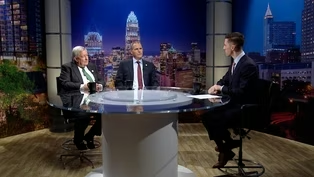
Candidates for NC Court of Appeals Judge Seat 1: John Arrowood (D) & Michael Byrne (R)
Video has Closed Captions
Meet the Democratic and Republican candidates for the NC Court of Appeals Judge Seat 1. (11m 54s)
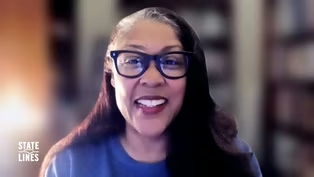
Kimberly Hardy, Democratic Candidate for NC’s 7th Congressional District
Video has Closed Captions
An interview with Kimberly Hardy, Democratic candidate for NC’s 7th Congressional District (2026). (14m 16s)
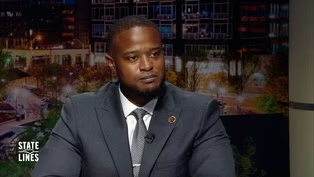
Cyril Jefferson, Democratic Candidate for NC’s 6th Congressional District
Video has Closed Captions
An interview with Cyril Jefferson, Democratic candidate for NC’s 6th Congressional District (2026). (13m 42s)
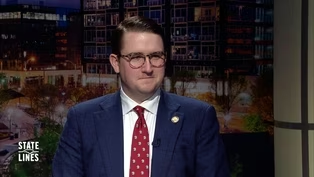
Addison McDowell, Republican Candidate for NC’s 6th Congressional District
Video has Closed Captions
An interview with Addison McDowell, Republican candidate for NC’s 6th Congressional District (2026). (14m 11s)
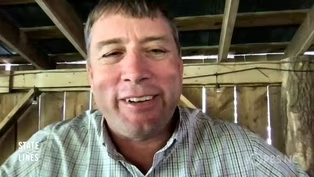
Jamie Ager, Democratic Candidate for NC’s 11th Congressional District
Video has Closed Captions
An interview with Jamie Ager, Democratic candidate for NC’s 11th Congressional District (2026). (14m)
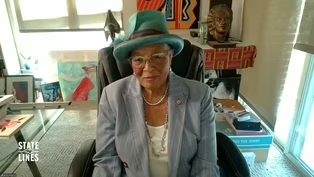
Alma Adams, Democratic Candidate for NC’s 12th Congressional District
Video has Closed Captions
An interview with Alma Adams, Democratic candidate for NC’s 12th Congressional District (2026). (15m 19s)
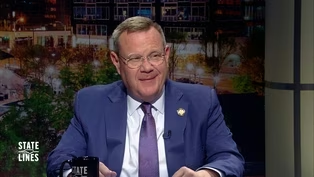
Tim Moore, Republican Candidate for NC’s 14th Congressional District
Video has Closed Captions
An interview with Tim Moore, Republican candidate for NC’s 14th Congressional District (2026). (14m 46s)
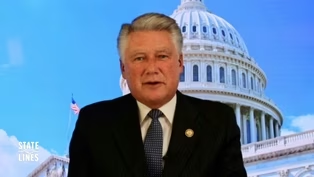
Mark Harris, Republican Candidate for NC’s 8th Congressional District
Video has Closed Captions
An interview with Mark Harris, Republican candidate for NC’s 8th Congressional District (2026). (15m 27s)
Providing Support for PBS.org
Learn Moreabout PBS online sponsorship- We're joined by Dr.
Raymond Smith, Democratic candidate for the new U.S.
District 3 in eastern North Carolina, challenging Greg Murphy, the incumbent Republican representative.
Dr.
Smith, thanks for sitting down for this interview.
- Well, first and foremost, thank you so much for this interview.
This is an opportunity to get before the people in this district, the state of North Carolina, and those individuals who are interested in what's happening in our country.
So thank you.
- And third district now, newly redrawn to help the first district.
Don't get into all of that, but you're covering eastern North Carolina.
You're from Goldsboro, which is Wayne County.
- That is correct.
- And heading eastward, do you get close to Raleigh in any?
- This district, this newly formed district, starts on I-95 in Wilson, and it goes all the way across the eastern part of North Carolina, all the way to Jacksonville, all the way to the coast.
So from I-95 to the coast, there are nine counties, starting in Wilson, Wayne, Green, Pitt, Lenore, Sampson, Duplin, Jones, and Onslow.
So those are the nine counties that now comprise the third congressional district.
- I was not going to stumble you by asking which counties it was, but it's a nice-sized district.
I want to ask you who you are because even though a part of North Carolina would elect you to the House, your votes will change a country.
- Absolutely.
- So who are you?
What's your background?
What makes you ready for U.S.
House?
- Well, first and foremost, I am a son, a native son of North Carolina, eastern North Carolina, born and raised in Goldsboro, North Carolina.
My parents, Thelma Smith, my father, Raymond Smith Sr., United States Marine.
My mother was a lifelong educator, served on the Board of Education for Wayne County Schools.
My dad, after leaving the Marine Corps, went to work for the Civil Service at Seymour Johnson Air Force Base and worked there for 35 years until his retirement.
But I watched my parents both serve the community.
They were both community servants, civil servants, and their whole life was what I have emulated.
They taught me what I am doing now.
This is something -- this is a labor of love.
This is absolutely nothing that I had aspired to be.
It is just who I am because I watched my parents do that their whole lives.
- What's your top issue?
What happened to make you think 2026 is the year you should run for U.S.
House?
- Well, first and foremost, my background, as you well know, my first foray into politics was in 2016 when I ran for the at-large seat on the Wayne County Board of Education.
I am the first African-American to ever win that seat, actually the only to ever win the at-large seat on the Board of Education for Wayne County Schools.
And during the time that I was there, in my second year, I became the vice chairman of the Board of Education for Wayne County Schools.
And upon achieving that goal of becoming vice chair, the opportunity to go into the state legislature presented itself when my predecessor and mentor, Dr.
Larry Bell, decided to retire from the legislature after 18 years of exemplary service serving Wayne and Sampson counties.
And so, that opportunity presented itself.
And so, at that point, I ran for the state legislature.
And in the legislature, I won my first term in 2018, started serving in 2019.
I served in the General Assembly for two terms.
During my first term in the legislature, got to really know what the lay of the land was.
And in my second term, I became a minority whip.
I became a member of the legislative Black Caucus Executive Committee.
So I became a leader in the General Assembly.
And so, that opportunity prepared me for what we are, where we are today.
So how did I get here?
Well, I got here because the legislature decided that it wanted to gerrymander the first congressional district.
The first congressional district, as we knew it, is no longer.
There was an attempt to gerrymander, I believe, Congressman Don Davis, by moving counties like Carteret, Craven, Beaufort, into the first congressional district.
But as you well know, the districts have to be equivalent as far as population is concerned.
So there had to be counties moved out of the first.
And those counties were Wilson, Wayne, Green, and Pitt.
Well, those counties lean Blue, and are Purple, for the most part.
So the removal of the Republican counties out of the eastern part of the state, on the coast, into the first, and the removal of the Blue and Purple counties out, actually went—it actually took the third congressional district from an R-12 down to an R-5.
And so, that's what made this district possible.
So when that was the outcome of the attempted gerrymander, then I received a communication from the DCCC in Washington, D.C., because they knew me.
They knew my record.
They knew that I am known for being a reasonable legislator.
I don't lean far left.
I don't lean far right.
Right there in the middle, for the most part.
And so, for me, it was a great opportunity.
And I said, "Well, sure, I'll give it a try."
- I was gonna ask you about that.
You know, we have Republican candidates on here.
And we have, you know, the Social Conservative, the Libertarian, the Establishment Republican, the MAGA Republican, and now they accuse RINO Republicans.
But Democrats had it easy until the Democratic Socialists have come along.
And some of them are now in the Democratic Party.
Now you have your Liberals, your Moderates, your Traditionals, and Socialists, or however you want.
You just said you fall into the Moderate wing.
Can you prove that to the voters?
What do you make of the changes happening at the federal level, with Republicans and with Democrats, as new ideas come in that may shake the elite establishment, as they say?
- Okay.
Well, you used the term "moderate."
I did not.
I said "middle."
- What's the difference in a middle and a moderate?
- Middle doesn't... There is no definition.
And that's my point.
My vote belongs to the people who put me in office.
My vote does not belong to a particular group.
My vote does not belong to a particular party.
My vote belongs to the people, the constituents that I have in my district, who vote me in the office.
And the proof in the pudding is my record in the legislature.
My record in the legislature stands for itself.
Anybody can look up the votes that I took in the legislature.
There were numerous times where I did not vote along party lines.
And those were votes that I felt very compelled to stand firm, because my district needed me to stand firm.
And for instance, I'll give you the Farm Bill.
The majority of my constituents in the Democratic caucus voted against the Farm Bill.
Well, I live in a district where the number one industry is agriculture.
And under no circumstances can I not stand with my farmers and make sure that their needs are being taken care of.
Everybody in the state of North Carolina does one thing, and that's eat.
And under no circumstances can I stand against my farmers because of a political ideology.
So those are, there are other examples from my time in the legislature where I stood firm because it was the vote that I needed to take for my district.
- As of right now, heading into fall 2026, what are the voters telling you when you go out and shake hands?
What issues bother them?
- The everyday kitchen table issues.
What it costs to live.
What it costs to buy groceries.
What it costs to purchase gas.
What it costs to clothe your children.
What it costs to live on a day-to-day basis.
The number one issue that I am being confronted with is the cost of living.
People are suffering.
People are struggling.
One paycheck is not getting it done anymore.
Salaries are not going up, but cost of living is.
And so, people are struggling.
So that's what I'm met with most places.
- How can federal policy lower prices and still keep a market economy so that the good products rise and the bad products go obsolete?
- Well, first and foremost, the federal government has complete and total control over taxation at the federal level.
We have to take into consideration that these tariffs have been tremendously detrimental to our country.
These tariffs who we were promised were going to be paid by other countries, those tariffs are not being paid by other countries.
Those tariffs are being paid by everyday working people like you and I. Those tariffs are damaging to this country.
Then the tax cuts.
Under no circumstances can a tax cut result in prosperity, because when we have—let's just say, for instance, you have a household income, and there is a cut to your household income.
Either you're going to have to cut your expenses, or you're going to have to find an additional source of income.
And under no circumstances can a tax cut in and of itself result in prosperity, because we've tried it numerous times before.
It does not work that way.
And it's a simple matter of people who are invested in the stock market and people who are wealthy, people who are rich, for lack of a better term, they benefit tremendously from tax cuts, but they don't pass that money along.
They keep that money, and they put it away, and they invest it for their future.
- So you would expect an incoming administration to wipe out the tariffs that Congress never approved?
- Absolutely.
Those tariffs were not approved by Congress, and under no circumstances will I sit there and let them continue.
- I was looking through your platform.
You want to fight corruption.
You call it corruption.
Stock trading among Congress members.
This is corporate money that comes into PACs, the Citizens United ruling that opened up some fundraising.
So take me through that, because if you become a Congress member and you can trade stocks and make a killing, it's going to be—I would imagine it would be seductive.
- Well, it's seductive to people who are susceptible to seduction.
I don't smoke, and I don't drink coffee.
And those are things that, in my humble opinion, are habits that, once one develops, that that person can probably be subject to that habit.
So for me, I'm not in the habit of taking money from people.
I'm not in the habit of being bought or sold.
I'm not in the habit of letting people own me.
I've turned down money from Duke Energy left and right, because I refused to be a part of a decision that is already made before I'm presented with the evidence.
- Every candidate's running on health care to some degree, maybe with a different philosophy.
You've got it as part of your platform.
You call it accessible health care.
Make it accessible.
- Health care right now is accessible when you have the Affordable Care Act that's fully funded, the Affordable Care Act that is fully implemented, and whatever challenges there are in the Affordable Care Act, we can work on those challenges.
I recall vividly, when I was in the legislature during my freshman year, my then colleague, Congressman Greg Murphy, who I'm challenging this upcoming November, approached me and others in the legislature about a bill called Carolina CARES.
And it was a Medicaid expansion bill.
That bill, we thought, was quite an opportunity.
However, it had one caveat.
It had a work requirement that was attached to the bill.
And of course, initially, my caucus was against the work requirement, because we were thinking about people with disabilities, people with—older people, people who just did not have the ability to do a 9-to-5, and everybody cannot, you know, get a job.
You know, we've never had zero unemployment.
So, those are some of the challenges.
However, we went into caucus, and we talked about it, and we said, "You know what?
We need Medicaid expansion.
And if a work requirement is what we've got to do, then we will do just that."
So once we agreed to the work requirement, immediately the bill was pulled and was not implemented.
And it became pretty obvious that that was an attempt by the other side to put the Democrats on record as voting against Medicaid expansion, and it was never a genuine attempt at Medicaid expansion.
- You are a doctor, an EDD, an educational doctor.
- Yes.
- And you said you wanted—the federal government should have a role in stronger public schools.
I mean, I know you elect school boards in North Carolina, and a lot of state funding goes to the schools.
What is the federal government's role there, without meddling in localism?
- Well, the Department of Education at the national level has a tremendous responsibility as it comes to education.
And the reduction in funding for the Department of Education and the dismantling of the Department of Education has been detrimental to the country, not just the state, but to the country.
And then that trickles down to the decisions that have been made by the state legislature.
I fought vehemently when I was in the legislature for the Leandro bill.
I fought—I wrote numerous bills in support of Leandro to fully fund education here in the state of North Carolina.
It's documented that we're not providing a fundamental education for all here in the state of North Carolina.
So—and, of course, the vouchers in and of themselves are detrimental.
I am not against school choice.
Don't ever say that Raymond Smith is against school choice.
I am a proponent of school choice.
However, when it comes to using state tax dollars to fund private education, that is not my idea of school choice.
That—and so—and one of the caveats—well, not caveats, one of the really detrimental parts of that is, once that money leaves the public schools and goes to the private school, once that student returns back to public school, if they—if he or she chooses to do so, the money does not return with the child.
The money is kept by the private school.
So again, that process in and of itself has flaws that has to be worked out.
- And you being a combat veteran of Iraq, you have the VA.
Not every candidate pushes for the VA or protecting it.
You like the way the VA works and you want to protect how it's working or—at the last minute we have left, what would you do with veterans' medical care?
Because I know a lot of veterans enjoy it.
- Veterans' medical care has a good foundation, but it has a lot left to be desired.
I am in the veterans' medical system as a veteran.
And one of the things that stands out to me is the fact that we don't have VA clinics in close proximity to a lot of veterans.
A lot of veterans, as they get older, they're not able to access the major hospitals in Fayetteville and Durham.
So we need to expand the local clinics for veterans and make sure that they are taken care of.
- Very quickly, your website, how do we find you if we want to look you up on the Internet?
- I am at RaymondSmithForNC.com.
- Dr.
Smith, thank you so much.
Third U.S.
Congressional District Democratic candidate.
Thank you, sir.
- Thank you.
♪
 New Episode
- News and Public Affairs

Top journalists deliver compelling original analysis of the hour's headlines.
 New Episode
- News and Public Affairs

Today's top journalists discuss Washington's current political events and public affairs.
 New Episode
 New Episode
 New Episode
 New Episode
 New Episode



 New Episode

Support for PBS provided by:
State Lines is a local public television program presented by PBS NC