
Richard Ojeda, Democratic Candidate for NC’s 9th Congressional District
Special | 15m 5sVideo has Closed Captions
An interview with Richard Ojeda, Democratic candidate for NC’s 9th Congressional District (2026).
Richard Ojeda, Democratic candidate for NC’s 9th Congressional District, discusses his 2026 campaign with PBS NC’s Kelly McCullen. This interview was recorded on August 11, 2026.
Problems playing video? | Closed Captioning Feedback
Problems playing video? | Closed Captioning Feedback
State Lines is a local public television program presented by PBS NC
Richard Ojeda, Democratic Candidate for NC’s 9th Congressional District
Special | 15m 5sVideo has Closed Captions
Richard Ojeda, Democratic candidate for NC’s 9th Congressional District, discusses his 2026 campaign with PBS NC’s Kelly McCullen. This interview was recorded on August 11, 2026.
Problems playing video? | Closed Captioning Feedback
Where to Watch State Lines
State Lines is available to stream on pbs.org and the PBS app.
Providing Support for PBS.org
Learn Moreabout PBS online sponsorshipMore from This Collection
During major election cycles, PBS North Carolina's public affairs team sits down for in-depth conversations with candidates running for elected office in North Carolina. PBS North Carolina has invited major party candidates to a one-on-one interview with State Lines host and executive producer Kelly McCullen. Interviews are scheduled throughout the summer and early fall.
NC Judicial Candidates Forum: NC Court of Appeals Judge Seats 2 & 3
Video has Closed Captions
Meet candidates for the NC Court of Appeals Judge Seats 2 and 3. (26m 46s)
Candidates for NC Court of Appeals Judge Seat 3: Craig Collins (R) & Christine Marie Walczyk (D)
Video has Closed Captions
Meet the Republican and Democratic candidates for the NC Court of Appeals Judge Seat 3. (13m 7s)
Candidate for NC Court of Appeals Judge Seat 2: Tobias Hampson (D)
Video has Closed Captions
Meet the Democratic candidate for the NC Court of Appeals Judge Seat 2. (12m 57s)
Candidates for NC Supreme Court Associate Justice Seat 1: Anita Earls (D) & Sarah Stevens (R)
Video has Closed Captions
Meet the Democratic and Republican candidates for the NC Supreme Court Associate Justice Seat 1. (12m 38s)
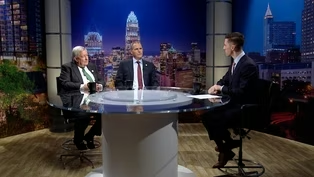
Candidates for NC Court of Appeals Judge Seat 1: John Arrowood (D) & Michael Byrne (R)
Video has Closed Captions
Meet the Democratic and Republican candidates for the NC Court of Appeals Judge Seat 1. (11m 54s)
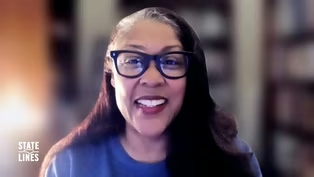
Kimberly Hardy, Democratic Candidate for NC’s 7th Congressional District
Video has Closed Captions
An interview with Kimberly Hardy, Democratic candidate for NC’s 7th Congressional District (2026). (14m 16s)
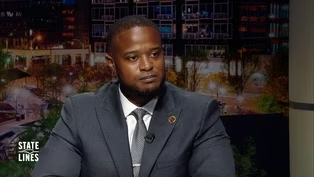
Cyril Jefferson, Democratic Candidate for NC’s 6th Congressional District
Video has Closed Captions
An interview with Cyril Jefferson, Democratic candidate for NC’s 6th Congressional District (2026). (13m 42s)
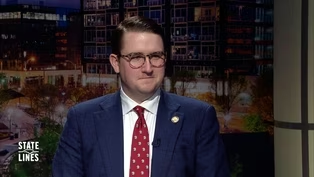
Addison McDowell, Republican Candidate for NC’s 6th Congressional District
Video has Closed Captions
An interview with Addison McDowell, Republican candidate for NC’s 6th Congressional District (2026). (14m 11s)
Jamie Ager, Democratic Candidate for NC’s 11th Congressional District
Video has Closed Captions
An interview with Jamie Ager, Democratic candidate for NC’s 11th Congressional District (2026). (14m)
Alma Adams, Democratic Candidate for NC’s 12th Congressional District
Video has Closed Captions
An interview with Alma Adams, Democratic candidate for NC’s 12th Congressional District (2026). (15m 19s)
Tim Moore, Republican Candidate for NC’s 14th Congressional District
Video has Closed Captions
An interview with Tim Moore, Republican candidate for NC’s 14th Congressional District (2026). (14m 46s)
Mark Harris, Republican Candidate for NC’s 8th Congressional District
Video has Closed Captions
An interview with Mark Harris, Republican candidate for NC’s 8th Congressional District (2026). (15m 27s)
Providing Support for PBS.org
Learn Moreabout PBS online sponsorship- Major retired Richard Ojeda is the Democratic candidate in the 9th US Congressional District where he is challenging incumbent Republican Representative Richard Hudson.
Major Ojeda, welcome to the interview.
It's great to meet you and put the face behind the name.
- Well, thank you very much for giving me the opportunity to be on the PBS show.
You know, we are, we're going non-stop, we're working around the clock, we're doing everything that I believe needs to be done to be able to flip this seat from red to blue.
- Tell us about yourself, what's your background, and at a very high level, what leads you through the political world and then you end up running for US House in that 9th District?
- So, I spent 24 years in service to the United States military.
Most of that time was spent actually in North Carolina at Fort Bragg.
I tell people my child, my daughter Kayla, was one of the last children born in the old Army Womack Medical Center.
You know, I loved North Carolina.
I loved being stationed at Fort Bragg, but when we retired, we decided we were going to return home and be with our aging parents and we did that.
And while I was there, I ran a nonprofit.
I ended up starting to teach at the high school level, JROTC, and then I become a legislator and I was able to get things done in a super minority because I do know how to push legislation and get people to back my bill.
But after a while, my wife and I made the decision that we missed home and that was North Carolina.
So, we made the decision that we were going to move back here and we brought my entire family with me.
My parents are with us.
My in-laws are with us.
My siblings are now moving down to this area here.
My children are in North Carolina with us.
So, you know, we love it here and I want you to know that when I first got here, I had no desire to get back into politics.
I was pretty much done with it, but I started seeing some of the issues that were out there, the attacks on the Veterans Administration, and I started doing some research about who is my representation.
And I found that my representation doesn't show up and that bothered me.
And I made the decision then that I was going to throw my hat in the ring and I was going to run for Congress.
- What is that top issue for you?
Is it veterans or is there something else that really pushed you over the top to say, "I'm going to challenge Richard Hudson"?
- Well, you know, it starts with veterans.
You know, here's a guy who calls himself the Veterans Representative and says, "I'm Fort Bragg's member of Congress," but he's not doing anything for our veterans.
Our veterans and our health care is under attack and that is absolutely 100% spot-on truth.
And he's basically just sitting idle on this and I don't think that's right.
But it's not just the VA.
It's not just veterans.
This has to do with affordability.
This has to do with corruption in Washington, D.C.
You know, this has to do with our seniors, how we absolutely need to protect these people so that they can grow old in dignity.
And what we are watching right now is attacks from everywhere and the only people in this country that feel like they're able to keep their nose above the waterline are the filthy rich.
The rest of us are just expected to just drown in this and it's unacceptable.
We need people in Washington, D.C.
to fight for the working class.
- You just explained why you had the reasons you were running, but what are voters telling you as you go out there and shake hands across that district?
What's on their minds?
VA for you, certainly VA for many of them, but what else?
- It's their farms.
It's being able to maintain their farms.
You know, worried about these data centers coming.
We're talking about grocery prices.
I mean, the price of gas.
People cannot afford this and this is all happening in a time when our government that right now is being ran by a bunch of buffoons are attacking things like SNAP benefits and welfare and things that, you know, the people at the bottom desperately need.
I mean, we need to have some fighters for the people because we're not seeing that.
- Let me ask you about some of the federal benefits.
Were COVID benefits passed during a historic time in this country, unseen since the pandemic of what, 1918?
And they supposedly were always going to be temporary benefits.
Did you see that once they were expanded, it becomes a national need to keep it at those levels?
Or do you see it as a true cut that they've gone back to what pre COVID funding might have been?
- I don't really have, I'm not going to sit here and spew word salad on that question there, you know, but I just, I know that people are struggling.
See, I'm going throughout this district.
I'm putting boots on the ground everywhere and everybody that I'm talking to, it's an affordability issue.
It's an issue in reference to their farms and their water.
It's data centers that are, that are, that are potentially getting ready to pop up.
You know, people are worried about this.
People are worried, you know, that they, you know, they're not getting raises, but the prices of everything is on the rise.
And, you know, we've got parents right now that are sitting at their kitchen table at night and they're, they're, they're, they're, you know, asking each other, which bill do we pay this month and which bill do we pass off to next month?
You know, you got people that are standing in the grocery stores and they're doing math in their head because they're scared that when they get up to the cashier, they're going to have to put things back because the price went up.
You know, that's what's going on right now in this country.
And we need people that are willing to go and fight to try to, to try to help and solve these issues.
And I don't have the answer to all the questions, but the one thing that I can promise you is that I will surround myself with the right people to make sure that every single thing that I say has been researched and is the absolute stance that we believe in wholeheartedly.
- Is there any topic you as a Congress member, if you go up there and majorities change, is there one thing the federal government can do or budget writers can do that would bring affordability more aligned with people's paychecks, as you're saying?
Because if everything is high price, how can, can anything get it down across the board?
- I mean, at the end of the day, I think that, you know, that's absolutely something that we have, we have to, to figure this out.
We've got to figure out how we can reduce the prices of things.
And, and that's what I'm committed to do.
You know, when, when people can't afford food, what, what, what, what, what are they going to do?
You know, when, when we attack the people at the very bottom, it's time for us to actually do something for the people.
Let's tax the wealthy.
Let's, let's remove the cap on social security so that social security will be here for us forever for our children.
You know, these are the things that we need to be doing to make sure that we prepare for the next generation.
You know, we should be doing everything in our power.
We should allow Medicare to negotiate drug prices.
Right now.
You've got elderly people that can't put food on the table.
And when they're choosing between food and medicine, it's not a winning situation there.
You know, we can do those things.
We can, we can end the corruption in Washington, DC.
You know, these people they're, they're, they're playing stocks and they should not be allowed to play stocks.
You know, we, we've got to stop this corruption that has taken place.
I am dealing with things.
I look at things in buckets.
My first bucket is affordability.
And one of the things that I really, really want to do to basically help that is I want to make the first $45,000 that everybody in this country makes to be tax free.
Now you may make more money than that.
And you may think that's not a big deal, but ask a teacher, ask a firefighter, ask a police officer, ask a school service personnel.
What would happen if we made the first $45,000 tax free, it would be life changing for these people.
We need to raise the minimum wage.
We need to maybe even tie minimum wage to the cost of living.
So if the prices of groceries go up, well, guess what?
The price of the minimum wage has to go up.
We need to support unions because unions also fight for better wages for their people.
We are living in a world right now where a CEO is making 300 to 3000 times more than the highest paid worker that they have.
We, we need unions, we need to support unions because unions not just fight for safety on the job.
They also fight for better pay and opportunities for their people.
So these are the things that we must do.
Once again, we know that for seniors, it's protecting social security.
It's making sure that we can allow Medicare to deal with the prices.
Because my mother, my mother has one medicine that costs almost $1,000 a month.
Now my mother lives with me and I take care of my mother, but she only gets about $850 a month on her social security.
So she would not even be able to afford the one pill in the medicine she takes.
So we've got to fix this.
- A couple of things on part of your platform, you do address rural hospitals.
How do you keep them alive?
- Well, we must not kill Medicare and Medicaid because you got to understand that those rural hospitals rely on those reimbursements.
So if they go in there and they gut those programs, that rural hospital is no longer going to get that money.
When a person is poor and they don't have adequate health care, the one place that they can go is the emergency room.
But the taxpayers end up paying for that bill.
If they kill those capabilities, rural hospitals, they're going to have to close.
They're all for profit hospitals.
That's that's the way that it is.
But if we don't allow that to happen, they're going to go under and when they go under, get ready because the home, the county that you live in will probably become a ghost town pretty soon because people that must be close to health care will have to leave and move closer to health care.
- Why is nobody talking about social security?
They're saying that it may not be the next two year term of a U. S. Congress member, but certainly within the two year term of the next U. S. President, we could, we will see social security exhaust that trust fund, they said exists.
You take me through a simple process for keeping it around for for people like us.
- Thank you so much for asking that question.
First off, there's a cap right now and you have to pay into social security to a certain level.
Let's say it's $126,000, I believe.
if we remove that, first of all, we raised that cap to 250,000 social security would be here for another 30, 45 years.
But if we remove that cap and everybody had to pay into social security with every dollar that they made, and I'm talking about the filthy rich too, it would create a $300 billion surplus every year.
So social security would be here for all of us.
I've paid into this my entire adult life.
I don't want somebody telling me that in 2032 it's going to close.
Are you going to give me the money that I've paid into this program?
I mean, we must do what we can to keep this program alive.
This is a promise that our government made to the elderly, and it is something that we must continue because people desperately need this.
There's also something that we could do in this country is we could provide a 5% wealth tax on everything over a billion dollars.
That right there alone would create $4.5 trillion every 10 years.
Now we're $40 trillion in debt, but imagine if we had $4.5 trillion dollars and we used it for the people, not giving it to the rich, not finding ways that we can create more tax breaks for the people that already have more money than they could spend in 1000 lifetimes.
Look, the working class citizen in the United States of America has carried this country on our backs ever since Ronald Reagan said trickle down economics and nothing ever trickled down.
They just got bigger plates to catch it all.
Look, it's time for us to hold the billionaires accountable and the multimillionaires.
They can afford to pay their fair share.
It's time for that to happen.
We've got to start looking at the working class people.
We've got to elevate people's lives.
People like teachers, firefighters, police officers, first responders, you know, school service personnel.
These are people that we absolutely need in this country and it's time for us to start putting them first.
- We have a couple of minutes left.
Social Security, you have a plan now.
You say accessible health care for all.
Now there's some candidates are out there in other states running on Medicare for all.
I've had candidates come interview me in North Carolina going, let's improve the Affordable Care Act or Obamacare.
What needs to happen holistically with the U.S.
health care market?
Is it through Affordable Care Act improvements or do you want Medicare for all or some other universal health care?
- I mean, at the end of the day, you know, I'm willing to listen to everything, but I want I want affordable health care.
I want to make sure everybody in this country has coverage and they can afford it.
You know, this is the thing, too, is that we've got a lot of people in Washington, D.C.
to include my opponent who takes an awful lot of money from Big Pharma.
Two hundred seventy five thousand dollars is what we've already seen that he's taken from Big Pharma and he votes for them.
The same thing with the insurance industry.
He votes for them.
The truth is, is we need somebody that's actually fighting for the people, because once again, my opponent is the one who voted to not expand Medicare across this or Medicaid in North Carolina.
So that right there is unacceptable.
He also voted to not cap insulin at thirty five dollars cap.
I mean, come on, really?
Is that the path that we're going to go?
And he he doesn't think that Medicare should be able to negotiate drug prices.
You know, you can tell that he's taking money from Big Pharma and Big Insurance because he votes exactly the way they want him to vote.
And I want to go to Washington, D.C.
and I want to fight for the people.
- One minute left.
If people want to know more, those in your district and the ones outside this district would like to know Richard Ojeda.
How do we find you online?
- So you can go to OjedaForNC.com Check me out.
I do lives every night at eight thirty on Facebook and YouTube.
Look, I am doing everything in my power.
We're doing everything right.
We are running against a person that really is the one who told everybody no town halls.
Look, I want to do town halls.
I want to meet with the people.
And when I win this, I'm going to show up and put boots on the ground, even if it is to receive scorn for something somebody doesn't like the way that I voted or something like that.
But it's important that we finally have people in Washington, D.C.
that will be accountable to the people.
And that is what I will do.
- Retired Major Richard Ojeda, Democratic candidate in the ninth U.S.
congressional district, challenging incumbent Republican Representative Richard Hudson.
Major Ojeda be safe on the campaign trail.
Good luck.
Thank you for this interview.
- Airborne.
Thank you very much.
♪
 New Episode
- News and Public Affairs

Top journalists deliver compelling original analysis of the hour's headlines.
 New Episode
- News and Public Affairs

FRONTLINE is investigative journalism that questions, explains and changes our world.

 New Episode
 New Episode
 New Episode
 New Episode
 New Episode
 New Episode


 New Episode
Support for PBS provided by:
State Lines is a local public television program presented by PBS NC