
Valerie Foushee, Democratic Candidate for NC’s 4th Congressional District
Special | 14m 2sVideo has Closed Captions
An interview with Valerie Foushee, Democratic candidate for NC’s 4th Congressional District (2026).
Valerie Foushee, Democratic candidate for NC’s 4th Congressional District, discusses her 2026 campaign with PBS NC’s Kelly McCullen. This interview was recorded on August 13, 2026.
Problems playing video? | Closed Captioning Feedback
Problems playing video? | Closed Captioning Feedback
State Lines is a local public television program presented by PBS NC
Valerie Foushee, Democratic Candidate for NC’s 4th Congressional District
Special | 14m 2sVideo has Closed Captions
Valerie Foushee, Democratic candidate for NC’s 4th Congressional District, discusses her 2026 campaign with PBS NC’s Kelly McCullen. This interview was recorded on August 13, 2026.
Problems playing video? | Closed Captioning Feedback
Where to Watch State Lines
State Lines is available to stream on pbs.org and the PBS app.
Providing Support for PBS.org
Learn Moreabout PBS online sponsorshipMore from This Collection
During major election cycles, PBS North Carolina's public affairs team sits down for in-depth conversations with candidates running for elected office in North Carolina. PBS North Carolina has invited major party candidates to a one-on-one interview with State Lines host and executive producer Kelly McCullen. Interviews are scheduled throughout the summer and early fall.
 New
NewCandidates for NC Supreme Court Associate Justice Seat 1: Anita Earls (D) & Sarah Stevens (R)
Video has Closed Captions
Meet the Democratic and Republican candidates for the NC Supreme Court Associate Justice Seat 1. (12m 38s)
 New
NewCandidates for NC Court of Appeals Judge Seat 1: John Arrowood (D) & Michael Byrne (R)
Video has Closed Captions
Meet the Democratic and Republican candidates for the NC Court of Appeals Judge Seat 1. (11m 54s)
Kimberly Hardy, Democratic Candidate for NC’s 7th Congressional District
Video has Closed Captions
An interview with Kimberly Hardy, Democratic candidate for NC’s 7th Congressional District (2026). (14m 16s)
Cyril Jefferson, Democratic Candidate for NC’s 6th Congressional District
Video has Closed Captions
An interview with Cyril Jefferson, Democratic candidate for NC’s 6th Congressional District (2026). (13m 42s)
Addison McDowell, Republican Candidate for NC’s 6th Congressional District
Video has Closed Captions
An interview with Addison McDowell, Republican candidate for NC’s 6th Congressional District (2026). (14m 11s)
Jamie Ager, Democratic Candidate for NC’s 11th Congressional District
Video has Closed Captions
An interview with Jamie Ager, Democratic candidate for NC’s 11th Congressional District (2026). (14m)
Alma Adams, Democratic Candidate for NC’s 12th Congressional District
Video has Closed Captions
An interview with Alma Adams, Democratic candidate for NC’s 12th Congressional District (2026). (15m 19s)
Tim Moore, Republican Candidate for NC’s 14th Congressional District
Video has Closed Captions
An interview with Tim Moore, Republican candidate for NC’s 14th Congressional District (2026). (14m 46s)
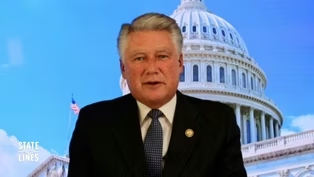
Mark Harris, Republican Candidate for NC’s 8th Congressional District
Video has Closed Captions
An interview with Mark Harris, Republican candidate for NC’s 8th Congressional District (2026). (15m 27s)
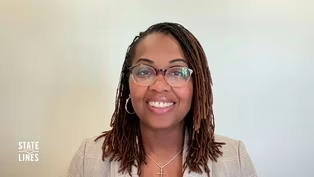
Lakesha Womack, Democratic Candidate for NC’s 14th Congressional District
Video has Closed Captions
An interview with Lakesha Womack, Democratic candidate for NC’s 14th Congressional District (2026). (14m 56s)
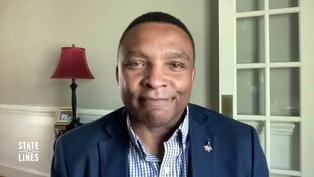
Don Davis, Democratic Candidate for NC’s 1st Congressional District
Video has Closed Captions
An interview with Don Davis, Democratic Candidate for NC’s 1st Congressional District (2026). (14m 22s)
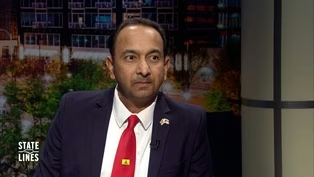
Mahesh Ganorkar, Republican Candidate for NC’s 4th Congressional District
Video has Closed Captions
An interview with Mahesh Ganorkar, Republican Candidate for NC’s 4th Congressional District (2026). (14m 55s)
Providing Support for PBS.org
Learn Moreabout PBS online sponsorship- We're joined by incumbent Democratic U.S.
Representative Valerie Foushee from the fourth U.S.
Congressional District, which is Durham County up on Chapel Hill.
Where exactly are you covering when you run for office?
- So the fourth district is comprised of all of Orange, all of Durham, parts of Wake, and parts of Chatham Counties.
- You've represented now two terms.
What's prepared you from local service, because you were in Orange County for years and a state, state senator?
What about all that service has prepared you to serve and not only serve in the House, but win re-election and are poised to win re-election again?
- Well, thank you.
Certainly my experience having served at every level of government has prepared me for serving in Congress, but particularly I served 10 years in the North Carolina General Assembly in both the House and the Senate.
And so all of those years were served in the minority.
And so coming to Congress and being a part of the minority, I have experience with how to have the relationships that make you successful in passing legislation that's meaningful for the district.
- What are some secrets to that?
Operating from the minority party position, still bring home things for your district, get policies influenced.
- It is absolutely necessary that you establish relationships with people on a personal level.
Having a conversation just as we are, sitting across from each other, we find that we have more in common than we do that's different about us.
I think every elected official wants to do what's best for his or her constituency.
I think we all want to make sure that our children have access to good education.
We want everybody to have access to good health care.
We want people to have good housing.
We want people to have good jobs.
How we get to those, get through to those goals may be different, but I think on a personal level, we want the same things.
It's just about how we think we should arrive at a conclusion.
- What is the practical tone in Washington, D.C.
from inside of Congress?
Because I watch the news almost every night and I see, you know, the talking heads and the legislators are barbing each other, sometimes being disrespectful on air.
But what is it?
Is it like that in person or is there something else in D.C.
going on operationally that allows progress to be made, if slowly?
- What I will say to you is that on a personal level, that is not what I see mostly.
What you see that is captured by media are those points that tend to be more salacious.
But I would say to you that we do have conversations that are not just personal, but they are conversations that are meaningful.
I think that we have, in this country, we are so hyper-partisan that we don't want people to see us getting along and I would submit to you that the American public would like to see us get along, discuss what they believe the issues to be, and then to find solutions for those issues and not be at each other's throats.
If I say yes, you're going to say no.
If I say right, you're going to say left, even though we know what the real deal is.
- Well, in two terms, what are you most proud of accomplishing in D.C.?
- I am most proud of being able to get a bill passed in the House.
One of the few Democrats that has gotten a bill passed twice.
My impact bill that provides support for technology to work to reduce carbon emissions is a bipartisan bill that has passed the House twice.
It has not been taken up by the Senate, but it lets me know that it is possible to find bipartisan solutions and to be able to have a relationship with a Republican or some Republicans that is about accomplishing something for the American people.
So what that says to me is that it's always possible.
We just have to get in and do the work.
- What's been elusive for you?
What's frustrated you?
Where does work continue?
- Well, one thing is getting that bill passed.
But, um... - Well, you're not a senator yet.
- But the thing is that what we have not been able to do is to come together on many pieces of legislation and get it done.
I'm proud that we were able to get a housing bill done, even though the president did not sign it.
It was a bipartisan bill, a bicameral bill, where we understand that people are in need of housing.
And this is a step forward.
Again, that's a signal to the American public that when we take seriously what our roles are as it relates to what the needs are, that we can get it done.
And so I'm looking for more opportunities such as that.
- Well, you're home during this time period.
What are voters and folks telling you when they see you out in public and you ask them what's bothering you?
- What they tell me is that America is too expensive, that we do indeed have an affordability problem from housing to health care, from groceries to gas.
It's costing too much for Americans to be able to have the quality of life that they should have.
And so people want us to bring solutions to bringing down the cost of everyday living.
- Well, you're the representative.
Do you have a solution for inflation?
You know, we stimulated the economy during COVID and you know, you've got one side of the economic theory team that says you print more, you spend more.
It does drive the price up, but it does stabilize the economy.
What needs to be done in 2027 and beyond to bring prices down?
Is it a spending problem or is there something else with the economy that's flawed?
- First, we need to get out of a reckless war that was not approved by Congress.
Because what we know is that the price of gas has risen because of this conflict.
And as long as the price of gas stays high, everything else is.
Transporting goods and services are going to cost more.
And as long as it's costing more for us to purchase groceries, as long as it's costing more for gas, as long as our utility bills are remaining high, then we're going to see what we're seeing now.
We have to start at the beginning.
The beginning is ending our participation in the war in Iran.
- Should America pull out of that conflict and that tension, just pull out and end it right there?
Or are we stuck in a conflict with Iran heading into the next congressional session after Election Day?
- My fear is that we will not have pulled out by Election Day, but certainly we should be moving to withdraw any of our presence there.
This is not something that the American people want.
It is very unpopular and it is costing the quality of life for Americans, and it's not helping others around the world.
- I did know that you ran in a very competitive Democratic primary, one of the few incumbent congressional races where you had to face off from someone who come at you when what everyone said was your political left.
And it was over Israel.
What do we do with Israel in the Democratic Party?
And then how does that affect how you will lead going forward?
Because it's not just your district, it's U.S.
Senate races now are being influenced by it.
- That's a tough question.
What I would say to you is that what we are hearing, what we're seeing, is that there is not a meeting of the minds between our president and the prime minister.
For America, Israel has been a partner.
Israel has been an ally.
I believe that Israel has the right to defend itself.
I do not believe that what is happening is Israel defending Israel.
And I think that our connection with what is going on should be such that we are not using taxpayer dollars to continue a conflict that seems to have no end.
- Can you support what's happening and what has happened in Gaza and future policies?
- I do not support what is happening in Gaza.
- And support Israel at the same time?
Or is that really an either/or discussion that voters are going to ask anyone?
Take a stand.
- Oh, yeah.
What I believe in and what I've always believed in is a two-state solution.
But players on both ends have to believe in that.
And I don't see that what we're seeing from Netanyahu is a desire to accomplish a two-state solution.
I believe that as it relates to having a partner or an ally that opposes a democracy, has benefited America.
I do not believe that what is going on in Gaza or the West Bank is something that America should support.
- Let's pivot back to home, too, with another issue, health care.
I cover a lot of state politics and there are some increased Medicaid accountability measures coming in from the one big beautiful bill county government's facing.
- Can we just call it H.R.1 and not the one big beautiful bill?
- Call it whatever you want.
H.R.1 was the number on it.
What do we do with health care?
Some candidates are running, even Democrats, some say it's Medicare for all.
Some say health care accessibility.
Those are different terms.
What needs to happen?
- I am a proponent of Medicare for all and I will continue to advocate for that such that we are providing access to health care to as many Americans as possible.
What we know is that if we keep people healthy, then the costs for health care will fall and not continue to work.
We have a broken health care system.
One way to start patching that up is Medicare for all.
- How close is this country to having a universal health care solution?
Because even now Republicans in this state supported expanded Medicaid where they could have let the cuts come.
They didn't.
They funded it.
Is the public inching closer toward that?
- I believe the public is inching closer towards that and I think that what will what will require, what is required for us getting there is a Democratic majority in the next Congress.
- What do you expect this country to go through in 2027 and 28 as we head towards the next presidential campaign and another run for U.S.
House possibly?
- So what I do believe is that we need to work to make sure that we are protecting our democracy.
And that starts with protecting the right to vote.
I think that we're at a point where we have to make sure that our government is of the people, for the people, and by the people.
The best way to do that is to ensure that every eligible citizen has that right and has access to the ballot box.
I think as long as we are protecting democracy and the American citizens believe that they have a stake in it, that they are informing and influencing it, then that's how we begin to move forward and get out of what we have seen over the last 18 to 20 months, where it's been clear that there is an effort to suppress the right to vote in this country.
That moving forward, we have to find a way to eliminate gerrymandering and give the power of the ballot box back to the people, where they are choosing their representatives rather than elected officials choosing who gets to vote for them.
- Last question is always, how do folks learn more about you?
Because the 4th District, that little swath of North Carolina, will elect or choose your fate as the incumbent, but your decisions will affect Americans.
And this will be viewed by people outside of North Carolina.
If they want to learn more, how?
- Well, you can go to my website, which is ValerieFoushee.com or you can go to my federal website.
Just type in Representative Valerie Foushee.
It'll get you right there.
- Lots of articles about you, the price you pay for being a U.S.
Congress member.
Representative Valerie Foushee, you are the incumbent Democratic candidate for the 4th U.S.
Congressional District seeking re-election.
It has been a pleasure to have you here in our studio.
- Likewise, Kelly.
Thank you so much.
♪
 New Episode
- News and Public Affairs

Top journalists deliver compelling original analysis of the hour's headlines.

- News and Public Affairs

Today's top journalists discuss Washington's current political events and public affairs.
 New Season
 New Episode

 New Episode

 New Episode

 New Episode
Support for PBS provided by:
State Lines is a local public television program presented by PBS NC