MARKED! - The Series
A Ghost Town With A Story
Clip | 13m 38sVideo has Closed Captions
The trials, tribulations and resilience of one of Georgia's earliest settlements.
One of Georgia's earliest settlements, Ebenezer-now a ghost town-once was a thriving community during the Revolution and also spent three years under British occupation. It is home to one of America's oldest lutheran churches, is the oldest standing church in Georgia and was once filled with congregants whose religious pilgrimage from Europe was among the earliest examples of the American Dream.
Problems playing video? | Closed Captioning Feedback
Problems playing video? | Closed Captioning Feedback
MARKED! - The Series is a local public television program presented by GPB
MARKED! - The Series
A Ghost Town With A Story
Clip | 13m 38sVideo has Closed Captions
One of Georgia's earliest settlements, Ebenezer-now a ghost town-once was a thriving community during the Revolution and also spent three years under British occupation. It is home to one of America's oldest lutheran churches, is the oldest standing church in Georgia and was once filled with congregants whose religious pilgrimage from Europe was among the earliest examples of the American Dream.
Problems playing video? | Closed Captioning Feedback
Where to Watch MARKED! - The Series
MARKED! - The Series is available to stream on pbs.org and the PBS app.
Providing Support for PBS.org
Learn Moreabout PBS online sponsorship- It's one of Georgia's earliest settlements and home to a church that more than two centuries later, still opens its doors on Sundays.
And for the briefest of moments, it was even Georgia State Capitol, kind of.
This is Marked!, a series that zooms in on Georgia and it's backstory one historical marker at a time.
I'm Maiya May, and I'm here at Georgia Historical Marker 051 - 12 to tell you the story of a settlement, a church and the folks who once called this place home.
Coastal Georgia is one of our state's richest areas.
Tourism, agriculture, and manufacturing all play a big part here.
Throw in the port of Savannah and it's fair to say that the bottom right corner of Georgia's map is thriving.
But in order to thrive, you have to start somewhere.
And part of Georgia's origin story begins right here.
It's a ghost town now, but it was once a place called Ebenezer.
And if you're asking someone about the story of Ebenezer, there's one person to start with.
Patsy Zeigler.
Patsy's roots here at Ebenezer are deep.
So deep, in fact, her lineage traces back not just here to Ebenezer, but all the way to Europe.
And my ancestors were the settlers that came to this area from Salzburg, Austria.
They were forced out of their country in 1733 because of their religious beliefs.
Archbishop Fermin wanted everyone to be Catholic.
But the Salzburgers wanted to follow Martin Luther's teachings and be Lutheran.
Archbishop Fermin gave them the ultimatum, my religion or leave.
He gave them eight days to leave.
If they owned property, he gave them three months.
20,000 Salzburgers left their homeland because of their religious beliefs.
And so it wasn't 20,000 Salzburgers that came to Georgia, right?
Right.
Most of them went to East Prussia, a few went to Holland.
But in England, the King makes a special request or special offer for the folks in Salzburg.
And the king has exactly the idea where he thinks these Salzburgers should go.
And that's the brand new colony over across the Atlantic Ocean.
The new colony of Georgia.
The Salzburgers are led by a pastor Johann Boltzius.
He takes up King George on his offer.
They board a ship.
They first stop in Rotterdam, but they head across the ocean to the new colony of Georgia.
Everybody on that ship knows it's gonna be a dangerous voyage.
The Pastor Johann Boltzius, he says, we are going into danger, but closer to God.
Getting the invitation is one thing, but actually getting here nearly 5,000 miles in a whole ocean away and setting up shop, well that's a whole different thing entirely.
And they first arrived in 1734, and this is nearly 40 years before the start of the American Revolution.
And it's actually about five miles up the road that they start building the first version of Ebenezer.
The first attempt to settle Ebenezer does not go well at all.
The area is prone to flooding.
The land that they're on is not conducive to growing food and having food is essential.
So this is not going to go well.
This is just the beginning of their problems because we've got disease coming up, and within the first years of this colony, about half the people die.
They are trying hard for two years, but there's not a lot of redeeming qualities about it.
And at this time, Georgia is being led by a British general, James Oglethorpe.
James Oglethorpe is the name in early Georgia.
He's also the namesake of Oglethorpe University.
King George back in England has tapped James Oglethorpe to be the guy to run things here in Georgia.
And it's pretty clear after two years that things aren't gonna work in Ebenezer.
So the Salzburgers go to Oglethorpe for some help.
And they say, Hey, look, we need a better place to live.
We can't stay in this place.
And Oglethorpe is receptive.
And he says, okay, I'll move you.
And that's how they wind up here in New Ebenezer.
About five miles from the original.
New land and a fresh start.
They moved here in 1736.
Pastor Boltzius realized there were many widows and children.
So one of the first buildings that they built was the first orphanage.
George Whitefield brought the first bell.
And you're actually about to ring them right now.
Yes.
Oh gosh.
We ring them every Sunday morning, okay, before the worship service at 11 o'clock, because bells were very important.
Why?
Because if you had meetings, they would ring the bells.
Oh yeah, yeah.
If you had an emergency, We get in contact and notify each other by texting.
And their way of doing that was by ringing a bell Back then ringing the bell.
So the first bell came in 1740.
And in fact, George Whitefield fashioned his orphanage at Bethesda in Savannah after our orphanage here at Ebenezer.
New Ebenezer is modeled after Savannah.
Savannah already has a history.
James Oglethorpe models the way Ebenezer is laid out after the original colony.
Moving Ebenezer from the old location to the new one is good, but it's also gonna have its own issues in time.
We know a lot about what's happening at Ebenezer because of the writings of Pastor Boltzius.
Now, according to the journal, this is nasty.
We've got scurvy, we've got swollen legs, we have bleeding gums.
And even worse, there's mix ups around food.
You know, they're supposed to be getting provisions from Savannah, but it's getting rerouted.
They don't know where it's going.
And so you have 200 people basically eating from the rations of 150.
And there are political challenges too.
I mean, we got a lot of people there with strong ideas about the way things should be run.
And so people are butting heads.
It's becoming a real headache.
Look, every single startup story has its share of challenges.
But by the halfway point of the 18th century, Ebenezer, and it's not really new anymore, is still standing on its own.
And their settlement here, remember all comes back to religion and looking for a place to worship.
So it's fitting that in 1767, the Salzburgers began building this, the crown jewel of the new Ebenezer settlement Jerusalem Lutheran Church.
This church took two years to build in 1767 and completed in 1769 as you can see on the clock.
Where the roof comes up to the point it's inscribed on the brick 1769.
I love all the cool little touches.
The swan at the top.
And do you notice that the swan has a bullet hole through it?
During the Revolutionary War, a British soldier shot the hole through the swan.
Oh goodness.
The Salzburgers built the church out of handmade bricks from the clay that was found nearby.
But here you see, there's the hand print, And this is from an original Salzburger?
Original Salsburger child.
Well, I wanna see the inside.
Can we go check that out?
Yes, you may.
Awesome.
I'm stepping into a time machine here with Miss Patsy.
Yes, come in.
Oh my gosh, this is so cool.
During the Revolutionary War, the British camped here.
They camped at New Ebenezer and the church was used actually as a hospital.
and a stable for their horses.
Were the Salzburgers largely considered Patriots?
Some were loyalists and some were patriots.
Okay.
Yes.
So it seems a little bit complicated.
Yes.
That was a time that the church was almost destroyed.
A lot of the congregation members moved farther away.
Patsy's not the only one.
Keeping the story alive, we also met Lisa Repasy, a member of the church council.
Are your descendants Salzburgers?
Yes, mine are.
And I was actually born into the congregation, so I was baptized here.
I was confirmed.
I was married here, and eventually I think my funeral will probably be here.
I'm in awe that the congregation and just the community of the church itself has survived all these years.
Is it just a testament of the Salzburgers and just their resilience?
Oh yeah.
It's a lot of believing that God gives forgiveness and we need to give forgiveness to our brothers and sisters in Christ.
But it's also, there's just something special here.
There's something that you just don't feel other places.
There are people who are not believers, but have been here and really, really feel that there is something special and it is peaceful.
It's still like that.
It is, it is.
And you can sit in here and it's just like the world is just out there, but you are in here enclosed and peaceful.
During the revolution, Ebenezer, like a lot of places, is quite literally going through a tug of war.
Control of the settlement flips back and forth between the Patriots and the British.
A few times actually.
And by the time we get to 1782, the war has been going on for a while, but Savannah is still under the British control, and so they're gonna have to move the capitol of Georgia again.
Anthony Wayne has his headquarters in Ebenezer.
The legislature starts to meet there.
And so for all intents and purposes, for a brief period of time, this town that struggled for so many years becomes the capital of Georgia.
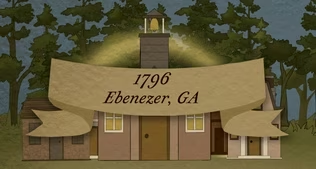
By 1796, Ebenezer is now the county seat of Effingham County.
So it's the seat of commerce, it's the seat of government.
People are traveling through the town and it gains importance.
Now, some would say that this time is the time when Ebenezer is at its high water mark.
It really starts to decline, and we can say it for sure when the county seat moves from Ebenezer to Springfield in 1799.
So the courts move, the businesses move along with it.
People aren't traveling through the town anymore.
And so Ebenezer basically becomes like a ghost town.
I've done a little bit of research on the community and it is considered a ghost town, the community of Ebenezer.
So there was some sort of like decline, right?
Well, that's because during the Revolutionary War, and then later the Civil War, people still lived here, but people had farms and houses out in the rural area.
And so they would go there.
So as the wars came and they would just move out to their plantation house, if that's what you want to call it, your farmhouse.
And instead of coming back to town, they just stayed there and they even had some houses that they just took apart and moved out of town.
What is it like today on a Sunday?
We all feel like we're family.
How about that?
I love it.
Put it that way.
And we're not all Salzburgers.
You do not have to be a Salzburger descendant to come here.
Matter of fact, we have a lot of members who are not Salzberger descendants.
And I think that's a testament to the ideal behind why they came here in the first place.
They wanted to freely practice their religion.
Keeping that openness going seems like a testament to who the Salzburgers were.
Being the first to do anything is difficult.
It means stepping out and taking risk, putting it all on the line and settling in Georgia in the 1730s like the Salzburgers did was all of those things, whether it was disease, food shortage, or even war.
The resilience of Ebenezer and those brave enough to settle here is pretty remarkable.
And while it may no longer be here as an actual town, the legacy of what Ebenezer's original settlers did is very much still alive and well.
It's in that building every Sunday.
I'm Maiya Ma, and we'll see you at our next stop.
Video has Closed Captions
The story of an early Georgia woman who stepped in to help the resistance and outrun King George. (10m 35s)
Video has Closed Captions
The story of a soldier who rallied an army and-according to legend-saved patriot prisoners of war. (10m 57s)
Video has Closed Captions
The story of a Georgia frontier leader, the legend of his death and the vengeance that came after. (13m)
Video has Closed Captions
The Georgians who signed the Declaration of Independence and their influence on the early republic. (12m 52s)
Video has Closed Captions
The story of an international coalition and the attempt to recapture Colonial Georgia's most importa (14m 6s)
Georgia's Fight Goes To The Water
Video has Closed Captions
The story of a small Georgia fleet that stands tall in the face of the powerful British Navy. (12m 8s)
 Now Playing
Video has Closed Captions
The trials, tribulations and resilience of one of Georgia's earliest settlements. (13m 38s)
Video has Closed Captions
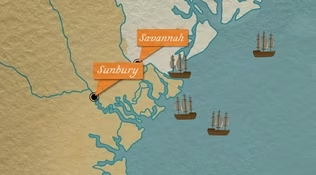
A Liberty County landmark that once protected the people and resources of Coastal Georgia. (12m 49s)
The First President Heads South
Video has Closed Captions
The story of George Washington's first and only visit to Georgia. (13m 32s)
The Soldier Who Arrested A Governor
Video has Closed Captions
An early Georgia leader who was key to Patriot resistance and the early days of the postal service. (13m 31s)
The Frontier's Fierce Protector
Video has Closed Captions
The story of a Colonial Georgia woman who was a fierce protector of home, family and liberty. (14m 9s)
Video has Closed Captions
The story of a founding father, his influence on early Georgia, and the duel that ended his life. (14m 18s)
Providing Support for PBS.org
Learn Moreabout PBS online sponsorship














Support for PBS provided by:
MARKED! - The Series is a local public television program presented by GPB