MARKED! - The Series
The Siege of Savannah
Clip | 14m 6sVideo has Closed Captions
The story of an international coalition and the attempt to recapture Colonial Georgia's most importa
The Siege of Savannah was one of the first instances of a unified, international coalition taking on the British in a full-on assault. What unfolded in October of 1779 at Savannah's Spring Hill Redoubt would become a storied example of the Patriots' relentless fight for freedom and the true cost of independence.
Problems playing video? | Closed Captioning Feedback
Problems playing video? | Closed Captioning Feedback
MARKED! - The Series is a local public television program presented by GPB
MARKED! - The Series
The Siege of Savannah
Clip | 14m 6sVideo has Closed Captions
The Siege of Savannah was one of the first instances of a unified, international coalition taking on the British in a full-on assault. What unfolded in October of 1779 at Savannah's Spring Hill Redoubt would become a storied example of the Patriots' relentless fight for freedom and the true cost of independence.
Problems playing video? | Closed Captioning Feedback
Where to Watch MARKED! - The Series
MARKED! - The Series is available to stream on pbs.org and the PBS app.
Providing Support for PBS.org
Learn Moreabout PBS online sponsorship- It was one of the seminal moments in the American Revolution Southern Theater.
A fight that meant forming an international coalition and the attempt to reclaim the soul of a city that's controlled by the crown.
This is Marked!, a series that zooms in on Georgia and its backstory, one historical marker at a time.
I'm Maiya May, and I'm here in Savannah at historical marker 025-10 to tell you the story of a group of Patriots, their global allies, and a push to take back their city.
When you explore what happened during the American Revolution, stories pop up everywhere.
Patriots refusing to give up, colonists and militia groups that even in the face of long shot odds just wouldn't back down.
And that relentlessness, the resilience to fight, was on full display here during the siege of Savannah, October 9th, 1779, to be exact, and the attack at the Spring Hill Redoubt.
Tell me a little bit about where we are.
- So we're standing in what's called Battlefield Memorial Park here in Savannah.
This was kind of ground zero for probably the most important thing that happened in Georgia during the American Revolution.
We're at the site of what was called then the Spring Hill Redoubt, which is this urban mound.
As you can see, it's manmade.
This was the far western end of the British line, the British recaptured Savannah.
In December, 1778, the British shifted all of their maneuvers to the south.
They wanted to tap in what they thought was a hotbed of loyalism down here.
Savannah was very lightly defended in December of 78.
- At this point in the war, as far as the English are concerned, the war in the North is just getting a little difficult.
The Patriots in the north are becoming a problem, so then they try a new tactic and one that's known as their southern strategy.
A strategy that was the brainchild of Royal Governor James Wright.
- After being exiled from Georgia, following his arrest and escape in February of 1776, governor James Wright goes back to England, where he harangues minister after minister, member of parliament, after member of parliament, and even the king to initiate a southern strategy because there are strong numbers of loyalists in Georgia and in South Carolina.
There was a belief among the British high command that Georgia was home to many loyalists that it might be more easily captured.
And from that capture, the British could kind of roll up the rest of the colonies, going from Georgia to South and North Carolina, and then to Virginia, and then meeting their northern army there.
A large component of their colonial wealth is in the South.
Tobacco, cash crops.
Rice, cash crops.
To a lesser extent, Indigo.
Cash crops are driving the American economy.
The British begin their operations in Georgia in the spring of 1778.
They invade Savannah in December of 1778, and by February of 1779, they have full control of Georgia.
- During the British occupation, everyday life here for the Patriots is awful.
- With the British back in control in Savannah, they are, in a sense, strangers in their own land.
Enemies to the governmental apparatus that is now controlling Georgia as Georgia kind of flip flops during the revolution from rebel control to loyalist or British control.
And for citizens of all stripes, those kinds of fluctuations and power and those power vacuums created are gonna make life complex and difficult.
- And so for nearly nine months, all of that control is unchallenged, but the patriot forces that are still in the south have a renewed sense of resolve.
They're determined to fight back against this southern strategy.
- General Robert Howe, who was the continental leader in Georgia, is dismissed and replaced by General Benjamin Lincoln.
Lincoln will perhaps be most well known for accepting the British surrender following the Battle of Yorktown.
Joining Benjamin Lincoln in Savannah was a Polish volunteer named Casimir Pulaski, who was recruited to the cause by Benjamin Franklin.
- So the Patriots have a bit of a leadership refresh, but if they're going to win back Savannah, they're also gonna need some help on the water.
And so they outsource some of that and they recruit some French naval forces who are willing to help and looking for a fight.
- So joining Lincoln and Pulaski is a French admiral Charles Count d'Estaing who has just experienced great success in the Caribbean and believes that capturing Savannah will be no difficult task whatsoever.
D'Estaing brings with him a fleet of ships, 4,000 soldiers and 500 Haitian volunteers making this an incredibly strong international coalition to recapture Georgia from the British.
It is believed that one of those Haitian volunteers is Henri Christophe, who would later become the first king of Haiti.
- They land here in September thinking this is a fairly lightly fortified, defended city.
D'Estaing is told you can do this without any problem really, and he wants to get it done fast.
Everybody who lives down here knows September is hurricane season.
He's just come from the Caribbean.
He wants to get this done and get out of the way.
The problem is all of these maneuvers take time.
He sends in his terms to the British and demands they surrender the city, but gives them two days to respond.
They dig in even more.
They say, Nope, we're not gonna surrender the city.
You'll have to come and take it.
He finally loses patience.
And on the night of October 8th, a Friday night, he tells American Allies led by Benjamin Lincoln, we are going in tomorrow morning.
- Talk to me about that dynamic between d'Estaing and Lincoln.
That must've been interesting.
- Well, it was, and it kind of encapsulated the whole American French alliance.
So d'Estaing was very flamboyant.
Benjamin Lincoln arrived with the American Continentals from South Carolina, and he was a little bit more of a slow it down, let's get the lay of the land here first.
And eventually d'Estaing just overruled him and everybody else.
- And it all starts right here on the morning of October 9th, 1779.
And the American and French forces are well organized and ready to take back Savannah.
And the assault becomes one of the bloodiest fights of the revolution.
- They believe that a morning attack will provide great results.
They decide they want to attack directly the Spring Hill Redoubt, believing that it is lightly manned and that once taken, it'll provide a gateway to the rest of the city.
However, for some reason, they didn't take into account that morning on the coast can often bring fog.
And so they have a difficult way making their way to the redoubt.
Once the fog lifts, to their surprise are many more men facing them than they anticipated.
They also become sitting ducks because the fog is lifted.
And now those people looking at them have free shots at them.
- Paint a picture of what happened that day.
British soldiers would've been in something like this, I'm assuming.
- They would've been manning this redoubt throughout what was known as the siege of Savannah.
After d'Estaing and the French got here, they were bombarding the city from the river, from the southern part.
And eyewitness accounts said that it was literally hell to be in the city while that was going on.
As you can imagine, the inhabitants who had not evacuated Savannah were sort of trapped here behind these lines.
So hot shells were being lobbed into the city from as far away as thunderbolt and even ships out on the river, starting fires, landing indiscriminately, killing people.
From the earliest moment shots were exchanged and the battle was on at that point.
Now, once it started, you've got chaos in the sense of trying to move troops around to key points.
So you've got generals who are trying to give orders in the chaos of battle.
The British are shifting interior people along their lines here.
But for the most part, this was the hotspot.
This was the place where the battle was going to be won or lost.
- I've heard that fog played a huge role in this battle as well.
Can you talk to me about that?
- Yeah.
So that morning, undercover of darkness, d'Estaing and the French thought they would get the jump on the British just by the virtue of the fact that they would start this whole operation while it was still dark.
And that didn't happen because they came from the south.
People got confused about where they were, but then that morning it was also foggy.
So the Americans and their allies all said that they were gonna put white pieces of paper on their uniforms or their hats so that you weren't shooting at each other.
So you knew who was who, which eventually, as it got to be more daylight, the fog dissipated.
So the British who were behind this readout, it was like shooting fish in the barrel at that point.
There was a big loss of life on the American side, but not the British.
The Americans lost over a thousand.
Now, some of the people who were here turned out to be quite famous.
D'Estaing himself took two bullets that morning before he was finally carried off the field.
Casimir Pulaski, and in a breach in the lines, he shot through on his horse and took a shot to the groin, the size of an egg, a grape shot took him right out of the saddle, and he died about two or three days later.
So there were horses out here, there was cavalry, there's infantry.
You can imagine the sound of all this.
There would've been men screaming, there would've been blood everywhere.
There would've been people who were decapitated, arms shot off, cut off, horses that were wounded, bodies you have to step over or step on.
All of that's happening at the same time.
So combat is one of the most intense experiences anybody will ever experience.
What it was like that morning, from the vantage point where you and I are standing right now, it must have an awesome sight.
And I use that word not carelessly.
- This assault on the Spring Hill Redoubt wasn't going according to plan at all, and the British artillery is just relentless.
And for the continental army, it's only getting worse.
- The attack on the Spring Hill Redoubt went sideways immediately.
British forces outnumbered the French and Americans.
The battle for Savannah in the fall of 1779 was expected to be a fait accompli; just show up and you win.
It didn't turn out that way.
- The eyewitnesses who survived, they described it as just a killing feat.
It was just amazing.
In less than an hour, there were over a thousand casualties.
- The British were better prepared.
They had more soldiers than anticipated, and the loyalist allies really rose up to the situation.
- And it was a total disaster.
- So even with the help from the French and the coalition united, the Patriots attempt to take back, Savannah failed in a really, really big way.
There's been discussion for centuries, two in fact, on how everything could have gone so wrong, including one particular reason that is still discussed today.
- There are rumors and myths about this battle that suggests that someone informed General Prevost that an attack was imminent.
We don't know for sure, but certainly the British were ready when the assault happened.
Patriot leaders from George Washington to John Adams and Benjamin Franklin in Europe were astonished.
They thought that the battle would be quick and easy, much less the second bloodiest battle in the entirety of the American Revolution, which resulted in a humiliating defeat of their prized Franco American alliance.
- So ultimately, we know this battle for the Patriots was a failure.
Talk to me about why this battle is important, not only for just the time, but the American revolutionary period in general.
- One of the things that came out of this was the tenuous nature of the French American Alliance.
It hadn't worked very well here.
It was still in its infancy, really.
And the question was, are they gonna be able to work together going forward?
So that was a huge question mark then.
What's the future of the American army in the South?
It did not look good from here.
Benjamin Lincoln went on and ended up surrendering the city of Charleston in May of 1780.
Just six months later, that opened up the whole nature of what's the future of these southern most states in the future United States or in the British Empire?
What's the future of the city of Savannah?
The British held Savannah for the duration of the war, but ultimately it didn't really matter because they couldn't control outside of this city.
They couldn't control the rest of Georgia.
And so there was a lot at stake that morning, and that French and American defeat and the British victory, what would happen in the future to this part of the world and the people who lived there.
So there were enormous ramifications, as they say, for generations yet unborn for what happened that morning.
- Whether it was for planning, overconfidence, or knowing the other side's plans all together, the discussion of why and how things went wrong for the Patriots will probably go on forever.
But the siege of Savannah and the attack of Spring Hill is a good reminder two centuries later of what the true cost of independence looks like.
I'm Maiya May, and we'll see you at our next stop.
Video has Closed Captions
The story of an early Georgia woman who stepped in to help the resistance and outrun King George. (10m 35s)
Video has Closed Captions
The story of a soldier who rallied an army and-according to legend-saved patriot prisoners of war. (10m 57s)
Video has Closed Captions
The story of a Georgia frontier leader, the legend of his death and the vengeance that came after. (13m)
Video has Closed Captions
The Georgians who signed the Declaration of Independence and their influence on the early republic. (12m 52s)
 Now Playing
Video has Closed Captions
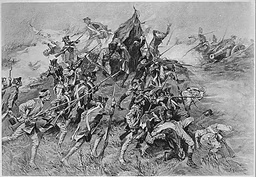
The story of an international coalition and the attempt to recapture Colonial Georgia's most importa (14m 6s)
Georgia's Fight Goes To The Water
Video has Closed Captions
The story of a small Georgia fleet that stands tall in the face of the powerful British Navy. (12m 8s)
Video has Closed Captions
The trials, tribulations and resilience of one of Georgia's earliest settlements. (13m 38s)
Video has Closed Captions
A Liberty County landmark that once protected the people and resources of Coastal Georgia. (12m 49s)
The First President Heads South
Video has Closed Captions
The story of George Washington's first and only visit to Georgia. (13m 32s)
The Soldier Who Arrested A Governor
Video has Closed Captions
An early Georgia leader who was key to Patriot resistance and the early days of the postal service. (13m 31s)
The Frontier's Fierce Protector
Video has Closed Captions
The story of a Colonial Georgia woman who was a fierce protector of home, family and liberty. (14m 9s)
Video has Closed Captions
The story of a founding father, his influence on early Georgia, and the duel that ended his life. (14m 18s)
Providing Support for PBS.org
Learn Moreabout PBS online sponsorship











Support for PBS provided by:
MARKED! - The Series is a local public television program presented by GPB