MARKED! - The Series
John Dooly & The Tory Pond
Clip | 13mVideo has Closed Captions
The story of a Georgia frontier leader, the legend of his death and the vengeance that came after.
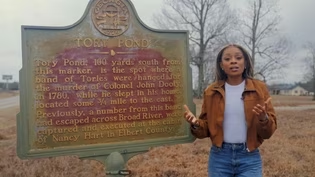
The murder of Colonel John Dooly, a symbol of Patriot leadership on the frontier of Georgia, exemplified the brutal divide between Patriots and Loyalists. He was killed in his own home, three quarters of a mile from here, and the hanging of the Tories responsible took place at the pond that once sat nearly 100 yards away.
Problems playing video? | Closed Captioning Feedback
Problems playing video? | Closed Captioning Feedback
MARKED! - The Series is a local public television program presented by GPB
MARKED! - The Series
John Dooly & The Tory Pond
Clip | 13mVideo has Closed Captions
The murder of Colonel John Dooly, a symbol of Patriot leadership on the frontier of Georgia, exemplified the brutal divide between Patriots and Loyalists. He was killed in his own home, three quarters of a mile from here, and the hanging of the Tories responsible took place at the pond that once sat nearly 100 yards away.
Problems playing video? | Closed Captioning Feedback
Where to Watch MARKED! - The Series
MARKED! - The Series is available to stream on pbs.org and the PBS app.
Providing Support for PBS.org
Learn Moreabout PBS online sponsorship- He was a key leader at one of Georgia's most important battles.
He was also a driving force in the war that took place on the Georgia frontier, and his death would make him a martyr.
This is Marked!, a series that zooms in on Georgia and its backstory, one historical marker at a time.
I'm Maiya May and I'm here at Georgia Historical Marker 090-5 to tell you the story of a colonel in the remote Georgia back country, his death and how it turned into a pursuit of vengeance that according to some historians, ended not too far from here.
One of the things that makes history, and in our case, Georgia history so interesting is sifting through what's known for sure and what's also a mix of uncertainty.
A little bit of fact and a whole lot of, it's hard to say for sure.
We've had some of that with our episode about Nancy Hart, and ironically enough, this episode, the story of Colonel John Dooly and the Tory Pond is connected to Nancy Hart too, and just like her, maybe even more so in this case.
There's a lot of legend, maybe some myth, and plenty of uncertainty.
- To know what happened at Tory Pond, you first have to know the story of John Dooly.
And if you wanna look him up, it's gonna take some work because he's not at the top of the pages in the history books.
Portraits and drawings are non-existent.
- As far as we've determined, this is the only artistic interpretation of John Dooly, a 2022 painting by South Carolina artist Dale Watson.
And to help tell this story, we've also made one of our very own.
- He's one of those forgotten figures from the revolutionary era.
I'm not sure if I would call him a founder of the state of Georgia, but he was certainly involved all throughout early state of Georgia history.
- He's originally a Virginian and he moves south after his father picks up the family and heads to the Georgia backcountry.
- The backcountry was Wilkes County.
Today it encompasses about 12-10 counties.
Wilkes County was huge.
I mean it stretched all the way from Augusta all the way beyond Elbert County into what became Hart and part of Madison.
It was massively huge.
So I know he was from here.
He's part of the Wilkes County militia.
- By the time that Dooly is becoming an influence in the Georgia back country, he is with a lot of Virginians who have filtered their way down after the 1763 Proclamation Act looking for land, - It was the ceded lands that Georgia had gotten when Wright was governor from the Muskogee and also from the Cherokee.
And that was in 1773, and they just got it.
And then we had the revolution and Georgia created Wilkes County out of it.
- These were a group of people that the Royal Governor, James Wright, had no use for.
- He called those people the crackers, indicating that they were rough, they were uncouth, they didn't care about law, they were constantly at war with the Native Americans.
- As far as James Wright was concerned, these people were breaking all kind of rules established by the British Crown.
The rules were meant to maintain peace between indigenous Native Americans and the Colonist.
And John Dooly had a part in this.
But like a lot of the accounts in this era, you have to keep perspective on the words written at this time.
- Well, our first or second historian of Georgia, Hugh McCall, he was a major in the Revolutionary War, writes about the Revolutionary War in early Georgia, and he paints Dooly in very flattering terms.
He perpetuates the propaganda from the 1770s and eighties, and that's where most people get their information from because over the course of the 19th century and into the early 20th century, folks are just looking for, you know, brief character sketches and whoever's writing that character sketch goes straight to the source, but that source is not terribly reliable.
- Georgia historian, Otis Ashmore wrote of Dooly, quote: - Of the many heroic men who illustrated that stormy period of the revolution in Georgia that tried men's souls, none deserves a more grateful remembrance by posterity than Colonel John Dooly.
- John Dooly also did a bit of flip-flopping like a lot of people during the colonial period did.
He was a patriot, yes, in every way possible, but that wasn't always the case.
- He started out as a loyalist, beginning of the war, and then was convinced to, to switch sides as many people were convinced, you know, bullied, however you want to say it.
The Revolutionary War in Georgia and South Carolina was a civil war from the very beginning.
- Making the switch from loyalist to patriot isn't uncommon either.
It depends on your personal situation, your economics, your safety, all of those things.
- And in 1777, Thomas gets wrapped up in a clash with the Native Americans.
- John Dooly's brother Thomas is murdered in a skirmish with the Creek Indians.
- The fight is near the Oconee River and it's over what some historians say are about stolen horses.
And along the river, Thomas Dooly is severely wounded and kind of abandoned by his own men, including the second in command who leaves Dooly to die.
- John Dooly wanted to avenge his brother's death, and he really had it out for Native Americans, particularly the Muskogee.
- John Dooly, as I imagine any brother would, is near driven insane by this prospect of his brother dying at the hands of the Creek and he wants to exact cold-blooded revenge.
The leaders in Georgia at the time, both moderate and fairly radical, don't really want him to pursue that path because it is going to create a situation that they may not be able to handle just yet.
And so they try to prevent him from doing that.
- Later that year, Dooly manages to seize a group of Creek Indians and before he can carry out his vengeance of Thomas's death, he's arrested.
He's tried in Savannah, and the court martial is led by another familiar name in colonial history, Samuel Elbert.
And as a result of all of this, Dooly resigns his commission and becomes colonel of a militia in Wilkes County.
And in 1779, John Dooly goes on to lead that militia at Kettle Creek.
Serving alongside Andrew Pickens and Elijah Clark.
Kettle Creek was a really important battle in the revolution and in the Southern Theater, and more importantly, it was a huge victory for the Patriots.
- Dooly's work in Georgia is an all leadership, victory and popularity.
He made some enemies, plenty of them.
- He is arrogant, he is ambitious, flexible with truth.
- Dooly also served as state's attorney.
He had a real thing for aggressively pursuing loyalists and pushing for really strict legal punishments.
- One of the characteristics of the fighting in frontier Georgia is that the fights are smaller, they're more personal.
And for men like Dooly, they can become a never ending cycle of revenge.
- It is recrimination for recrimination.
Each side is exacting revenge for past wrongdoings, and there's not always an ideological reason behind it.
It's not patriotism versus loyalism.
It's you burnt my father's farm down, now I'm coming for you.
And so Dooly finds himself as someone who's always acting the aggressor.
- And it's those recriminations and cycle of getting even that appear to be what ends Dooly's life.
The legend is that John Dooly, in front of his wife and kids, in his own home, was murdered by a band of Tories.
According to Hugh McCall's first history of Georgia, a band of Tories under the clear direction of a man named Captain Corker break into John Dooly's log cabin home in the middle of the night.
- He finds himself in harm's way in front of his family, and he is murdered.
Because of the successful patriot propaganda, they are able to paint him as a martyr at the time of the revolution.
- John Dooly's death symbolizes what's going on in the rural frontier of Georgia.
He's been killed.
And while the specifics are still unclear, this is a murder and that kind of rises to a different level, even in the context of war.
- Patriot propagandists used John Dooly's death in front of his family, in front of his children.
They use the very loaded term murder in a time in which we're killing people left and right, honorably and dishonorably, including Dooly himself killing folks dishonorably.
And his enemies killing others dishonorably.
That's the nature of civil war.
- Like we told you at the top, what's legend and what's a hundred percent raw truth in the Dooly story is difficult.
But according to that legend, the Tories responsible for his death are marched to a nearby pond where, near the water, each of the men responsible is hanged.
- And the other part of the story that's long been told with some of the men in this small band of Tories, they were some of the same men that made their way to Nancy Hart's cabin.
- And the ones that did that, they paid for it because they went and started messing with Nancy Hart, talked among themselves saying what they did.
- And when you read some of the text written about John Dooly, a couple of things emerge.
He was a pretty abrasive guy.
- John Dooly is always someone who I've never thought much of.
And that's 20th century, 21st century looking back 250 years.
So it's hard to do that.
But you know, as you read and and and research more and more and more, there are people that you can admire even if you understand who they are in whole.
And then there are people like John Dooly who to me just comes across as a little bit sketchy.
I don't know if I would ever trust John Dooly if I lived in that time period.
I would go to battle with him, but I don't know if I would trust him.
He was a fighter.
He was able to avenge his brother's death.
He was able to lead Patriots to victory on the battlefield.
So he wasn't just this guy who is kind of breaking societal norms in terms of fighting in the back country against the loyalists or seeking more recompense from the state government than he may have been due.
He is a guy that can bring you victory.
Not always, but nobody does.
- Dooly and his death tell us a few things about the revolution too.
This wasn't just a war fought with big armies, cannons, and ships.
This was a hand-to-hand militia fight too.
- The revolution made people do bad things to each other.
Like breaking into the home of John Dooly when he is eating in front of his family and wife and kill him.
You know, like what Nancy Hart did, hanging loyalists when they catch 'em and it's vice versa.
When the loyalists got their hands on Patriots, they did the same kind of thing.
- And so I imagine in every civil war, throughout history, especially when it is militia groups fighting militia groups rather than the continental army versus the British army.
Initially ideology is important, but in a civil war there's no rhyme or reason.
It's just what it is.
- Yeah, it was brutal up here.
It was a wide open society.
Civilization had hardly crept up.
- John Dooly was a soldier.
He was a fighter in a bloody civil.
And fighters in civil wars do bloody things for good or for bad in other contexts.
While we can look at John Dooly with a critical eye, there's no reason to disparage his character in toto fully.
- The death of John Dooly and the hanging of the men responsible is violent.
And it also illustrates how this era in Georgia could often be an infinite cycle of vengeance, revenge, and the evening of scores.
The American Revolution wasn't just a world war.
Far from the coast and all the hot hotspots we all think of, the revolution in the back country was a regional conflict too.
I'm Maiya May, and we'll see you at our next stop.
Video has Closed Captions
The story of an early Georgia woman who stepped in to help the resistance and outrun King George. (10m 35s)
Video has Closed Captions
The story of a soldier who rallied an army and-according to legend-saved patriot prisoners of war. (10m 57s)
 Now Playing
Video has Closed Captions
The story of a Georgia frontier leader, the legend of his death and the vengeance that came after. (13m)
Video has Closed Captions
The Georgians who signed the Declaration of Independence and their influence on the early republic. (12m 52s)
Video has Closed Captions
The story of an international coalition and the attempt to recapture Colonial Georgia's most importa (14m 6s)
Georgia's Fight Goes To The Water
Video has Closed Captions
The story of a small Georgia fleet that stands tall in the face of the powerful British Navy. (12m 8s)
Video has Closed Captions
The trials, tribulations and resilience of one of Georgia's earliest settlements. (13m 38s)
Video has Closed Captions
A Liberty County landmark that once protected the people and resources of Coastal Georgia. (12m 49s)
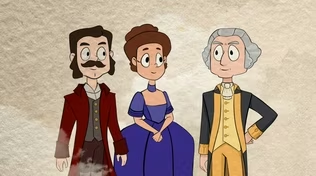
The First President Heads South
Video has Closed Captions
The story of George Washington's first and only visit to Georgia. (13m 32s)
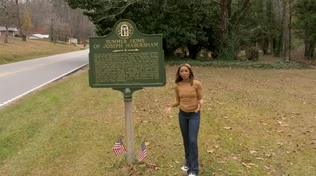
The Soldier Who Arrested A Governor
Video has Closed Captions
An early Georgia leader who was key to Patriot resistance and the early days of the postal service. (13m 31s)
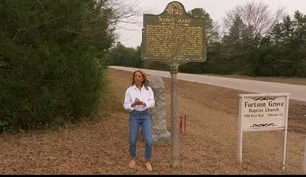
The Frontier's Fierce Protector
Video has Closed Captions
The story of a Colonial Georgia woman who was a fierce protector of home, family and liberty. (14m 9s)
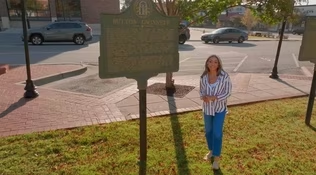
Video has Closed Captions
The story of a founding father, his influence on early Georgia, and the duel that ended his life. (14m 18s)
Providing Support for PBS.org
Learn Moreabout PBS online sponsorship











Support for PBS provided by:
MARKED! - The Series is a local public television program presented by GPB