MARKED! - The Series
Georgia's Fight Goes To The Water
Clip | 12m 8sVideo has Closed Captions
The story of a small Georgia fleet that stands tall in the face of the powerful British Navy.
In April of 1778, Col. Samuel Elbert commanded the Georgia Navy, four row galleys designed for naval action on Georgia's coast and rivers. What those vessels delivered was a remarkable victory for the Patriots in 1778 that became a rallying cry for morale and held off the British invasion of Savannah for another eight months.
Problems playing video? | Closed Captioning Feedback
Problems playing video? | Closed Captioning Feedback
MARKED! - The Series is a local public television program presented by GPB
MARKED! - The Series
Georgia's Fight Goes To The Water
Clip | 12m 8sVideo has Closed Captions
In April of 1778, Col. Samuel Elbert commanded the Georgia Navy, four row galleys designed for naval action on Georgia's coast and rivers. What those vessels delivered was a remarkable victory for the Patriots in 1778 that became a rallying cry for morale and held off the British invasion of Savannah for another eight months.
Problems playing video? | Closed Captioning Feedback
Where to Watch MARKED! - The Series
MARKED! - The Series is available to stream on pbs.org and the PBS app.
Providing Support for PBS.org
Learn Moreabout PBS online sponsorshipIt's the story of a Georgia military leader, one time prisoner of war and future governor.
But it's also the story of the group of ships he led and their relentless push on British naval forces.
And all of it, another example of Georgia meeting the moment and the fight for independence.
This is Marked!, a series that zooms in on Georgia and its backstory, one historical marker at a time.
I'm Maiya May and I'm here at Georgia Historical marker 63-6 to tell you the story of a revolutionary battle that would change hearts and minds while rallying a state at war.
The American Revolution has often been talked about is not only a war between the British and the 13 Colonies, but it was also a Civil War.
Loyalist to the Crown, pitted against their neighbors, who are pushing back against taxation without representation.
And a lot of us, we envision the bloody images from the battlefields with muskets and bayonets.
But the American Revolution had a lot more than that.
There was also plenty of fighting on the water.
And in Georgia, that meant the Georgian navy.
The American Revolution had its fair share of battles on the water that became landmark victories.
You have the Battle of Valcour Island.
You have Flamborough Head.
You have the raid on Nassau.
But in the south, Georgia had its own offering on the water, and it came in the form of the Georgia Navy.
When we think of the Navy, especially in this era, we think of the big mast, big guns, big frigate type vessels.
The Georgia Navy was very much not that.
The vessels commissioned for Georgia were a lot smaller, and they were designed for navigating the shoals in the shallow waters of coastal Georgia at that time.
The vessels were known as row galleys.
They were designed to sort of have like a flat bottom and relied heavily on oars, which meant they needed manpower.
They had three row galleys.
Continental Congress had given Georgia money to make up.
They were going to do four, but the fourth one wasn't made yet.
And those row galleys, they were good on the coastal estuary waters and up rivers, but not out in the ocean.
And some of them even had sails.
The names of the three row galleys that were involved were the Washington, the Lee, and the Bulloch, and they were named after George Washington, Charles Lee, who had been the first Southern Continental commander, and Archibald Bulloch, Georgia's first president.. ie Governor.
He got these boats were under the command of Major General Robert Howe, North Carolinian, who has a bit of a complicated legacy.
The Continental Congress created the Southern Department of the Continental Army in 1776.
The first commander of it was Charles Lee.
But Charles Lee did not stay commander long.
That's when they went and got Robert Howe.
And in Georgia, Howe has Colonel Samuel Elbert running the Continental Army.
Samuel Elbert was born in Savannah in 1740.
His parents died, and he was a teenager when his daddy died.
And so he was an orphan.
But he came to Savannah in 1765.
From that point on, he was a merchant on the make.
Learning how to be a merchant.
He did hold himself up by the bootstraps.
He would go on to become governor of Georgia.
But the main part of his story is his leadership of the Georgia Navy, which he would be in command of in 1778.
On April 15th, Colonel Elbert catches wind of something.
He learned that off Saint Simon Sound, not far from Savannah.
There's a group of British ships that have made their way into colonial waters.
And it's certainly not intended to be a friendly visit.
It's actually four ships.
One's called the Galatea, but it's hanging out behind.
And that's where the commander is.
But there are three others, either in the river and one's called the Hinchinbrook.
One was called the Rebecca, and there watering brig.
Colonel Elbert learns that these ships are getting closer to Georgia's inner coastal waters.
He needs to sound an alarm for this.
He's got to make some moves.
What we know about this action actually comes from a letter that Elbert wrote to his commander, General Robert Howe, having received intelligence that the above vessels were at this place, I put about 300 men by detachment from the troops under my command at Fort Howe, n board the three gallies, the Washington, Captain Hardy, the Lee Captain Braddock, and the Bullock, Captain Hatcher; and a detachment of artillery from two field pieces under Captain Young, I put on board a boat.
Elbert didn't just put them on a boat.
He rounded up 300 men and gave them orders to head to Darien, where they would intercept the British ships.
Elbert's plan is to preempt the British and just be one step ahead, and it ends up working out.
Each of the Row galleys had a pivot cannon in the front.
And of course, these row gallies were no good in the open water ocean.
They couldn't do anything there, but they were good in the rivers, and they were good along the coastal areas.
And the Frederica River was a coastal area.
So this is where they were good.
And so the row gallies went down, and Elbert had the men march down as quick as they could, and they got them across on Saint Simons Island.
On April 18th, late in the afternoon, Elbert's fleet come around the bend with those row gallies, and those ships were there in the river.
And rather than engaging the row gallies, the British dropped back that night and got ready for the next morning.
Early in the morning on April the 19th, the gallies began to open fire on those two big British ships.
The galley guns had further range, and the British guns were not making it to.
So they began to pound those two ships really bad.
And the men that were on the island, they had their weapons, and some cannonry too and they begin to fire at the ships from the island.
The ships were getting it from two sides.
The battle lasted two hours.
The sails were ripped up.
There were knocking down masts and the British the had no effect on that little flotilla.
The British, of course, have planned to engage too.
But in a spooky twist of fate, the Patriots get a boost from, of all things, the weather.
They lifted up anchor to go back out with the tide, but the wind wasn't favorable to them.
It was favorable to Elbert's little row galley fleet.
The wind disappeared.
It just vanishes.
And the British ships, with their big sails are sort of stuck and they can't really move.
As the British were drifting back out trying to get away from this situation they've got out of the channel and they got into some very shallow water.
And when they did that, the ships just stuck.
And when they did that, the ships kind of went back like this so that the guns, they could only shoot up, they were defenseless.
Colonel Elbert and his troops are just bombarding the British.
Literally, the British are just like sitting ducks in the water.
The only choice that they had was to go down the river and get out of the situation.
But even then, the winds were not favorable.
It was favorable to the Americans, but it was not favorable to the British trying to get out.
That's how they got stuck in the mud when they got stuck in the mud, The tide current made the ships go back a little bit so the cannon were just totally ineffective.
With their ships now stuck, no wind, and the constant assault from the Lee, the Washington and the Bulloch, the British naval officers are staring down a difficult choice.
At this point, the British have two options.
They can either surrender and almost certainly end up as prisoners, or they can abandon ship.
And some of them choose that second option.
And so some of them make a run for it.
And they managed to get all the way back to the Galatea, which is one of their ships station near Jekyll Island.
And when you read Colonel Elbert's letter to General Howe, the man who put him in charge of all of this, you can almost hear Elbert's excitement as he describes it.
It being late, the gallies did not engage until this morning.
You must imagine what my feelings were to see our three little men of war going to the attack of these three vessels who have spread terror on our coast, and who were drawn up in order of battle.
But the weight of our metal soon damped the courage of these heroes, who soon took to their boats, and as many as could abandon the vessels with everything on board of which we immediately took possession.
What is extraordinary?
We have not one man hurt.
I think Elbert himself was stunned at what he had pulled off.
He had no naval experience.
I mean, this is not anything, him being in the Navy, he was the commander of the Continental Army and even the militia.
But he had no naval experience.
Colonel Elbert has managed to get through this entire ordeal with not a single casualty.
The British, on the other hand, weren't so lucky.
They lost two captains with three more officers captured.
Captain Ellis of the Hinchinbrooke is drowned and Captain Moubray of the Rebecca made his escape.
As soon as I see Colonel White, who has not yet come to us with his prizes, I shall consult with him the other three officers and the commanding officers of the galleys, on the expediency of attacking the Galatea now lying off Jekyll.
They took the ships, and not one person was killed on the American side, but some of the British were.
They even got some prisoners that were British, all of their weapons.
Everything that was on the ships.
And they got the ships.
This was the first major engagement in southern waters.
This entire episode is not really a battle in the traditional sense, which is why it's called the Frederica Naval Action.
It was quick and pretty decisive.
That doesn't diminish the importance of it.
It also proved that these row gallies, which were built in Savannah, were an effective means for defending the Georgia coast, where the shallow waters you had to be able to navigate them.
It's important to note that these ships were built in Georgia by Georgians to defend the Georgia coast.
As you can imagine, there's a lot of pride that comes with that.
The British naval efforts were big, hulking ships.
They are made for crossing huge oceans.
And here you have row gallies designed for fresh water that take all of them out.
The victory for the Patriots and for Georgia came at a time when morale wasn't high.
So this was a big win for the South.
One of the other major ripple effects of this entire operation is the legacy of Colonel Samuel Elbert.
This is the first victory for Georgia in the American Revolution right there on the Frederica River.
And it was all because of Elbert.
I mean, he's the one that made the plan.
Nobody over him was messing him up.
He showed right there if he was left to his own resources and abilities he would have been an excellent commander on the battlefield.
That's Georgia's first big victory.
It created morale.
Boom!
That was his leadership and foresight at the Frederica naval action that really cemented his legacy.
I mean, this is what gave him status.
He knew that the gallies he was commanding may not be as powerful as the British vessels that were built up around Saint Simons, but Elbert and his more than 300 men went to defend the coast anyway because independence was on the line.
It's his only battle victory.
So in his military life is right at the peak of it.
Those other things that he was involved in were disasters.
It's his greatest gem that sits in his crown in terms of his military career.
You've heard us talk a lot about the Georgia forces during the revolution, and the incredible courage it took to stand up to the British and all of that courage was on the water, too, because the Georgia Navy and what it accomplished during the naval action on the Frederica River, just down the road from here, is extremely important for its own reasons.
It was a profound moment in our state's story, and only added to the narrative of what Georgians were capable of.
I'm Maiya May, and thanks for watching.
Once.
Video has Closed Captions
The story of an early Georgia woman who stepped in to help the resistance and outrun King George. (10m 35s)
Video has Closed Captions
The story of a soldier who rallied an army and-according to legend-saved patriot prisoners of war. (10m 57s)
Video has Closed Captions
The story of a Georgia frontier leader, the legend of his death and the vengeance that came after. (13m)
Video has Closed Captions
The Georgians who signed the Declaration of Independence and their influence on the early republic. (12m 52s)
Video has Closed Captions
The story of an international coalition and the attempt to recapture Colonial Georgia's most importa (14m 6s)
 Now Playing
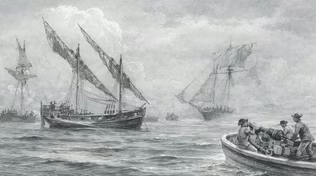
Georgia's Fight Goes To The Water
Video has Closed Captions
The story of a small Georgia fleet that stands tall in the face of the powerful British Navy. (12m 8s)
Video has Closed Captions
The trials, tribulations and resilience of one of Georgia's earliest settlements. (13m 38s)
Video has Closed Captions
A Liberty County landmark that once protected the people and resources of Coastal Georgia. (12m 49s)
The First President Heads South
Video has Closed Captions
The story of George Washington's first and only visit to Georgia. (13m 32s)
The Soldier Who Arrested A Governor
Video has Closed Captions
An early Georgia leader who was key to Patriot resistance and the early days of the postal service. (13m 31s)
The Frontier's Fierce Protector
Video has Closed Captions
The story of a Colonial Georgia woman who was a fierce protector of home, family and liberty. (14m 9s)
Video has Closed Captions
The story of a founding father, his influence on early Georgia, and the duel that ended his life. (14m 18s)
Providing Support for PBS.org
Learn Moreabout PBS online sponsorship New Episode
 New Episode
- News and Public Affairs

Top journalists deliver compelling original analysis of the hour's headlines.





 New Season




Support for PBS provided by:
MARKED! - The Series is a local public television program presented by GPB