MARKED! - The Series
The Jasper Spring
Clip | 10m 57sVideo has Closed Captions
The story of a soldier who rallied an army and-according to legend-saved patriot prisoners of war.
Sergeant William Jasper, who once defiantly held up the South Carolina flag in the midst of British artillery fire was known for his toughness and bravery. And in the spring of 1779, one of his most noted exploits-despite little modern day confirmation-occurred in Savannah, when he managed to liberate a group of Patriot soldiers from the grip of a British detachment.
Problems playing video? | Closed Captioning Feedback
Problems playing video? | Closed Captioning Feedback
MARKED! - The Series is a local public television program presented by GPB
MARKED! - The Series
The Jasper Spring
Clip | 10m 57sVideo has Closed Captions
Sergeant William Jasper, who once defiantly held up the South Carolina flag in the midst of British artillery fire was known for his toughness and bravery. And in the spring of 1779, one of his most noted exploits-despite little modern day confirmation-occurred in Savannah, when he managed to liberate a group of Patriot soldiers from the grip of a British detachment.
Problems playing video? | Closed Captioning Feedback
Where to Watch MARKED! - The Series
MARKED! - The Series is available to stream on pbs.org and the PBS app.
Providing Support for PBS.org
Learn Moreabout PBS online sponsorship- His is a story that begins in South Carolina as a hero that kept the state flag in the air.
It ended after he suffered a mortal wound during the Battle of Savannah.
But in between, he's a devoted patriot and a man who would reach legendary status for his commitment to fellow soldiers.
This is Marked!, a series that zooms in on Georgia and it's backstory, one historical marker at a time.
I'm Maiya May and I'm here at Historical marker 025-48 to tell you the story of bravery and heroism and how the man who pulled it off raised a flag and rallied an army.
Stories of heroism and the revolution are pretty easy to find.
They're everywhere and a lot of those stories as time has gone on, have faded.
Finding concrete accounts and written documents can be tough, which is why they're important to tell, to make sure they're preserved.
And this one, the story of the Jasper Spring and what happened here is one of those.
But to know the story of the Jasper Spring, you first need to know the story of William Jasper.
- The name Jasper is on a lot of things in Georgia.
We have Jasper County, we have the town of Jasper in Pickens County, - And it's not just in Georgia.
Throughout the south, you'll find places peppered with the name Jasper, and it's all an homage to William Jasper, a South Carolinian.
- Jasper was a soldier in the American Revolution, and his story starts in South Carolina.
- And his story isn't the story of a big general, somebody who stood in front and led men.
He was just an ordinary soldier.
- And on June 28th, 1776, Jasper first makes his way into revolutionary lore at the battle of Fort Sullivan.
- Now strategically, Fort Sullivan is key to Charleston, and at this time the British are in a full blown assault.
- And the Patriots don't have nearly the firepower that the British do.
Research suggests that the British were firing about 50 shots for every one from the Patriot side.
- So the Patriots, they're going have to conserve their shots.
Not only that, they have to vigorously defend Fort Sullivan from British naval forces.
- And it's during all this gunfire, when cannonballs are just raining down on the fort, that the fort's Flagstaff falls near the water.
- You've probably heard before the whole idea that everyone has a moment when their life can change, when the opportunity presents itself and you rise to the occasion and just deliver.
This is William Jasper's moment.
- Now when the Flagstaff falls, 26-year-old William Jasper climbs over the walls, goes over to the other side, gets the flag and picks it up.
Now Jasper gets down there and he finds some way to MacGyver this flag back onto a staff and get it up raised again.
Not only does the flag manage to fly again, amid all of this assault that the Patriots are enduring, the fort manages to be saved as well.
- This moment has been immortalized in a number of artists renditions, and it's also been immortalized in the witness accounts that we have of the battle from that time.
- Sergeant Jasper perceiving that the flag was shot away and had fallen without the fort, jumped from one of the embrasures and brought it up through a heavy fire, fixed it upon a sponge staff and planted it upon the ramparts again.
Our flag once more waving in the air, revived the drooping spirits of our friends, and they continued looking on, till night had closed the scene.
- After all that William Jasper got his shine.
Governor Rutledge of South Carolina had given him a sword for his bravery and even offered a lieutenant's commission.
But Jasper turned it down, he said because he couldn't read or write that he didn't wanna be a burden to the more educated soldiers.
Instead, he's given what's called a roving commission.
- A roving commission means he's not tied to a regiment or a unit.
He's kind of operating independently.
And this is not uncommon during the American Revolution in the South.
Now, in Jasper's case, his job is about intelligence.
That's figuring out where the British are, how many of them there are.
- He's funneling information back to General Benjamin Lincoln, who is leading the patriot forces at the second battle of Savannah.
During this roving commission, Jasper's in the town of Ebenezer just outside Savannah, and he meets a Mrs.
Jones.
She is absolutely distraught.
Her husband has just been captured by British forces.
- Now, her husband once had swore an allegiance to the British crown, but he changed his mind, switched over to the Patriot cause and that obviously made him a traitor in the eyes of the British.
- So here's Mrs.
Jones with a young child, desperate for help, and begs William Jasper to help get her husband free.
And Jasper is just struck with the humanity of all of this.
You have a a prisoner of war, you have a wife and mother, you have the young child.
He is just pulled to all of this.
- A lot of what we know comes from the writings of M.L.
Weems and his book, the Life of General Francis Marion.
- According to the story, Jasper says to his friend, John Newton, quote, I must rescue these poor prisoners or die with them; otherwise that woman and that child will haunt me to my grave.
- And like a lot of books about this period, the historical accuracy can be a little blurry.
And so as those prisoners are being let out of town, Jasper and his friend John Newton actually follow them hanging back out of sight.
- Hiding in the woods, Jasper sees the group of prisoners.
Amoung them is Mrs.
Jones, who is escorting her husband, and they're being led by British soldiers.
- Outside Savannah, there's a spring that's used by travelers or water, and this is where Jasper decides to make his move.
- In that moment, there's two muskets leaning against a tree.
And this is when Jasper and Newton jump out of the woods, grab the muskets and start firing upon the opposing soldiers.
Jasper and Newton then lead the entire group of prisoners across the Savannah River, back into the city.
- Now, you can just imagine how Mrs.
Jones is feeling at this point.
She, according to what we know, calls Jasper and Newton, her angel, he has saved her husband.
She's just over the moon about it.
- That story, the bravery, the guts of William Jasper and his friend Newton, has almost become immortal in Georgia revolutionary folklore.
- When you look in the history books, William Jasper is not a name that you may actually find.
We often talk about these larger than life noble military figures and what they did for the revolution.
But William Jasper's name is just that.
It's just a name and there's no real legacy attached to it for most people.
But when we talk about the American Revolution, stories like William Jasper's are the ones that really resonate.
I mean, you have a guy who can't read, who can't write.
He turned down a major promotion by South Carolina's Governor John Rutledge, but what he did is absolutely heroic.
He saved prisoners of war in a surprise ambush on the British, and that takes guts.
- Being the guy who during the midst of battle, jumps over a wall and keeps the flag raised, that might seem minor.
But it can change the course of a battle.
It helps the morale of the troops.
- After that incident at the spring, Jasper rejoined the continental army here in Savannah in the fall of 1779, just in time for one of the biggest moments in Georgia's revolutionary story, the siege of Savannah and the attack at the Spring Hill redoubt.
- The attack at the Spring Hill redoubt was a huge event at the siege of Savannah.
I mean, the British are way outnumbering the Patriots, but this is also when the Patriots had a big international coalition in their favor.
And that battle for a number of reasons, did not go as planned.
But that's a whole other episode.
The Patriots take a ton of losses and are sadly defeated.
And William Jasper was mortally wounded at the attack on Spring Hill.
- The valiant efforts of William Jasper will come to an end in Savannah at the battle that unfolded just a short distance from here.
But even as he was dying, Jasper's commitment to the fight for independence never wavered.
And he made it clear in some of his final words.
- Jasper come to terms with his death.
As he lay dying, he told General Marion quote, I've killed men in my time major, but not in malice, but in what I thought was a just war in defense of my country.
And as I bear no malice against those I killed, neither do I bear any against those who have killed me.
And I heartily trust in God.
- The story of William Jasper is an exercise in the two ends of the revolution.
He raised that flag at that battle in Charleston.
And then at the second battle in Savannah, he's part of an attack that ends up as a horrific defeat and one that ultimately cost him his life.
And between those two ends, his story is one actually of valiant heroism because he's breaking prisoners of war free.
There's no shortage of stories to be told about Georgia and the revolution.
William Jasper's is just another one that jumps out at you.
It's one of those smaller little granular events that in aggregate really lead up to how the Patriots were victorious.
- Hero, soldier, patriot.
They all apply.
But William Jasper was also something else.
He was the cause a walking embodiment of what we're talking about when we say the fight for American independence.
Not a decorated general, but a rank and file devoted fighter committed to country.
And in each of these moments was a portrait of bravery in a new America.
I'm Maiya May and I'll see you at our next stop.
Video has Closed Captions
The story of an early Georgia woman who stepped in to help the resistance and outrun King George. (10m 35s)
 Now Playing
Video has Closed Captions
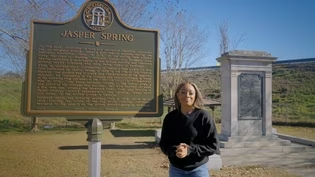
The story of a soldier who rallied an army and-according to legend-saved patriot prisoners of war. (10m 57s)
Video has Closed Captions
The story of a Georgia frontier leader, the legend of his death and the vengeance that came after. (13m)
Video has Closed Captions
The Georgians who signed the Declaration of Independence and their influence on the early republic. (12m 52s)
Video has Closed Captions
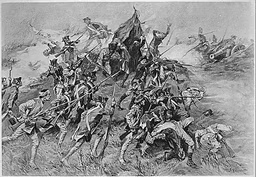
The story of an international coalition and the attempt to recapture Colonial Georgia's most importa (14m 6s)
Georgia's Fight Goes To The Water
Video has Closed Captions
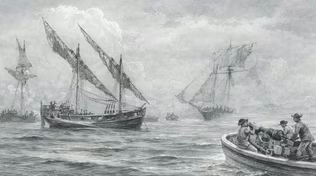
The story of a small Georgia fleet that stands tall in the face of the powerful British Navy. (12m 8s)
Video has Closed Captions
The trials, tribulations and resilience of one of Georgia's earliest settlements. (13m 38s)
Video has Closed Captions
A Liberty County landmark that once protected the people and resources of Coastal Georgia. (12m 49s)
The First President Heads South
Video has Closed Captions
The story of George Washington's first and only visit to Georgia. (13m 32s)
The Soldier Who Arrested A Governor
Video has Closed Captions
An early Georgia leader who was key to Patriot resistance and the early days of the postal service. (13m 31s)
The Frontier's Fierce Protector
Video has Closed Captions
The story of a Colonial Georgia woman who was a fierce protector of home, family and liberty. (14m 9s)
Video has Closed Captions
The story of a founding father, his influence on early Georgia, and the duel that ended his life. (14m 18s)
Providing Support for PBS.org
Learn Moreabout PBS online sponsorship










Support for PBS provided by:
MARKED! - The Series is a local public television program presented by GPB