
How the Railroads Standardized Time
Clip: Special | 2m 59sVideo has Closed Captions
Once upon a time—time wasn’t standardized. And that was a problem for the booming railroad industry.
Once upon a time – time wasn’t standardized. And that was a big problem for the booming railroad industry. So in 1883, railroad companies came together in Chicago to create a standardized time system in the United States.
Problems playing video? | Closed Captioning Feedback
Problems playing video? | Closed Captioning Feedback
Chicago Tours with Geoffrey Baer is a local public television program presented by WTTW
How the Railroads Standardized Time
Clip: Special | 2m 59sVideo has Closed Captions
Once upon a time – time wasn’t standardized. And that was a big problem for the booming railroad industry. So in 1883, railroad companies came together in Chicago to create a standardized time system in the United States.
Problems playing video? | Closed Captioning Feedback
Where to Watch Chicago Tours with Geoffrey Baer
Chicago Tours with Geoffrey Baer is available to stream on pbs.org and the PBS app.
(clock ticking loudly) - Once upon a time, time wasn't standardized, and that was a big problem for the booming railroad industry.
A problem that would be solved in Chicago in 1883.
Before a standardized time system was adopted in the United States, determining the time of day was a bit of a free for all.
(upbeat music) Each city set its clocks based on the position of the sun.
So noon in Chicago was different from noon in St.
Louis.
That meant there were more than 100 different local times across the country in the 19th century.
In Illinois alone, there were nearly 30 different local times.
But as railroads expanded rapidly, the problems with this became unsustainable, even dangerous, because every city kept its own time.
Railroad timetables were head-spinning, often listing multiple arrival and departure times for the same train.
(upbeat music) And it wasn't just a travel headache, it was also a matter of safety.
If railroads confuse the time, trains were at risk of colliding.
In 1883, one such crash happened when two passenger trains collided near Valley Falls, Rhode Island killing 14 people.
The two conductors watches were said to be off by two minutes.
(intense music) (gentle music) So it was high-time for a solution.
On October 11th, 1883, railroad companies came together for the general time convention at the Grand Pacific Hotel in Chicago.
The delegates ultimately established five time zones, each one hour ahead of the zone to its west.
Today, of course, we only have four.
A month after the convention on November 18th, 1883, the railroads implemented standard time on what was called "The Day of Two Noons".
At precisely noon, local time in Pittsburgh, the Allegheny Observatory sent a telegraph signal to railroads across the country and station agents reset their clocks to the top of the hour.
Finally, on time, meant the same everywhere.
Congress would later make railroad time the law of the land with the Standard Time Act of 1918, making four-time zones in the continental United States, a federal standard.
After half a century of railroading, America had solved the problem.
It was only a matter of time.
(gentle music)
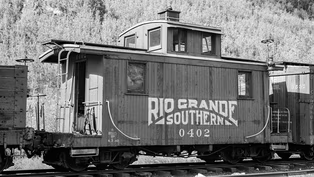
The Caboose: A Home Away from Home
Video has Closed Captions
Geoffrey Baer tours an old freight caboose at the Illinois Railway Museum. (5m 24s)
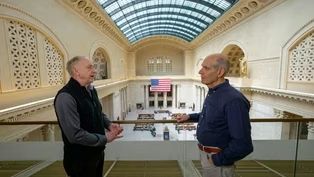
Chicago’s Bygone Downtown Train Stations
Video has Closed Captions
Chicago once had six majestic train stations downtown. (4m 46s)
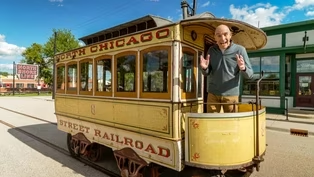
The Days of Cable Cars in Chicago
Video has Closed Captions
In the late 19th century, Chicago had the largest cable car network in the nation. (5m 3s)
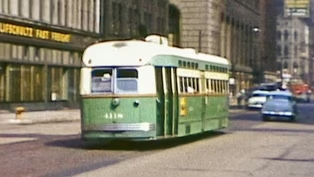
The Delightful Nostalgia of the Streetcar
Video has Closed Captions
Kenosha, Wisconsin, is home to a nostalgic array of streetcars. (3m 32s)
The Early Days of Chicago’s Loop
Video has Closed Captions
A little bit of Chicago-style palm-greasing went a long way in getting the Loop built. (3m 31s)
The Forgotten History of Chicago’s Yellow Line
Video has Closed Captions
Chicago’s Yellow Line is all that remains of an old high-speed rail line. (2m 9s)
Geoffrey Baer Drives a Steam Train
Video has Closed Captions
At the Illinois Railway Museum, a dream comes true for Geoffrey Baer. (2m 15s)
Go Inside an Intermodal Rail Container Yard
Video has Closed Captions
Visit the impressive CSX intermodal rail terminal near Midway Airport. (3m 25s)
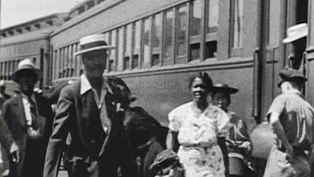
How Trains Carried the Great Migration
Video has Closed Captions
Trains played a big role for Black Americans traveling north during the Great Migration. (2m 37s)
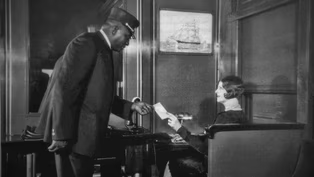
The Innovation and Invisible Labor of Pullman Railcars
Video has Closed Captions
As George Pullman expanded his rail car empire, he hired formerly enslaved men as porters. (3m 59s)
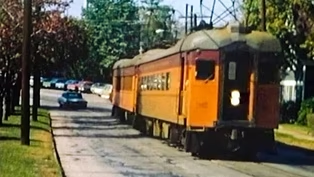
Video has Closed Captions
The South Shore Line is the sole survivor from the days of interurban railroads. (3m 4s)
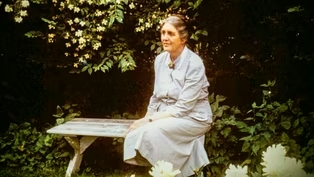
May Theilgaard Watts and the Rails-to-Trails Movement
Video has Closed Captions
A Chicago naturalist helped propel the rails-to-trails movement. (3m 50s)
Riding in Style: The Golden Age of Rail Travel
Video has Closed Captions
In the first half of the 20th century, railroads exuded a sense of glamour. (4m 39s)
Riding the Rails with Geoffrey Baer – Trailer
Video has Closed Captions
Lifelong train enthusiast Geoffrey Baer explores how railroads shaped Chicago. (1m 1s)
Video has Closed Captions
It took a band of robbers only 30 minutes to pull off America’s biggest train heist. (4m 9s)
Video has Closed Captions
Rail enthusiasts gather at a busy railroad crossing in Rochelle, Illinois. (1m 50s)
Untangling America’s Busiest Rail Intersection
Video has Closed Captions
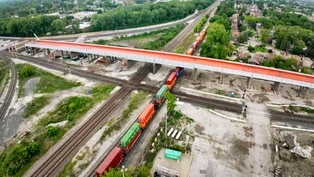
Geoffrey Baer visits America’s busiest and most frustrating rail intersection near Chicago. (2m 49s)
Providing Support for PBS.org
Learn Moreabout PBS online sponsorship











Support for PBS provided by:
Chicago Tours with Geoffrey Baer is a local public television program presented by WTTW