
The Caboose: A Home Away from Home
Clip: Special | 5m 24sVideo has Closed Captions
Geoffrey Baer tours an old freight caboose at the Illinois Railway Museum.
Geoffrey Baer tours an old Union Pacific freight caboose with the help of Phil Hehn at the Illinois Railway Museum.
Problems playing video? | Closed Captioning Feedback
Problems playing video? | Closed Captioning Feedback
Chicago Tours with Geoffrey Baer is a local public television program presented by WTTW
The Caboose: A Home Away from Home
Clip: Special | 5m 24sVideo has Closed Captions
Geoffrey Baer tours an old Union Pacific freight caboose with the help of Phil Hehn at the Illinois Railway Museum.
Problems playing video? | Closed Captioning Feedback
Where to Watch Chicago Tours with Geoffrey Baer
Chicago Tours with Geoffrey Baer is available to stream on pbs.org and the PBS app.
(gentle music) - Everybody loves a caboose, don't they?
- Everybody does.
The last car on the train?
- [Geoffrey] Yeah.
- [Phil] Something to look for.
- [Geoffrey] But wait a minute, if you look for a caboose today, you'll be disappointed.
They were phased out years ago.
To many people, a modern freight train looks like an animal missing its tail.
Fortunately, you can still see plenty of cabooses at the Illinois Railway Museum in Union, Illinois, home to one of the largest collections of historic railroad equipment in the country.
- It's called a marker light.
This is an air gauge.
These are signaling devices called fusees.
- [Geoffrey] And if there's one guy you want showing you around a train, it's Phil Hehn.
- Cabooses had lots of different names, depending on what railroad you worked for.
Sometimes they were a caboose, sometimes they were a cabin car, sometimes they were away car.
- [Geoffrey] This sunny looking caboose was built in 1942 and spent nearly a half century bringing up the rear of Union Pacific freight trains.
So what's the purpose of a caboose anyway?
- The caboose is the train crew's home away from home.
When they would get to their terminal, their destination, their caboose would be taken off the train.
- [Geoffrey] Yeah.
- Set on a sidetrack, they were done for the day, and then this is where they would take their meals, and it would also be where they would sleep.
These benches would turn into bunks.
There's compartments where they would keep their bedding and whatever else they needed.
- So the train crew traveled with the train.
- Train crew.
They didn't go home at night?
- No.
- [Geoffrey] But the caboose was much more than a place to sleep.
It was a home office on wheels where the conductor and one or more brakemen did a lot of work before and during the train's journey.
- The caboose was the conductor's office.
He needed to know how many cars were in the train.
He needed to know what was in those cars, where they were going, and what they were carrying.
- And so people think the engineer is the boss, the captain, right?
- [Phil] Yeah, he's not.
He's like the second in command, right?
He's doing his job up there up in the front of the train.
- [Geoffrey] And who's in command?
- [Phil] The conductor.
The conductor is the boss of the train.
That's why a lot of times the nickname for a conductor would have been the captain.
- [Geoffrey] In the earliest days of railroading, brakeman risked life and limb by manually cranking the brakes, rain or shine.
- [Phil] The brakeman was the guy that would run along the roofs of the cars.
And when the engineer would call for brakes to slow down, he had a brake club and they would jump from car to car and tighten down the hand brake.
- [Geoffrey] You're kidding.
- [Phil] No.
- [Geoffrey] On every car?
- On every car.
So if you had a real long train, you had more than one brakeman, obviously, because- - [Geoffrey] That's a dangerous job.
- [Phil] It was very dangerous.
And the train's in motion, don't forget.
- [Geoffrey] The job improved with the invention of air brakes, thanks to an engineer named George Westinghouse who patented the design.
Yes, that's the same Westinghouse who later made your refrigerator.
Another key role of the caboose?
To keep an eye out for any problems on the train, and there's one place with the best view in the house, the Cupola.
- [Geoffrey] The Cupola.
- [Phil] Right.
- [Geoffrey] Can you go up there?
- [Phil] Yes, you can.
Just watch your step getting up.
- This is awesome.
Okay.
Now, why would you have somebody up here?
- [Phil] Okay.
You would wanna sit and you would wanna face in the direction that the train was going.
- Okay, so the train's going this way.
- [Phil] Right.
You're looking for smoke coming from any of the wheels, sparks.
- So sometimes you would, like, literally stick your head out the window here and- - [Phil] Right, right.
And you're also listening for strange noises.
- Uh-huh.
- [Phil] And you know, back in the 30s, when hobos were moving all about the country.
- Ah, yeah.
- You'd watch for people climbing on or climbing off.
- What's it like when the train's going 60 miles an hour and you're up here rocking and rolling?
- [Phil] Well, if you're on a good railroad with good track, it's gonna be a smooth ride.
- [Geoffrey] Oh, okay.
- [Phil] Otherwise, you're gonna be rocking and rolling.
- Well, and they've got a lot of things to grab onto up here.
- [Phil] Oh, absolutely.
- [Geoffrey] Yeah.
I think if I were riding a caboose, I'd stay up here the whole time.
By the 1980s, railroads phased out cabooses, replacing them with electronic gizmos called FREDs.
That stands for flashing rear-end device.
It was part of a broader shift toward automated monitoring and smaller crews.
So who's doing that job that the conductor did?
- There's an engineer and a conductor.
- There's a conductor still on the train.
- Still.
But they ride the locomotive now.
- [Geoffrey] In the locomotive.
- [Phil] Yeah.
- [Geoffrey] Though they quietly vanished, cabooses still charm train enthusiasts today.
They represent the most human part of a train, a reminder that the caboose wasn't just a piece of equipment, it was a workplace, a home away from home, and a way of life.
And by the way, what's the plural of caboose, cabeese?
- Cabeese.
Sure.
(gentle music)
Chicago’s Bygone Downtown Train Stations
Video has Closed Captions
Chicago once had six majestic train stations downtown. (4m 46s)
The Days of Cable Cars in Chicago
Video has Closed Captions
In the late 19th century, Chicago had the largest cable car network in the nation. (5m 3s)
The Delightful Nostalgia of the Streetcar
Video has Closed Captions
Kenosha, Wisconsin, is home to a nostalgic array of streetcars. (3m 32s)
The Early Days of Chicago’s Loop
Video has Closed Captions
A little bit of Chicago-style palm-greasing went a long way in getting the Loop built. (3m 31s)
The Forgotten History of Chicago’s Yellow Line
Video has Closed Captions
Chicago’s Yellow Line is all that remains of an old high-speed rail line. (2m 9s)
Geoffrey Baer Drives a Steam Train
Video has Closed Captions
At the Illinois Railway Museum, a dream comes true for Geoffrey Baer. (2m 15s)
Go Inside an Intermodal Rail Container Yard
Video has Closed Captions
Visit the impressive CSX intermodal rail terminal near Midway Airport. (3m 25s)
How the Railroads Standardized Time
Video has Closed Captions
Once upon a time—time wasn’t standardized. And that was a problem for the booming railroad industry. (2m 59s)
How Trains Carried the Great Migration
Video has Closed Captions
Trains played a big role for Black Americans traveling north during the Great Migration. (2m 37s)
The Innovation and Invisible Labor of Pullman Railcars
Video has Closed Captions
As George Pullman expanded his rail car empire, he hired formerly enslaved men as porters. (3m 59s)
Video has Closed Captions
The South Shore Line is the sole survivor from the days of interurban railroads. (3m 4s)
May Theilgaard Watts and the Rails-to-Trails Movement
Video has Closed Captions
A Chicago naturalist helped propel the rails-to-trails movement. (3m 50s)
Riding in Style: The Golden Age of Rail Travel
Video has Closed Captions
In the first half of the 20th century, railroads exuded a sense of glamour. (4m 39s)
Riding the Rails with Geoffrey Baer – Trailer
Video has Closed Captions
Lifelong train enthusiast Geoffrey Baer explores how railroads shaped Chicago. (1m 1s)
Video has Closed Captions
It took a band of robbers only 30 minutes to pull off America’s biggest train heist. (4m 9s)
Video has Closed Captions
Rail enthusiasts gather at a busy railroad crossing in Rochelle, Illinois. (1m 50s)
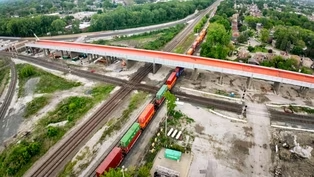
Untangling America’s Busiest Rail Intersection
Video has Closed Captions
Geoffrey Baer visits America’s busiest and most frustrating rail intersection near Chicago. (2m 49s)
Providing Support for PBS.org
Learn Moreabout PBS online sponsorship











Support for PBS provided by:
Chicago Tours with Geoffrey Baer is a local public television program presented by WTTW