
The Days of Cable Cars in Chicago
Clip: Special | 5m 3sVideo has Closed Captions
In the late 19th century, Chicago had the largest cable car network in the nation.
In the late 19th century, Chicago had the largest cable car network in the nation, with some 3,000 cable cars and 80 miles of rails. Unlike electric trolleys, these were motorless streetcars pulled by a steam-powered moving cable under the tracks. Charles Tyson Yerkes – known for shady business dealings – is the man who made it happen, as author Greg Borzo tells Geoffrey Baer.
Problems playing video? | Closed Captioning Feedback
Problems playing video? | Closed Captioning Feedback
Chicago Tours with Geoffrey Baer is a local public television program presented by WTTW
The Days of Cable Cars in Chicago
Clip: Special | 5m 3sVideo has Closed Captions
In the late 19th century, Chicago had the largest cable car network in the nation, with some 3,000 cable cars and 80 miles of rails. Unlike electric trolleys, these were motorless streetcars pulled by a steam-powered moving cable under the tracks. Charles Tyson Yerkes – known for shady business dealings – is the man who made it happen, as author Greg Borzo tells Geoffrey Baer.
Problems playing video? | Closed Captioning Feedback
Where to Watch Chicago Tours with Geoffrey Baer
Chicago Tours with Geoffrey Baer is available to stream on pbs.org and the PBS app.
- [Host] Almost nothing elicits more feelings of nostalgia than a streetcar.
Those clattering contraptions once carried folks to every corner of Chicago and many suburbs.
Well, we don't have 'em in Chicago anymore, but they've still got one in Kenosha.
Hi.
These electric trolleys drew their power from an overhead wire, but Chicago's first street cars were drawn by horses.
This is an actual wooden horse car that ran on the streets of Chicago before the Great Fire.
It was built in 1859, and it's the oldest artifact at the Illinois Railway Museum.
Prior to horse drawn street rail, mass transit in Chicago meant the omnibus, basically just a 12 passenger wagon with large wooden wheels pulled by horses.
And Chicago was one muddy place.
It could be a slow process, slogging from one place to another.
Putting the horse-drawn vehicle on rails was the first revolution.
It doubled or tripled your speed.
Now you could go up to six miles per hour, but Chicago's horse cars were replaced in the late 1800s by a kind of street rail more typically associated with San Francisco, the cable car.
Cable cars predate electricity in most of Chicago.
So what made them go?
The answer was in this building on LaSalle Street, built in 1887.
It was a powerhouse where a giant steam engine pulled a long cable made of steel and iron.
The cable ran continuously beneath the tracks embedded in the streets of Chicago.
Cable car drivers used a grip handle to latch onto the cable and pulled the car along to stop.
They simply released the grip and applied the brakes.
Today, the powerhouse is a steakhouse called Hawksmoor, formerly Michael Jordan's restaurant, where I bellied up to the bar with author and cable car expert Greg Borzo.
So what was the first day of cable car service like in Chicago?
- Chicagoans were real proud.
They came out in the tens of thousands to see the first cable car train go down State Street.
- And what must they have thought seeing this car?
- They were mystified because it made hardly any sound.
There was no horse in front, there were no electric cables of any kind, and it seemed like this train was just floating down the street.
- [Host] Within a handful of years, Chicago had 13 powerhouses, 80 miles of rails, and over 3,000 cable cars.
It was the largest cable car system in the nation.
So who rode cable cars?
Everybody.
It mixed wealthy with poor people and working class people.
- [Host] By 1892, Chicago's cable car network reached from just south of Diversity Avenue on the North Side all the way to 71st Street on the South Side.
- They helped to take parts of the city that were not yet developed and make them accessible.
It helped to democratize, I think, Chicago.
- [Host] Sounds nice, but the man who built Chicago's cable car network really just wanted to make himself rich.
His name was Charles Tyson Yerkes.
- And he was a robber baron of great fame, and he made a tremendous amount of money off of the cable car industry through bribery, through kickbacks, by watering down the stock of his companies.
- [Host] Yerkes moved from Philadelphia to Chicago after serving time in jail for shady business dealings out east.
He said, "I am in Chicago to make money, and if it were not for what I expect to make out of it, I would take the first train to New York and never set eyes on the beastly place again."
Beyond corruption, Yerkes didn't win any points for customer service either.
- [Greg] Many people complained that Yerkes overloaded his cars.
So those nickel fairs added up if you could cram enough people into the cars, even on the roof above the car.
So Yerkes became very, very unpopular.
- [Host] Not all the cable cars shortcomings were Yerkes's fault.
There were accidents if a cable grip failed to release, crashing the car into the one ahead.
A cable could break and without electricity to heat and light the cars, the ride just wasn't that comfortable.
- What happened to the cable cars is, they got leapfrogged by electric trolley cars.
Those were so much better.
The Caboose: A Home Away from Home
Video has Closed Captions
Geoffrey Baer tours an old freight caboose at the Illinois Railway Museum. (5m 24s)
Chicago’s Bygone Downtown Train Stations
Video has Closed Captions
Chicago once had six majestic train stations downtown. (4m 46s)
The Delightful Nostalgia of the Streetcar
Video has Closed Captions
Kenosha, Wisconsin, is home to a nostalgic array of streetcars. (3m 32s)
The Early Days of Chicago’s Loop
Video has Closed Captions
A little bit of Chicago-style palm-greasing went a long way in getting the Loop built. (3m 31s)
The Forgotten History of Chicago’s Yellow Line
Video has Closed Captions
Chicago’s Yellow Line is all that remains of an old high-speed rail line. (2m 9s)
Geoffrey Baer Drives a Steam Train
Video has Closed Captions
At the Illinois Railway Museum, a dream comes true for Geoffrey Baer. (2m 15s)
Go Inside an Intermodal Rail Container Yard
Video has Closed Captions
Visit the impressive CSX intermodal rail terminal near Midway Airport. (3m 25s)
How the Railroads Standardized Time
Video has Closed Captions
Once upon a time—time wasn’t standardized. And that was a problem for the booming railroad industry. (2m 59s)
How Trains Carried the Great Migration
Video has Closed Captions
Trains played a big role for Black Americans traveling north during the Great Migration. (2m 37s)
The Innovation and Invisible Labor of Pullman Railcars
Video has Closed Captions
As George Pullman expanded his rail car empire, he hired formerly enslaved men as porters. (3m 59s)
Video has Closed Captions
The South Shore Line is the sole survivor from the days of interurban railroads. (3m 4s)
May Theilgaard Watts and the Rails-to-Trails Movement
Video has Closed Captions
A Chicago naturalist helped propel the rails-to-trails movement. (3m 50s)
Riding in Style: The Golden Age of Rail Travel
Video has Closed Captions
In the first half of the 20th century, railroads exuded a sense of glamour. (4m 39s)
Riding the Rails with Geoffrey Baer – Trailer
Video has Closed Captions
Lifelong train enthusiast Geoffrey Baer explores how railroads shaped Chicago. (1m 1s)
Video has Closed Captions
It took a band of robbers only 30 minutes to pull off America’s biggest train heist. (4m 9s)
Video has Closed Captions
Rail enthusiasts gather at a busy railroad crossing in Rochelle, Illinois. (1m 50s)
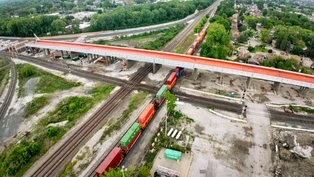
Untangling America’s Busiest Rail Intersection
Video has Closed Captions
Geoffrey Baer visits America’s busiest and most frustrating rail intersection near Chicago. (2m 49s)
Providing Support for PBS.org
Learn Moreabout PBS online sponsorship











Support for PBS provided by:
Chicago Tours with Geoffrey Baer is a local public television program presented by WTTW