
The Rondout Rail Robbery
Clip: Special | 4m 9sVideo has Closed Captions
It took a band of robbers only 30 minutes to pull off America’s biggest train heist.
On a summer night in 1924, a group of thieves brought a mail train to a halt at a rural junction called Rondout near Lake Bluff, Illinois. The infamous Newton Gang and their co-conspirators made away with $2 million, or approximately $37 million today. Geoffrey Baer explores how the robbers almost got away with it, were it not for one crucial error.
Problems playing video? | Closed Captioning Feedback
Problems playing video? | Closed Captioning Feedback
Chicago Tours with Geoffrey Baer is a local public television program presented by WTTW
The Rondout Rail Robbery
Clip: Special | 4m 9sVideo has Closed Captions
On a summer night in 1924, a group of thieves brought a mail train to a halt at a rural junction called Rondout near Lake Bluff, Illinois. The infamous Newton Gang and their co-conspirators made away with $2 million, or approximately $37 million today. Geoffrey Baer explores how the robbers almost got away with it, were it not for one crucial error.
Problems playing video? | Closed Captioning Feedback
Where to Watch Chicago Tours with Geoffrey Baer
Chicago Tours with Geoffrey Baer is available to stream on pbs.org and the PBS app.
- [Geoffrey] One smoky night in June of 1924, a crime right out of the Wild West began in downtown Chicago.
Two bandits snuck aboard a mail train leaving Union Station.
In those days, mail trains carried valuable merchandise, like bonds, jewels, and even sacks of cash.
Heading north, this particular train reached a rural junction, known as Rondout, near Libertyville, and those bandits were about to pull off the largest train robbery in American history.
How much money do you think is still out there?
- There's estimates that maybe just a little over a million.
Could still be out there somewhere, though- - Nicole Stocker from the Lake County Forest Preserve district took me to the scene of the crime.
She told me that when the train reached Rondout the two robbers climbed over the tender and into the cab of the engine with their guns drawn.
- And surprised the engineer and firemen who did not expect two men to come aboard.
So they told them they had to stop the train and they had guns in different things.
- [Geoffrey] The robbers were part of the notorious Newton Gang, four brothers from Texas, plus a number of accomplices, including an explosives expert named Brent Glasscock.
- The rest of the group was waiting in stolen Cadillacs.
- Stolen Cadillacs.
- Stolen Cadillacs.
- [Geoffrey] Not just like a stolen Ford or something?
- [Nicole] No.
And as soon as the train stopped, the rest of the group came out.
They knew exactly which car they wanted to target.
- [Geoffrey] The Newton boys clearly had inside information.
In less than 30 minutes, the gang had gathered a take worth an estimated $2 million.
That would be worth more than $37 million today.
And it all would've gone great, except for what?
- Well, during the course of this, one of the members of the group, Brent Glasscock, mistook another of their group as a train worker, and he shot him five different times.
He didn't realize who he was hitting.
- [Geoffrey] It was Doc Newton.
The gang piled the badly wounded Newton brother on top of some of the mail sacks in one of the Cadillacs, and made their getaway.
- And at least part of the group went back into Chicago to try to treat the injured brother.
- [Geoffrey] While a large portion of the money was never found, police soon found the robbers, - [Nicole] And it's still debated exactly who tipped them off, but somehow they were given an address to an apartment in Chicago, and when they got there, they found the injured brother with others in the group.
- Who's the insider in all of this.
- So the person who they eventually discovered was involved was William Fahy.
- [Geoffrey] As in Chicago postal inspector William Fahy.
He'd been a rising star in his field and gained notoriety for solving train robberies.
- He maintains his innocence until his death though, and says that he was framed for this crime by others who were jealous of his skill at solving train robberies.
- [Geoffrey] Doc survived and he and the rest of the Newtons received sentences from a year and a day to 12 years.
After being released, the Newtons returned to their lives of crime into their old age, and Joe Newton was interviewed on late night television.
- Now when's the first time you went to jail?
That Rondout train robbery.
- Yeah?
- Yes.
- I thought you were gonna put that on to stick me out.
(audience laughing) - You thought I was going to?
- Yeah, old habits die hard.
Don't they know?
(tense music) (inquisitive music)
The Caboose: A Home Away from Home
Video has Closed Captions
Geoffrey Baer tours an old freight caboose at the Illinois Railway Museum. (5m 24s)
Chicago’s Bygone Downtown Train Stations
Video has Closed Captions
Chicago once had six majestic train stations downtown. (4m 46s)
The Days of Cable Cars in Chicago
Video has Closed Captions
In the late 19th century, Chicago had the largest cable car network in the nation. (5m 3s)
The Delightful Nostalgia of the Streetcar
Video has Closed Captions
Kenosha, Wisconsin, is home to a nostalgic array of streetcars. (3m 32s)
The Early Days of Chicago’s Loop
Video has Closed Captions
A little bit of Chicago-style palm-greasing went a long way in getting the Loop built. (3m 31s)
The Forgotten History of Chicago’s Yellow Line
Video has Closed Captions
Chicago’s Yellow Line is all that remains of an old high-speed rail line. (2m 9s)
Geoffrey Baer Drives a Steam Train
Video has Closed Captions
At the Illinois Railway Museum, a dream comes true for Geoffrey Baer. (2m 15s)
Go Inside an Intermodal Rail Container Yard
Video has Closed Captions
Visit the impressive CSX intermodal rail terminal near Midway Airport. (3m 25s)
How the Railroads Standardized Time
Video has Closed Captions
Once upon a time—time wasn’t standardized. And that was a problem for the booming railroad industry. (2m 59s)
How Trains Carried the Great Migration
Video has Closed Captions
Trains played a big role for Black Americans traveling north during the Great Migration. (2m 37s)
The Innovation and Invisible Labor of Pullman Railcars
Video has Closed Captions
As George Pullman expanded his rail car empire, he hired formerly enslaved men as porters. (3m 59s)
Video has Closed Captions
The South Shore Line is the sole survivor from the days of interurban railroads. (3m 4s)
May Theilgaard Watts and the Rails-to-Trails Movement
Video has Closed Captions
A Chicago naturalist helped propel the rails-to-trails movement. (3m 50s)
Riding in Style: The Golden Age of Rail Travel
Video has Closed Captions
In the first half of the 20th century, railroads exuded a sense of glamour. (4m 39s)
Riding the Rails with Geoffrey Baer – Trailer
Video has Closed Captions
Lifelong train enthusiast Geoffrey Baer explores how railroads shaped Chicago. (1m 1s)
Video has Closed Captions
Rail enthusiasts gather at a busy railroad crossing in Rochelle, Illinois. (1m 50s)
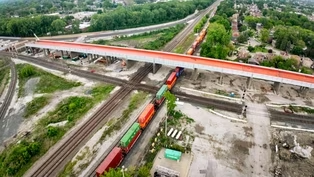
Untangling America’s Busiest Rail Intersection
Video has Closed Captions
Geoffrey Baer visits America’s busiest and most frustrating rail intersection near Chicago. (2m 49s)
Providing Support for PBS.org
Learn Moreabout PBS online sponsorship












Support for PBS provided by:
Chicago Tours with Geoffrey Baer is a local public television program presented by WTTW