
How Trains Carried the Great Migration
Clip: Special | 2m 37sVideo has Closed Captions
Trains played a big role for Black Americans traveling north during the Great Migration.
Trains played a major role in the Great Migration – the period between 1910 and 1970 that saw more than 7,000,000 Southern Black Americans move to Northern cities. Geoffrey Baer interviews author, poet, and professor Eve Ewing to discover how the train became a symbol of freedom and opportunity.
Problems playing video? | Closed Captioning Feedback
Problems playing video? | Closed Captioning Feedback
Chicago Tours with Geoffrey Baer is a local public television program presented by WTTW
How Trains Carried the Great Migration
Clip: Special | 2m 37sVideo has Closed Captions
Trains played a major role in the Great Migration – the period between 1910 and 1970 that saw more than 7,000,000 Southern Black Americans move to Northern cities. Geoffrey Baer interviews author, poet, and professor Eve Ewing to discover how the train became a symbol of freedom and opportunity.
Problems playing video? | Closed Captioning Feedback
Where to Watch Chicago Tours with Geoffrey Baer
Chicago Tours with Geoffrey Baer is available to stream on pbs.org and the PBS app.
- [Host] Of all the lost terminals, Central Station on the lakefront, home to the Illinois Central Railroad, probably did more than any other to mark a transformative time in Chicago history.
It stood here, near Michigan Avenue and Roosevelt Road, on tracks still used by the Metra Electric and South Shore lines.
- Every time I see that train coming or going, I do.
I think about the dreams, and the possibility, and the people who had all of their hopes invested in that train, right?
Invested in that ride, and how they made the city that made me.
- [Host] Author, poet, and professor, Eve Ewing, is talking about the Great Migration, the period between 1910 and 1970 that saw more than 7 million Southern African Americans move to Northern cities.
The Illinois Central Railroad brought many of the half million who settled in Chicago.
- We can imagine people arriving right at the spot in their Sunday best, and think about what a momentous occasion this must have been for folks.
- Kind of a sacred space.
- It's magical.
It's absolutely magical.
- [Host] Even after emancipation, Southern landowners kept Black people in hopeless debt as sharecroppers.
Many learned about better opportunities in the North from articles published in the "Chicago Defender" newspaper and distributed clandestinely by Pullman Porters.
- And they would say it's better to freeze to death as a free person than it is to die warm in bondage in the South.
During the Great Migration, the train really became a very literal symbol of dreaming, a symbol of freedom for Black people in the South.
- What did they find when they got here?
- You know, like most stories of the promised land, Chicago partially delivered and partially didn't.
There was housing segregation.
There was employment segregation.
There was educational segregation.
- [Host] By the end of the Great Migration, the Black population in Chicago had increased more than 30-fold, and while there were barriers to their dreams here, many did find a better life, and some became famous, like "Ebony" and "Jet" magazine publisher, John H. Johnson, and the great author, Richard Wright.
- We can think about the blues.
Think about people like Buddy Guy, people like Muddy Waters.
We can imagine this thread of culture that binds together these two places, but it wasn't just an invisible cultural thread.
It was literally the rail line, right?
For me, every time I see a train, hear a train, ride a train, I still feel that flicker, that childhood flicker that something is possible.
(train whooshes)
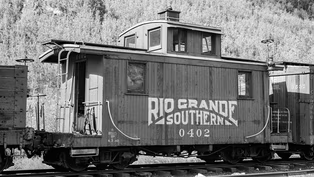
The Caboose: A Home Away from Home
Video has Closed Captions
Geoffrey Baer tours an old freight caboose at the Illinois Railway Museum. (5m 24s)
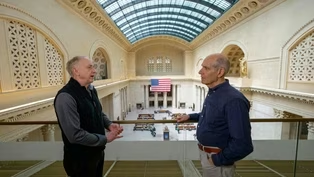
Chicago’s Bygone Downtown Train Stations
Video has Closed Captions
Chicago once had six majestic train stations downtown. (4m 46s)
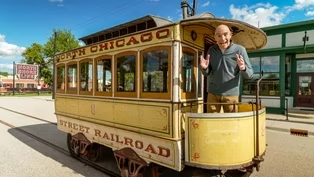
The Days of Cable Cars in Chicago
Video has Closed Captions
In the late 19th century, Chicago had the largest cable car network in the nation. (5m 3s)
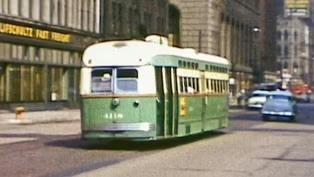
The Delightful Nostalgia of the Streetcar
Video has Closed Captions
Kenosha, Wisconsin, is home to a nostalgic array of streetcars. (3m 32s)
The Early Days of Chicago’s Loop
Video has Closed Captions
A little bit of Chicago-style palm-greasing went a long way in getting the Loop built. (3m 31s)
The Forgotten History of Chicago’s Yellow Line
Video has Closed Captions
Chicago’s Yellow Line is all that remains of an old high-speed rail line. (2m 9s)
Geoffrey Baer Drives a Steam Train
Video has Closed Captions
At the Illinois Railway Museum, a dream comes true for Geoffrey Baer. (2m 15s)
Go Inside an Intermodal Rail Container Yard
Video has Closed Captions
Visit the impressive CSX intermodal rail terminal near Midway Airport. (3m 25s)
How the Railroads Standardized Time
Video has Closed Captions
Once upon a time—time wasn’t standardized. And that was a problem for the booming railroad industry. (2m 59s)
The Innovation and Invisible Labor of Pullman Railcars
Video has Closed Captions
As George Pullman expanded his rail car empire, he hired formerly enslaved men as porters. (3m 59s)
Video has Closed Captions
The South Shore Line is the sole survivor from the days of interurban railroads. (3m 4s)
May Theilgaard Watts and the Rails-to-Trails Movement
Video has Closed Captions
A Chicago naturalist helped propel the rails-to-trails movement. (3m 50s)
Riding in Style: The Golden Age of Rail Travel
Video has Closed Captions
In the first half of the 20th century, railroads exuded a sense of glamour. (4m 39s)
Riding the Rails with Geoffrey Baer – Trailer
Video has Closed Captions
Lifelong train enthusiast Geoffrey Baer explores how railroads shaped Chicago. (1m 1s)
Video has Closed Captions
It took a band of robbers only 30 minutes to pull off America’s biggest train heist. (4m 9s)
Video has Closed Captions
Rail enthusiasts gather at a busy railroad crossing in Rochelle, Illinois. (1m 50s)
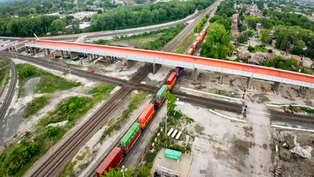
Untangling America’s Busiest Rail Intersection
Video has Closed Captions
Geoffrey Baer visits America’s busiest and most frustrating rail intersection near Chicago. (2m 49s)
Providing Support for PBS.org
Learn Moreabout PBS online sponsorship












Support for PBS provided by:
Chicago Tours with Geoffrey Baer is a local public television program presented by WTTW