
The Innovation and Invisible Labor of Pullman Railcars
Clip: Special | 3m 59sVideo has Closed Captions
As George Pullman expanded his rail car empire, he hired formerly enslaved men as porters.
George Pullman’s elegant sleeper cars transformed the rail experience in the 19th century. But the lives of the porters who tended to them were anything but glamorous, as Dr. Lionel Kimble tells Geoffrey Baer. Often formerly enslaved Black men, porters carried luggage, made the beds, served in the dining car, and even shined shoes while working long hours and staying in cramped quarters.
Problems playing video? | Closed Captioning Feedback
Problems playing video? | Closed Captioning Feedback
Chicago Tours with Geoffrey Baer is a local public television program presented by WTTW
The Innovation and Invisible Labor of Pullman Railcars
Clip: Special | 3m 59sVideo has Closed Captions
George Pullman’s elegant sleeper cars transformed the rail experience in the 19th century. But the lives of the porters who tended to them were anything but glamorous, as Dr. Lionel Kimble tells Geoffrey Baer. Often formerly enslaved Black men, porters carried luggage, made the beds, served in the dining car, and even shined shoes while working long hours and staying in cramped quarters.
Problems playing video? | Closed Captioning Feedback
Where to Watch Chicago Tours with Geoffrey Baer
Chicago Tours with Geoffrey Baer is available to stream on pbs.org and the PBS app.
- [Narrator] Back then, a train ride was a very uncomfortable ordeal, sitting on hard seats as the train lurched along.
In summer, you either sweated or opened the windows and got a lung full of coal dust from the steam engine.
(passenger coughing) The transformation of rail travel from punishing to pampering began after the Civil War, and it started in Chicago.
- They put a lot of work on the detail of these train cars.
- Yeah.
- [Narrator] Deluxe rail cars like this one , built by the Pullman Car Company on what is now Chicago's South Side, completely reinvented the idea of the rail car.
They were like luxury hotels on wheels.
- You know, honestly, in looking at this, this reminds me of someone's living room or someone's parlor.
- Yeah.
- [Narrator] You don't have to use your imagination to picture this kind of rail travel.
I rode a Pullman car at the Illinois Railway Museum in Union, Illinois with Dr.
Lionel Kimble, a history professor at Chicago State University.
- Blanket, it has the Pullman blanket.
- [Narrator] This was built as a private car with custom features, but even typical Pullman cars made by highly skilled craftsmen were sumptuous with lounges, private compartments that could be converted into sleeping quarters, and dining rooms.
And they were equipped with the finest suspension to ensure the ride was as smooth as it could be.
To go along with the luxurious surroundings, the company's all powerful owner, George Pullman, wanted his passengers treated to impeccable service.
- Pullman wanted to make the most opulent experience that he possibly could.
So you have these people waiting on you hand and foot 24 hours a day, as long as you're on this train.
(upbeat music) - [Narrator] To provide that service, Pullman found a ready-made workforce, formerly enslaved people who'd recently been freed.
- We have this underemployed section of people in the Deep South.
Why not use them?
- And did it sound like it would be a good job?
- I think relatively speaking.
These guys wore uniforms.
They traveled the country.
You know, they made more money than most people in their community was making.
So they were seen by their community as something to be celebrated.
- [Narrator] But a Pullman porter's day-to-day life on the train was anything but glamorous.
They carried luggage, made the beds, served in the dining cart, and even shined shoes.
- They were responsible for buying their own shoe-shine kits.
They had to count the towels.
You know, if anything ended up missing, they were financially responsible for it.
They would work upwards of 80 hours a week.
Get relatively little rest.
- What's in here?
- Hey, look.
This seems to be one of the cars or sections for the quarters.
- Yeah, so essentially this is servant's quarters.
- Yeah, I think that's an accurate way to put it.
- So we saw the luxury of the private car.
And this is what the Pullman Porters had.
When they were off duty, they were in here - Right, the time when they were off duty.
What I also thought what was interesting is that there's a small restroom here.
- A toilet?
- Yeah, a toilet here, you know, 'cause African Americans weren't allowed to use the same toilet facilities as whites.
- [Narrator] But Dr.
Kimble says that as the porters circulated almost invisibly among the passengers, they kept their ears open.
- They learned about the world.
They learned about politics.
They learned about the economy, and they learned about international occurrences, and they were able to bring that information back into their communities.
It was the beginning of the Black middle class.
You may see us as your wait staff, but we're doing something a lot greater.
We're building something.
And part of the story of African Americans in this country is that we're always building something.
(bright music) (steam hisses)
The Caboose: A Home Away from Home
Video has Closed Captions
Geoffrey Baer tours an old freight caboose at the Illinois Railway Museum. (5m 24s)
Chicago’s Bygone Downtown Train Stations
Video has Closed Captions
Chicago once had six majestic train stations downtown. (4m 46s)
The Days of Cable Cars in Chicago
Video has Closed Captions
In the late 19th century, Chicago had the largest cable car network in the nation. (5m 3s)
The Delightful Nostalgia of the Streetcar
Video has Closed Captions
Kenosha, Wisconsin, is home to a nostalgic array of streetcars. (3m 32s)
The Early Days of Chicago’s Loop
Video has Closed Captions
A little bit of Chicago-style palm-greasing went a long way in getting the Loop built. (3m 31s)
The Forgotten History of Chicago’s Yellow Line
Video has Closed Captions
Chicago’s Yellow Line is all that remains of an old high-speed rail line. (2m 9s)
Geoffrey Baer Drives a Steam Train
Video has Closed Captions
At the Illinois Railway Museum, a dream comes true for Geoffrey Baer. (2m 15s)
Go Inside an Intermodal Rail Container Yard
Video has Closed Captions
Visit the impressive CSX intermodal rail terminal near Midway Airport. (3m 25s)
How the Railroads Standardized Time
Video has Closed Captions
Once upon a time—time wasn’t standardized. And that was a problem for the booming railroad industry. (2m 59s)
How Trains Carried the Great Migration
Video has Closed Captions
Trains played a big role for Black Americans traveling north during the Great Migration. (2m 37s)
Video has Closed Captions
The South Shore Line is the sole survivor from the days of interurban railroads. (3m 4s)
May Theilgaard Watts and the Rails-to-Trails Movement
Video has Closed Captions
A Chicago naturalist helped propel the rails-to-trails movement. (3m 50s)
Riding in Style: The Golden Age of Rail Travel
Video has Closed Captions
In the first half of the 20th century, railroads exuded a sense of glamour. (4m 39s)
Riding the Rails with Geoffrey Baer – Trailer
Video has Closed Captions
Lifelong train enthusiast Geoffrey Baer explores how railroads shaped Chicago. (1m 1s)
Video has Closed Captions
It took a band of robbers only 30 minutes to pull off America’s biggest train heist. (4m 9s)
Video has Closed Captions
Rail enthusiasts gather at a busy railroad crossing in Rochelle, Illinois. (1m 50s)
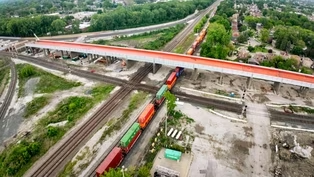
Untangling America’s Busiest Rail Intersection
Video has Closed Captions
Geoffrey Baer visits America’s busiest and most frustrating rail intersection near Chicago. (2m 49s)
Providing Support for PBS.org
Learn Moreabout PBS online sponsorship












Support for PBS provided by:
Chicago Tours with Geoffrey Baer is a local public television program presented by WTTW