
May Theilgaard Watts and the Rails-to-Trails Movement
Clip: Special | 3m 50sVideo has Closed Captions
A Chicago naturalist helped propel the rails-to-trails movement.
May Theilgaard Watts, a naturalist and educator who lived in and around Chicago, helped spark a rail reuse movement across the country as she sought to transform the old Chicago, Aurora and Elgin right-of-way into a walking trail.
Problems playing video? | Closed Captioning Feedback
Problems playing video? | Closed Captioning Feedback
Chicago Tours with Geoffrey Baer is a local public television program presented by WTTW
May Theilgaard Watts and the Rails-to-Trails Movement
Clip: Special | 3m 50sVideo has Closed Captions
May Theilgaard Watts, a naturalist and educator who lived in and around Chicago, helped spark a rail reuse movement across the country as she sought to transform the old Chicago, Aurora and Elgin right-of-way into a walking trail.
Problems playing video? | Closed Captioning Feedback
Where to Watch Chicago Tours with Geoffrey Baer
Chicago Tours with Geoffrey Baer is available to stream on pbs.org and the PBS app.
- [Narrator] Although trains still run on this short stretch of historic rails, the rest of the abandoned Chicago Aurora and Elgin right-of-way sat decaying for years until a remarkable local woman had an idea that sparked a movement across the country.
Her name was May Theilgaard Watts.
- May Watts is one of my heroes really.
- [Narrator] Dr.
Anne Keller teaches junior high school science in Michigan.
Her doctoral dissertation tells the story of May Watts' revolutionary idea to transform the abandoned rail line into a trail for hikers and bikers called the Illinois Prairie Path.
- Well, when you look at pictures of her, she's got her hair braided and her bandana on, and she's just ready to go.
She worked at the Morton Arboretum as their main educator there.
She wrote books and illustrated the works as well.
- [Narrator] Dr.
Keller's connection to May Watts started long before graduate school.
- I went to an environmental school just for sixth graders, and one of the songs that we learned, I found out later, was penned by May Watts.
- Can you sing the song?
- I can sing the song.
- Go ahead.
- All right.
♪ Know, know, know your oaks by the way they grow ♪ ♪ Red oak, white oak, bur oak, pin oak ♪ ♪ That's the way they grow ♪ (upbeat music) - [Narrator] The origin of the Prairie Path can be traced to a trip May Watts took to England where she marveled at the proliferation of footpaths.
She told Chicago's Studs Terkel about it.
in a 1969 radio interview.
- [May] I discovered footpaths and I went mad on footpaths and followed them.
And then I came home and I decided we need these footpaths.
But I looked at our landscape, I decided it's hopeless.
There is no place.
And then one day I crossed the old abandoned right-of-way of the electric railroad.
- [Studs] That's near here.
- [May] Yeah.
- [Narrator] Watts used all her powers of persuasion to put her plan into action.
There was a lot of opposition.
- A lot of opposition.
May Watts talked about the drooling bulldozers waiting, you know, to take over the space.
- She would take people on hikes along this proposed trail, right?
- She did to see the connections with all the forest preserves and the prairie remnants that were still here, and to get all these people on board and invite them in.
(light music) - [May] Having people become familiar and interested with things outdoors, they will be conservationists.
You never need to say that word.
- Whatever May Watts was doing, you wanted to be involved.
She was that dynamic and that charismatic and fought.
- [Narrator] In 1966, May Watts' dream became reality when the group secured a lease on 27 miles of the old line.
Other communities took notice and soon the rails-to-trails movement spread across the country.
In the Chicago area, the former North Shore line became the Green Bay Trail.
You can still spot remnants of former station platforms, pedestrian underpasses, and even the bases of the poles that supported the overhead wire.
On the south side, a stretch of the abandoned Wabash railroad became the Major Taylor Trail, and on the city's northwest side, a defunct elevated freight line became the 606 Trail.
Many more old lines remain abandoned, waiting for conversion as they cut mysterious diagonals through neighborhoods and towns.
(light upbeat music) (train rattling)
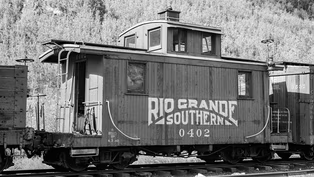
The Caboose: A Home Away from Home
Video has Closed Captions
Geoffrey Baer tours an old freight caboose at the Illinois Railway Museum. (5m 24s)
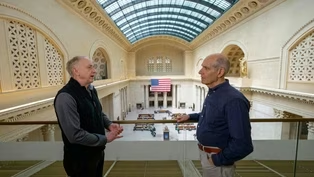
Chicago’s Bygone Downtown Train Stations
Video has Closed Captions
Chicago once had six majestic train stations downtown. (4m 46s)
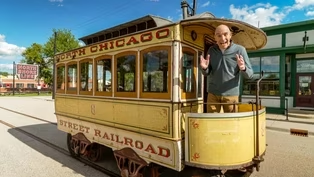
The Days of Cable Cars in Chicago
Video has Closed Captions
In the late 19th century, Chicago had the largest cable car network in the nation. (5m 3s)
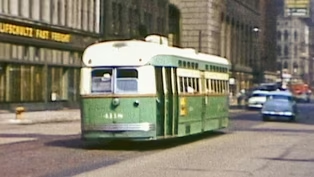
The Delightful Nostalgia of the Streetcar
Video has Closed Captions
Kenosha, Wisconsin, is home to a nostalgic array of streetcars. (3m 32s)
The Early Days of Chicago’s Loop
Video has Closed Captions
A little bit of Chicago-style palm-greasing went a long way in getting the Loop built. (3m 31s)
The Forgotten History of Chicago’s Yellow Line
Video has Closed Captions
Chicago’s Yellow Line is all that remains of an old high-speed rail line. (2m 9s)
Geoffrey Baer Drives a Steam Train
Video has Closed Captions
At the Illinois Railway Museum, a dream comes true for Geoffrey Baer. (2m 15s)
Go Inside an Intermodal Rail Container Yard
Video has Closed Captions
Visit the impressive CSX intermodal rail terminal near Midway Airport. (3m 25s)
How the Railroads Standardized Time
Video has Closed Captions
Once upon a time—time wasn’t standardized. And that was a problem for the booming railroad industry. (2m 59s)
How Trains Carried the Great Migration
Video has Closed Captions
Trains played a big role for Black Americans traveling north during the Great Migration. (2m 37s)
The Innovation and Invisible Labor of Pullman Railcars
Video has Closed Captions
As George Pullman expanded his rail car empire, he hired formerly enslaved men as porters. (3m 59s)
Video has Closed Captions
The South Shore Line is the sole survivor from the days of interurban railroads. (3m 4s)
Riding in Style: The Golden Age of Rail Travel
Video has Closed Captions
In the first half of the 20th century, railroads exuded a sense of glamour. (4m 39s)
Riding the Rails with Geoffrey Baer – Trailer
Video has Closed Captions
Lifelong train enthusiast Geoffrey Baer explores how railroads shaped Chicago. (1m 1s)
Video has Closed Captions
It took a band of robbers only 30 minutes to pull off America’s biggest train heist. (4m 9s)
Video has Closed Captions
Rail enthusiasts gather at a busy railroad crossing in Rochelle, Illinois. (1m 50s)
Untangling America’s Busiest Rail Intersection
Video has Closed Captions
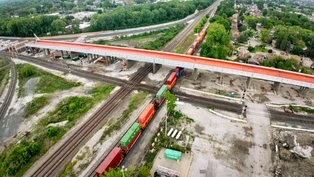
Geoffrey Baer visits America’s busiest and most frustrating rail intersection near Chicago. (2m 49s)
Providing Support for PBS.org
Learn Moreabout PBS online sponsorship












Support for PBS provided by:
Chicago Tours with Geoffrey Baer is a local public television program presented by WTTW