
The Delightful Nostalgia of the Streetcar
Clip: Special | 3m 32sVideo has Closed Captions
Kenosha, Wisconsin, is home to a nostalgic array of streetcars.
The Kenosha Streetcar Society maintains a fleet of nostalgic and colorful streetcars. Geoffrey Baer visits Kenosha and also explores the history of Chicago streetcars, which ran until the late 1950s.
Problems playing video? | Closed Captioning Feedback
Problems playing video? | Closed Captioning Feedback
Chicago Tours with Geoffrey Baer is a local public television program presented by WTTW
The Delightful Nostalgia of the Streetcar
Clip: Special | 3m 32sVideo has Closed Captions
The Kenosha Streetcar Society maintains a fleet of nostalgic and colorful streetcars. Geoffrey Baer visits Kenosha and also explores the history of Chicago streetcars, which ran until the late 1950s.
Problems playing video? | Closed Captioning Feedback
Where to Watch Chicago Tours with Geoffrey Baer
Chicago Tours with Geoffrey Baer is available to stream on pbs.org and the PBS app.
(trolley squeals) - This is the way to travel.
- Makes all the right noises.
- Yeah, I love those sounds.
- [Narrator] Chicago's electric streetcars, also called trolleys, didn't travel as far as Kenosha, Wisconsin, but that's where you can go for a trip down memory lane.
- My mom still talks about riding the Madison Street trolley, right?
I mean, is there something kind of magical about them?
- Oh, absolutely, absolutely.
- [Narrator] Author David Sadowski publishes a website called "The Trolley Dodger," devoted to the history of transit.
Even the name is history.
- Were people having to like literally dodge them, like they were in danger of being hit?
- Oh, sure, sure.
Those things did not slow down.
They were the kings of the street.
- [Narrator] In fact, this is how a certain baseball team got its name.
- The Brooklyn Dodgers, later Los Angeles Dodgers, were originally called the Trolley Dodgers 'cause you had to cross busy streets, dodging the trolleys in order to get to Ebbet's Field to watch them play.
- [Narrator] The streetcars in Kenosha, built in the 1950s, were the last generation of the streetcar age.
- They're sort of cool looking, you know, they're like- - Art deco.
Now, these were designed to try to get people outta their cars at a time when everybody was giving up on public transportation.
- [Narrator] Retired streetcar technician Brad Preston says the car's sleek lines were a big improvement over earlier streetcars.
- Rather than just a big box, you know, give it some style, give it some lines.
It looked like they were going 100 miles an hour standing still.
- [Narrator] Brad loves the cars so much that in his retirement, he still volunteers for the Kenosha Streetcar Society.
This car is painted in the colors, or livery as it's called, of the Chicago Surface Lines, a private company that predated the CTA.
These cars were nicknamed Green Hornets because of their sleek style and the buzzing noise they made.
(trolley buzzes) - There were no speed limits.
They weren't required to adhere to the speed limits that automobiles were, and the operators weren't even required to have driver's licenses for cars.
- [Narrator] But even the speedy Green Hornets couldn't catch up with the march of progress.
Chicago's last streetcar made its final run on June 22nd, 1958.
- Why did the trolleys go out of business in Chicago?
- It was part of a national trend.
The streets became more congested after World War II.
It slowed traffic down.
- [Narrator] The city switched to buses, which could weave around traffic, something street cars couldn't do.
And for faster service, there was the L.
- With the L cars, you've got your own right of way.
There isn't a beer truck stopped in the street, making a delivery, that's stopping all your forward progress.
- So when the CTA found that they were able to speed up service on the elevated and increase ridership that way, they decided to put more and more resources into the L and less into the surface system.
(bell chimes) - [Narrator] For many people, the only evidence that Chicago ever had a streetcar system is when road resurfacing crews unearth long-buried rails that their parents and grandparents remember fondly.
(upbeat music)
The Caboose: A Home Away from Home
Video has Closed Captions
Geoffrey Baer tours an old freight caboose at the Illinois Railway Museum. (5m 24s)
Chicago’s Bygone Downtown Train Stations
Video has Closed Captions
Chicago once had six majestic train stations downtown. (4m 46s)
The Days of Cable Cars in Chicago
Video has Closed Captions
In the late 19th century, Chicago had the largest cable car network in the nation. (5m 3s)
The Early Days of Chicago’s Loop
Video has Closed Captions
A little bit of Chicago-style palm-greasing went a long way in getting the Loop built. (3m 31s)
The Forgotten History of Chicago’s Yellow Line
Video has Closed Captions
Chicago’s Yellow Line is all that remains of an old high-speed rail line. (2m 9s)
Geoffrey Baer Drives a Steam Train
Video has Closed Captions
At the Illinois Railway Museum, a dream comes true for Geoffrey Baer. (2m 15s)
Go Inside an Intermodal Rail Container Yard
Video has Closed Captions
Visit the impressive CSX intermodal rail terminal near Midway Airport. (3m 25s)
How the Railroads Standardized Time
Video has Closed Captions
Once upon a time—time wasn’t standardized. And that was a problem for the booming railroad industry. (2m 59s)
How Trains Carried the Great Migration
Video has Closed Captions
Trains played a big role for Black Americans traveling north during the Great Migration. (2m 37s)
The Innovation and Invisible Labor of Pullman Railcars
Video has Closed Captions
As George Pullman expanded his rail car empire, he hired formerly enslaved men as porters. (3m 59s)
Video has Closed Captions
The South Shore Line is the sole survivor from the days of interurban railroads. (3m 4s)
May Theilgaard Watts and the Rails-to-Trails Movement
Video has Closed Captions
A Chicago naturalist helped propel the rails-to-trails movement. (3m 50s)
Riding in Style: The Golden Age of Rail Travel
Video has Closed Captions
In the first half of the 20th century, railroads exuded a sense of glamour. (4m 39s)
Riding the Rails with Geoffrey Baer – Trailer
Video has Closed Captions
Lifelong train enthusiast Geoffrey Baer explores how railroads shaped Chicago. (1m 1s)
Video has Closed Captions
It took a band of robbers only 30 minutes to pull off America’s biggest train heist. (4m 9s)
Video has Closed Captions
Rail enthusiasts gather at a busy railroad crossing in Rochelle, Illinois. (1m 50s)
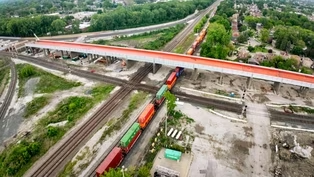
Untangling America’s Busiest Rail Intersection
Video has Closed Captions
Geoffrey Baer visits America’s busiest and most frustrating rail intersection near Chicago. (2m 49s)
Providing Support for PBS.org
Learn Moreabout PBS online sponsorship












Support for PBS provided by:
Chicago Tours with Geoffrey Baer is a local public television program presented by WTTW