
The Early Days of Chicago’s Loop
Clip: Special | 3m 31sVideo has Closed Captions
A little bit of Chicago-style palm-greasing went a long way in getting the Loop built.
CTA historian Graham Garfield joins Geoffrey Baer to discuss how Charles Tyson Yerkes got the Loop built – bribes and all.
Problems playing video? | Closed Captioning Feedback
Problems playing video? | Closed Captioning Feedback
Chicago Tours with Geoffrey Baer is a local public television program presented by WTTW
The Early Days of Chicago’s Loop
Clip: Special | 3m 31sVideo has Closed Captions
CTA historian Graham Garfield joins Geoffrey Baer to discuss how Charles Tyson Yerkes got the Loop built – bribes and all.
Problems playing video? | Closed Captioning Feedback
Where to Watch Chicago Tours with Geoffrey Baer
Chicago Tours with Geoffrey Baer is available to stream on pbs.org and the PBS app.
- The street cars may be long gone in Chicago, but city transit by rail is still alive and well: the L system.
You can take it to the South Side, the Southwest Side, it'll take you to the North Side.
It takes you down the Eisenhower Expressway to the West Side and up the middle of the Kennedy Expressway to the Northwest Side.
You can even ride it at street level through this quaint neighborhood.
(train rumbling) Of course, the most famous part of the L system is our Downtown Loop.
This is where nearly all the train lines come together.
It circles an area just five blocks wide by seven blocks long.
And it's the creation of our old friend Charles Tyson Yerkes.
So, as you can imagine, building it was hotly contested and involved more than a little grift.
- So what Yerkes was very good at was not only underhanded business practices, but figuring out which type of underhanded business practice was needed for each situation.
- [Geoffrey] CTA General manager, Graham Garfield, is the agency's unofficial historian.
- When the L lines first opened, the big disadvantage they had compared to the street cars was that they ended on the edge of downtown.
- [Geoffrey] In other words, there was no loop.
Yerkes was determined to unite the lines and reap the rewards.
- Long before CTA, all of the L routes were all built by private companies.
They had to get what was called a franchise in order to build the line.
And in Chicago, it would usually involve a lot of behind-the-scenes negotiation, some of it for favors, maybe some of it financial.
- Bribes.
- Yeah, but better known as bribes.
- [Geoffrey] In this case, Yerkes had to convince business owners along the planned route of the loop structure to allow him to build it.
But no amount of palm greasing was enough to convince business owners on Van Buren Street to let him build the final leg.
- So Yerkes really pulled a fast one there, right?
- Yes, you need the consent of half of the property owners along a public way for a private enterprise like the L. So he sought permission to build a line far longer than the loop segment that he needed, all the way from Wabash to Halsted Street.
- Way west.
- Way west.
But really, all he needed was from Wabash to Wells Street.
- So weren't the people further west, you know, enraged when he never built the L line?
- They might've been a little annoyed, but they probably were in it more for the money they were paid for their consent signatures than for the actual transportation.
- Yerkes' business strategies made him a pariah, and he soon left the city for points east, and ultimately England, where he helped finance the London Underground.
But he left Chicago with the Loop.
Over the decades, there were calls to tear it down, but defenders of the Loop made their voices heard.
Turns out Chicago loves the Loop.
The American Institute of Architects called it our Eiffel Tower.
(whimsical music)
The Caboose: A Home Away from Home
Video has Closed Captions
Geoffrey Baer tours an old freight caboose at the Illinois Railway Museum. (5m 24s)
Chicago’s Bygone Downtown Train Stations
Video has Closed Captions
Chicago once had six majestic train stations downtown. (4m 46s)
The Days of Cable Cars in Chicago
Video has Closed Captions
In the late 19th century, Chicago had the largest cable car network in the nation. (5m 3s)
The Delightful Nostalgia of the Streetcar
Video has Closed Captions
Kenosha, Wisconsin, is home to a nostalgic array of streetcars. (3m 32s)
The Forgotten History of Chicago’s Yellow Line
Video has Closed Captions
Chicago’s Yellow Line is all that remains of an old high-speed rail line. (2m 9s)
Geoffrey Baer Drives a Steam Train
Video has Closed Captions
At the Illinois Railway Museum, a dream comes true for Geoffrey Baer. (2m 15s)
Go Inside an Intermodal Rail Container Yard
Video has Closed Captions
Visit the impressive CSX intermodal rail terminal near Midway Airport. (3m 25s)
How the Railroads Standardized Time
Video has Closed Captions
Once upon a time—time wasn’t standardized. And that was a problem for the booming railroad industry. (2m 59s)
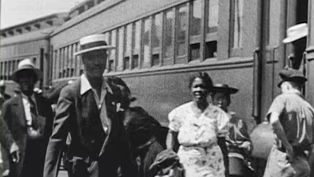
How Trains Carried the Great Migration
Video has Closed Captions
Trains played a big role for Black Americans traveling north during the Great Migration. (2m 37s)
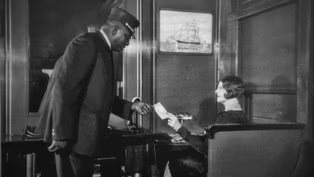
The Innovation and Invisible Labor of Pullman Railcars
Video has Closed Captions
As George Pullman expanded his rail car empire, he hired formerly enslaved men as porters. (3m 59s)
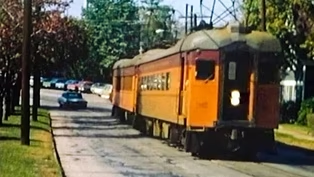
Video has Closed Captions
The South Shore Line is the sole survivor from the days of interurban railroads. (3m 4s)
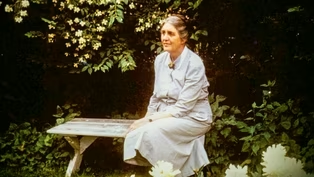
May Theilgaard Watts and the Rails-to-Trails Movement
Video has Closed Captions
A Chicago naturalist helped propel the rails-to-trails movement. (3m 50s)
Riding in Style: The Golden Age of Rail Travel
Video has Closed Captions
In the first half of the 20th century, railroads exuded a sense of glamour. (4m 39s)
Riding the Rails with Geoffrey Baer – Trailer
Video has Closed Captions
Lifelong train enthusiast Geoffrey Baer explores how railroads shaped Chicago. (1m 1s)
Video has Closed Captions
It took a band of robbers only 30 minutes to pull off America’s biggest train heist. (4m 9s)
Video has Closed Captions
Rail enthusiasts gather at a busy railroad crossing in Rochelle, Illinois. (1m 50s)
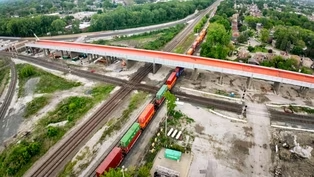
Untangling America’s Busiest Rail Intersection
Video has Closed Captions
Geoffrey Baer visits America’s busiest and most frustrating rail intersection near Chicago. (2m 49s)
Providing Support for PBS.org
Learn Moreabout PBS online sponsorship











Support for PBS provided by:
Chicago Tours with Geoffrey Baer is a local public television program presented by WTTW