
The Forgotten History of Chicago’s Yellow Line
Clip: Special | 2m 9sVideo has Closed Captions
Chicago’s Yellow Line is all that remains of an old high-speed rail line.
Chicago’s Yellow Line train is a curious little train with a hidden history. It is the last surviving fragment of the Skokie Valley branch of the old North Shore Line – a rail line to Milwaukee with speeds up to 90 miles per hour.
Problems playing video? | Closed Captioning Feedback
Problems playing video? | Closed Captioning Feedback
Chicago Tours with Geoffrey Baer is a local public television program presented by WTTW
The Forgotten History of Chicago’s Yellow Line
Clip: Special | 2m 9sVideo has Closed Captions
Chicago’s Yellow Line train is a curious little train with a hidden history. It is the last surviving fragment of the Skokie Valley branch of the old North Shore Line – a rail line to Milwaukee with speeds up to 90 miles per hour.
Problems playing video? | Closed Captioning Feedback
Where to Watch Chicago Tours with Geoffrey Baer
Chicago Tours with Geoffrey Baer is available to stream on pbs.org and the PBS app.
(intriguing music) - [Geoffrey] Here's a fact about the "L" that might surprise you.
The "L" once was part of a much larger rail system that extended way beyond Chicago, and you can still find remnants of it.
(intriguing music continues) - Far from the loop, (train humming) here at the northern end of the Red Line, you can transfer to a curious little train with a hidden history, the Yellow Line, aka, the Skokie Swift.
- [Announcer] It's a good bet most Yellow Line riders have no idea this is all that remains of a mostly forgotten high-speed rail line to Milwaukee that went into service way back in 1926.
(train horn blaring) This was the Skokie Valley branch of the North Shore Line.
(upbeat jazz music) An earlier branch that ran through the suburbs along the lakefront was just too slow of a way to get to Milwaukee.
It even ran as a street car in some places.
(train wheels screeching) The railroad built Ravinia Park in Highland Park to encourage ridership, but the real solution (train horn blaring) was to build a whole new branch that ran up the sparsely populated Skokie Valley, where today's Edens Expressway follows the same route.
(cheerful jazz music) Electric railroads like the North Shore Line were called interurbans.
They connected nearby cities in the days before good roads.
Riders on the Skokie Valley branch traveled at speeds up to 90 miles an hour on sleek, futuristic trains called Electroliners.
The North Shore Line was one of three interurbans in the Chicago area.
The Chicago Aurora and Elgin ran to communities in the Fox Valley, and the South Shore Line ran to northwest Indiana.
They all came to be controlled by Commonwealth Edison president Samuel Insull, who saw interurbans as a way to expand his electricity empire beyond Chicago, supplying power to new communities built along the route.
(cheerful jazz music ending) (upbeat jazz music)
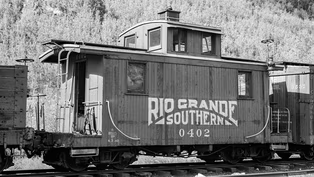
The Caboose: A Home Away from Home
Video has Closed Captions
Geoffrey Baer tours an old freight caboose at the Illinois Railway Museum. (5m 24s)
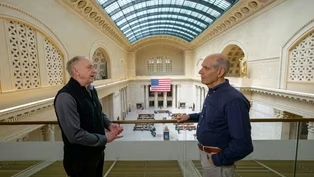
Chicago’s Bygone Downtown Train Stations
Video has Closed Captions
Chicago once had six majestic train stations downtown. (4m 46s)
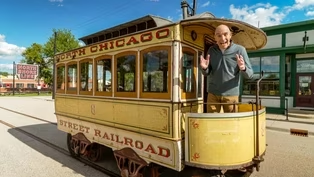
The Days of Cable Cars in Chicago
Video has Closed Captions
In the late 19th century, Chicago had the largest cable car network in the nation. (5m 3s)
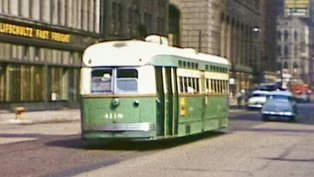
The Delightful Nostalgia of the Streetcar
Video has Closed Captions
Kenosha, Wisconsin, is home to a nostalgic array of streetcars. (3m 32s)
The Early Days of Chicago’s Loop
Video has Closed Captions
A little bit of Chicago-style palm-greasing went a long way in getting the Loop built. (3m 31s)
Geoffrey Baer Drives a Steam Train
Video has Closed Captions
At the Illinois Railway Museum, a dream comes true for Geoffrey Baer. (2m 15s)
Go Inside an Intermodal Rail Container Yard
Video has Closed Captions
Visit the impressive CSX intermodal rail terminal near Midway Airport. (3m 25s)
How the Railroads Standardized Time
Video has Closed Captions
Once upon a time—time wasn’t standardized. And that was a problem for the booming railroad industry. (2m 59s)
How Trains Carried the Great Migration
Video has Closed Captions
Trains played a big role for Black Americans traveling north during the Great Migration. (2m 37s)
The Innovation and Invisible Labor of Pullman Railcars
Video has Closed Captions
As George Pullman expanded his rail car empire, he hired formerly enslaved men as porters. (3m 59s)
Video has Closed Captions
The South Shore Line is the sole survivor from the days of interurban railroads. (3m 4s)
May Theilgaard Watts and the Rails-to-Trails Movement
Video has Closed Captions
A Chicago naturalist helped propel the rails-to-trails movement. (3m 50s)
Riding in Style: The Golden Age of Rail Travel
Video has Closed Captions
In the first half of the 20th century, railroads exuded a sense of glamour. (4m 39s)
Riding the Rails with Geoffrey Baer – Trailer
Video has Closed Captions
Lifelong train enthusiast Geoffrey Baer explores how railroads shaped Chicago. (1m 1s)
Video has Closed Captions
It took a band of robbers only 30 minutes to pull off America’s biggest train heist. (4m 9s)
Video has Closed Captions
Rail enthusiasts gather at a busy railroad crossing in Rochelle, Illinois. (1m 50s)
Untangling America’s Busiest Rail Intersection
Video has Closed Captions
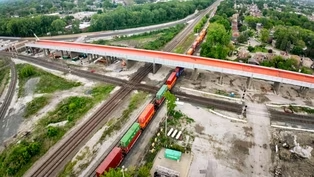
Geoffrey Baer visits America’s busiest and most frustrating rail intersection near Chicago. (2m 49s)
Providing Support for PBS.org
Learn Moreabout PBS online sponsorship











Support for PBS provided by:
Chicago Tours with Geoffrey Baer is a local public television program presented by WTTW