
Riding the Rails with Geoffrey Baer
Special | 57m 25sVideo has Audio Description
Geoffrey Baer hops aboard to tell the story of how railroads shaped Chicago.
Lifelong train enthusiast Geoffrey Baer hops aboard to tell the story of how railroads shaped our city. Along the way, he uncovers clues all around us to railroads of the past, recalls the colorful characters who built them and the unsung workers who toiled on them, and reveals why our current rail system remains just as vital today. Audio-narrated descriptions of key visual elements available.
See all videos with Audio DescriptionADProblems playing video? | Closed Captioning Feedback
Problems playing video? | Closed Captioning Feedback
Chicago Tours with Geoffrey Baer is a local public television program presented by WTTW
Riding the Rails with Geoffrey Baer
Special | 57m 25sVideo has Audio Description
Lifelong train enthusiast Geoffrey Baer hops aboard to tell the story of how railroads shaped our city. Along the way, he uncovers clues all around us to railroads of the past, recalls the colorful characters who built them and the unsung workers who toiled on them, and reveals why our current rail system remains just as vital today. Audio-narrated descriptions of key visual elements available.
See all videos with Audio DescriptionADProblems playing video? | Closed Captioning Feedback
Where to Watch Chicago Tours with Geoffrey Baer
Chicago Tours with Geoffrey Baer is available to stream on pbs.org and the PBS app.
- In Chicago, we love to toot our own horn.
(train horn blares) Maybe that's because we're the railroad capital of America.
In this show, we'll travel across miles and across time to see how railroads literally shaped Chicago.
- There were dozens of different railroads.
- Going up.
- This is the Super Bowl of railroading.
(train whooshing) (people cheering) - Every time I see a train, hear a train, ride a train, I think about this history.
(bell ringing) - Howdy.
Where's the gas pedal?
- We're a 24-hour operation, seven days a week.
(horn blowing) - Those things did not slow down.
- This is the way to travel.
- Come out and visit, come out and have picnics.
(bell rings) - I love this China cabinet.
- There's something about it.
- It's magical.
(horn blowing) - As soon as the train stopped, the robbery took less than 30 minutes.
- Well... - Still waiting.
- That was new to me.
I'd never heard of it before.
(steam hissing loudly) - Whoa!
I'm Geoffrey Baer.
Join me as we ride the rails.
(horn blows) (train clickety-clacking) (cheerful music) (train horn blows) (food sizzles) (indistinct chatter) (bell rings) If you're a kid who loves trains, and what kid doesn't, coming to "the choo-choo" restaurant in the northwest suburb of Des Plaines is like a pilgrimage.
You know, I was one of those kids.
I kind of still am.
Thank you.
(horn blows) Now the food's great, but it wasn't really about the food.
It's about how the food was delivered.
(cheerful music continues) I've loved trains ever since I was the same age as these kids.
I grew up in a neighborhood right along the tracks and every time a train passed by, I'd run to the window to watch.
The only thing better than getting your food delivered by a model train is getting to ride on a real one.
I hate to eat and run, but we've got a train to catch.
(bell ringing) We start our journey through Chicago's rails on Metra's Union Pacific Northwest Line.
(uplifting music) (train whooshing) You might think Metra is just a commuter rail service in the Chicago area, but did you know that all the lines used by Metra today were once part of rail systems that extended to the far corners of the country?
They were the great railroads, all of them originating or terminating in Chicago in the days before air travel or even automobiles.
Railroads with celebrated names like the Chicago Burlington and Quincy, the Rock Island Line, (train horn blowing) the Milwaukee Road, (train horn blows) (train clickety-clacking) and the Illinois Central.
- All aboard!
(upbeat music) (train chugging) (train whooshing) - [Geoffrey] Unlike today's commuter trains, cross country travelers of the past went in style.
(people chattering) The railroads fiercely competed on comfort, luxury and service.
- People talk about travel being the journey and not the destination.
And that's sort of what railroads were providing.
It was the experience of the journey of rail travel and not just the point of reaching your destination in the end.
- [Geoffrey] Here's one person who knows all about the glory days of rail.
Rachel Cole, the transportation librarian at Northwestern University.
- This is an album of promotional photographs from the Union Pacific City of Denver train.
It looks like a fun girls trip.
They're enjoying their time on the train.
This isn't even the glamorous car, and it looks very glamorous to me.
(Rachel chuckles) - Yeah.
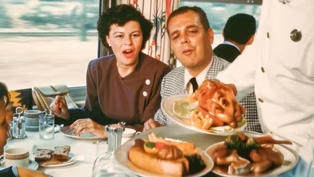
Railroads in the first half of the 20th century really played up the glamour and promised all the amenities of home.
- [Announcer] Spacious comfort is the keynote of this beautifully appointed apartment on rails.
(shaker rattling) - [Geoffrey] Lounges and observation cars offered diversions, drinks, and ever-changing decor out the windows.
(upbeat music continues) And dining cars were like high-end restaurants in motion.
- [Announcer] Nothing less than the best is more than a mere catchphrase for the chef and crew on this luxury train.
- Are you hungry, Geoffrey?
- Alright, let's see.
(both laugh) - This is a menu from the Milwaukee Road, Chicago, Milwaukee, and St.
Paul Railway back in its day from the 19th century.
- Look what's on the menu.
- [Rachel] It's really extensive.
- [Rachel] Had you heard of that before?
- Yeah.
- That was new to me.
I'd never heard of it before.
- [Geoffrey] Leg of venison.
- [Rachel] Leg of venison on your train.
- So I don't think kids would want like turtle soup and venison.
I know... - Mine definitely wouldn't.
- No.
- No.
- So was there some accommodation for them?
- There were accommodations for them.
This is just a really charming example from the Pennsylvania Railroad.
You can see the engineer- - It's a choo-choo.
- and his choo-choo.
(laughs) - Wow.
Poached egg.
(Rachel chuckles) Forget it.
Vegetable plate.
No.
But you could get cocoa and ice cream.
- That'll really make up for the vegetable plate, won't it?
- It was like the airlines back then.
They were private companies.
- That's right.
- Right?
- Yes.
- There were dozens of different railroads.
- [Geoffrey] And their trains had heroic names like the Super Chief, the Rocky Mountain Rocket, the Empire Builder, the Hiawatha, and the Iron and Copper Express.
And when diesel replaced steam, a revolutionary new kind of train appeared, the streamliners.
The Burlington Railroad promoted their streamliners as the Zephyrs, named for the Greek God of the west wind.
- [Rachel] You open the brochure and here it goes to the Century of Progress.
- Oh, gosh.
- Fair.
And the transportation building in 1934.
(light music) (bell ringing) - [Geoffrey] The Zephyr's arrival at that World's Fair on Chicago's lakefront was the grand finale of a stunt staged by the railroad.
A record-breaking dawn to dusk run from Denver to Chicago that saw the Zephyr reach a top speed of 112 miles an hour.
The Pioneer Zephyr is now permanently parked in the lower level of Chicago's Griffin Museum of Science and Industry.
Traveling this way would've been unimaginable to passengers in the early days of the railroads.
Back then, a train ride was a very uncomfortable ordeal, sitting on hard seats, as the train lurched along.
In summer, you either sweated or opened the windows and got a lung full of cold dust from the steam engine.
(man coughing) The transformation of rail travel from punishing to pampering began after the Civil War.
And it started in Chicago.
- They put a lot of work on the detail of these train cars.
- [Geoffrey] Deluxe rail cars like this one built by the Pullman Car Company on what is now Chicago's south side completely reinvented the idea of the rail car.
They were like luxury hotels on wheels.
- You know, honestly, in looking at this, this reminds me of someone's living room or someone's parlor.
- Yeah.
You don't have to use your imagination to picture this kind of rail travel.
I rode a Pullman car at the Illinois Railway Museum in Union, Illinois with Dr.
Lionel Kimble, a history professor at Chicago State University.
(indistinct chatter) - [Geoffrey] This was built as a private car with custom features.
But even typical Pullman cars made by highly skilled craftsmen were sumptuous with lounges, private compartments that could be converted into sleeping quarters and dining rooms.
And they were equipped with the finest suspension to ensure the ride was as smooth as it could be.
To go along with the luxurious surroundings, the company's all powerful owner, George Pullman, wanted his passengers treated to impeccable service.
- [Lionel] Pullman wanted to make the most opulent experience that he possibly could.
- Mm-hmm.
- [Lionel So you have these people waiting on you hand and foot 24 hours a day, as long as you're on this train.
(bright music) - [Geoffrey] To provide that service, Pullman found a ready-made workforce, formerly enslaved people who'd recently been freed.
- We have this underemployed section of people in the deep south.
Why not use them?
- And did it sound like it would be a good job?
- I think, relatively speaking.
These guys wore uniforms.
They traveled the country.
- Yeah.
- You know, they made more money than most people in their community was making.
So they were seen by their community as something to be celebrated.
- [Geoffrey] But a Pullman porter's day-to-day life on the train was anything but glamorous.
They carried luggage, made the beds, served in the dining cart, and even shined shoes.
- They were responsible for buying their own shoe shine kits.
They had to count the towels, you know, if anything ended up missing, they were financially responsible for it.
They would work upwards of 80 hours a week.
Got relatively little rest.
- What's in here?
- It look, so it seems to be one of the cars for the, the section for the quarters.
- Yeah.
So essentially this is servant's quarters.
- Yeah, I think that's a accurate way to put it.
- So we saw the luxury of the private car.
- Yeah.
- And this is what the Pullman porters had.
When they were off duty, they were in here.
- Right, the time when they were off duty.
But I also thought what was interesting is that there's a small restroom here.
- Toilet.
- Yeah, a toilet here.
You know, 'cause African-Americans weren't allowed to use the same toilet facilities as whites.
- [Geoffrey] But Dr.
Kimble says that as the porters circulated almost invisibly among the passengers, they kept their ears open.
- They learned about the world.
They learned about politics, they learned about the economy, they learned about international occurrences, and they were able to bring that information back into their communities.
It was the beginning of the Black middle class.
You may see us as your waitstaff, but we're doing something a lot greater.
We're building something.
And part of the story of African Americans in this country is that we're always building something.
(inspiring music) - In the heyday of rail travel, the terminals themselves were awe-inspiring.
And if you think they don't make 'em like that anymore, just ride a Metra train down to Ogilvie Transportation Center.
How's this for a grand entrance?
Architect Helmut Jahn was almost certainly thinking of the magnificent old Chicago and Northwestern train terminal that once stood right here when he designed this building to replace it.
The old Chicago and Northwestern Railroad terminal served riders for nearly 75 years.
It was one of the nation's largest and grandest terminals when it opened in 1911.
Ogilvie Transportation Center, which opened in 1987, tries to preserve that feeling.
And passengers who stop to notice seem to agree.
What did you think when you came through the doors?
- It's beautiful.
I'm so impressed.
- You know, the architecture allows the, allows you to feel open at all times.
- Not a bad way to introduce the city to people coming off the train.
- There were six historic train terminals in Chicago all the way up until the 1970s.
Only one of them is still in use for rail.
And that's where we're going next.
Chicago's Union Station.
(uplifting music) Today, Union Station bustles with humanity serving six Metra lines and Amtrak.
Well, this really gives you a wow effect, doesn't it?
- It is one of the favorite places in Chicago seeing the... - [Geoffrey] That's DePaul University professor, Joseph Schwieterman.
He remembers coming here as a child on family trips from Indiana in the days before Amtrak.
- It was just like coming to another world.
I'm from a little farm town.
So when you traveled, you had plans for people to meet you at the station.
You didn't have a cell phone to call.
So it was an adventure.
And this station, I think is a testament to that era where railroads shaped cities.
- Chicago's six great terminals almost made the city seem like Oz.
In addition to Union Station and Chicago and Northwestern Station, there was LaSalle Street Station.
The tracks are still there and used by Metra.
But the station was torn down in 1981.
Grand Central Station.
Yes, we had a Grand Central Station in Chicago along the Chicago River's south branch.
It was torn down in 1971.
Dearborn Station on Printer's Row still stands, but it was repurposed as a shopping mall in 1984.
And Central Station, which towered over the south end of Grant Park, torn down in 1974.
According to Schwieterman, no other city even came close to the number of major terminals Chicago had.
And this is because Chicago was the railroad hub for the country?
- We are the railroad hub times two you might say.
I mean Chicago, particularly in the area of passenger, had no rivals.
- [Geoffrey] All of Chicago's train terminals were on the edges of downtown and none connected to the others.
So if you were traveling through Chicago to another destination, you had to somehow make your way from one terminal to another.
- Oh.
It was a major headache for passengers.
And it can be, you know, close to a couple miles for some of these things.
You don't just take your bag and head down the street.
- The enterprising Parmelle Transfer Company capitalized on the situation, shuttling passengers and their luggage between terminals.
And there was another fringe benefit.
(bright music) - The Santa Fe's great trains to Los Angeles had the movie stars, and Chicago being the connecting point, we were the spot where celebrities would travel across the country.
- Chicago restaurateur, Ernie Byfield sent limos to transport stars like Richard Burton, Elizabeth Taylor, Lauren Bacall, and Humphrey Bogart to Byfield's famous Pump Room restaurant where Chicago Sun-Times gossip columnist, Irv Kupcinet, was waiting in Booth One for exclusive interviews.
The terminals might be gone, but they live on in the movies from high roller highjinks.
- It's worth that much to you?
- Yeah.
- [Geoffrey] To life-threatening mistaken identity.
- You keep walking.
I'll catch up.
- Yes, ma'am.
- [Geoffrey] To baby saving G-men.
(perambulator clacking) (tense dramatic music) (train crashes) And imagine cleaning up Union Station after this scene.
Fortunately, it was filmed on a sound stage.
(soft playful music) Of all the lost terminals, Central Station on the lakefront home to the Illinois Central Railroad probably did more than any other to market transformative time in Chicago history.
It stood here near Michigan Avenue and Roosevelt Road on tracks still used by the Metra Electric and South Shore Lines.
- Every time I see that train coming or going, I do, I think about the dreams and the possibility and the people who had all of their hopes invested in that train, right, invested in that ride and how they made the city that made me.
- [Geoffrey] Author, poet, and professor Eve Ewing is talking about the Great Migration, the period between 1910 and 1970 that saw more than 7 million southern African Americans move to northern cities.
The Illinois Central Railroad brought many of the half million who settled in Chicago.
- We can imagine people arriving right at this spot in their Sunday best and think about what a momentous occasion this must have been for folks.
- Kind of a sacred space.
- It's magical.
It's absolutely magical.
(slow music) - [Geoffrey] Even after emancipation, Southern landowners kept Black people in hopeless debt as sharecroppers.
Many learned about better opportunities in the North from articles published in the Chicago Defender newspaper and distributed clandestinely by Pullman porters.
- And they would say it's better to freeze to death as a free person than it is to die warm in bondage in the South.
During the Great Migration, the train really became a very literal symbol of dreaming, a symbol of freedom for Black people in the South.
- What did they find when they got here?
- You know, like most stories of the Promised Land, Chicago partially delivered and partially didn't.
There was housing segregation, there was employment segregation, there was educational segregation.
- [Geoffrey] By the end of the Great Migration, the Black population in Chicago had increased more than 30-fold.
(upbeat music) And while there were barriers to their dreams here, many did find a better life, and some became famous like Ebony and Jet Magazine publisher John H. Johnson and the great author Richard Wright.
- We can think about the blues, think about people like Buddy Guy, people like Muddy Waters.
We can imagine this thread of culture that binds together these two places.
But it wasn't just an invisible cultural thread, it was literally the rail line, right?
For me, every time I see a train, hear a train, ride a train, (bell ringing) I still feel that that flicker, that childhood flicker, that something is possible.
♪ Riding on the City of New Orleans ♪ (audience applauding) ♪ Illinois Central, Monday morning rail ♪ - [Geoffrey] If you've heard of one train on the old Illinois Central, it's likely the City of New Orleans.
Thanks to this famous anthem by Chicago folkie Steve Goodman lamenting the end of the railroad era.
♪ This train has got the disappearing railroad blues ♪ - [Geoffrey] But it hasn't disappeared.
Passengers can still ride these historic rails daily on Amtrak's City of New Orleans.
♪ I'm the train they call the City of New Orleans ♪ ♪ And I'll be gone a long long time when day is done ♪ (audience applauding and cheering) (upbeat jaunty music) - Here's the kind of Chicago map most of us are familiar with, showing the streets.
But trains run in a sort of parallel universe.
They follow pathways of their own.
Of course, there are times when those parallel universes intersect.
(bell ringing) (train clickety-clacking) We've all been here before, stuck at a railroad crossing, waiting for a mile long freight train to pass.
Fortunately, there's a group that's doing something about this.
(bright sanguine music) A decades long multi-billion dollar, multi-agency project with the acronym CREATE will weave railroads and streets over, under, and around each other so trains and cars can flow freely without interruption.
(spark crackling) - This is the Super Bowl of railroading in not just the USA, but in North America.
It's part of what makes this region the undisputed champion of freight.
(train whirring) - [Geoffrey] CSX railroads Tom Livingston took me to America's busiest railroad intersection to illustrate the problem.
It's at 75th Street on Chicago's south side.
- This is a major conflict point.
It would be, like, taking two of your major interstates in this region and putting a four-way stop sign.
It's just really everybody has to wait.
There is no close second place to Chicago in terms of daily freight exchange.
And so when Chicago gets a cold, the rest of the country gets the flu.
(Geoffrey chuckles) - [Geoffrey] To solve the problem here, CREATE is building a mile and a half long bridge to carry the north-south trains over the east-west trains.
So that first day when a train goes across, are you nervous?
Like, is it gonna hold?
- (chuckles) No, I know it's gonna hold.
I mean, this has been designed to last 200 years.
- [Tom] It's like a heart bypass for freight rail in the city.
And that begins to unlock the rest of the country.
- [Geoffrey] This is just one of 70 projects in the CREATE program, which started in the early 2000s and still has years to go.
- It's a make-no-small-plans industry in a make-no-small-plans city.
(train clickety-clacking) - Still waiting.
But for some people there's nothing better than the sight of a freight train.
(train clickety-clacking) (soft quirky music) These are rail fans, and they're passionate about train spotting.
So passionate that the city of Rochelle, Illinois created this railroad park about an hour and a half west of Chicago at a particularly busy crossing of two rail lines so rail fans could safely gather and indulge in their favorite pastime.
- When I was old enough to crawl, I would crawl myself up to the window and I'd pull myself up, watch the train go by, and then I thought I was the only one who liked trains in this world.
And then I met more people like these gentlemen right here- - Mm-hmm.
- and my interest just sparked - We'd get on our bicycles on summer nights and we would ride down to where the Indiana Harbor Belt and the Burlington Northern Cross and we would just watch trains all the time.
(train clickety-clacking) - And it's very relaxing to me.
There's something about it.
I don't know if it's the methodical aspect of it.
There's something that's very, I just really like it.
(train clickety-clacking) (wheels whirring) - That's so cool that you're here from Seattle to watch the train.
- I've worked for BNSF back home, so some of the trains that I handle out of Seattle show up here.
It's been a good career.
It's been a good living for my family and it's still fun.
- [Geoffrey] Yeah, I bet.
- Obviously I'm doing it on vacation, right?
- [Geoffrey] And who's responsible for the food?
- Well, my friend Ruth Ann always brings the candy.
She's the candy lady.
- Mm-hmm.
- And Cherry always bags up things for us and I try to bring popcorn or something else.
And cookies are from Doug and- - You gotta have a lot of nourishment while you're waiting.
- Oh, absolutely.
(both chuckle) - Some of the freight cars passing here are ones I remember from my train set as a kid.
Hopper cars, tank cars, gondolas, but many are a kind of car I wouldn't have recognized back then.
Something called a well car carrying shipping containers, like these at the CSX container yard in Bedford Park next to Midway Airport.
Containers can be transferred from ships to trains to trucks without their contents being unloaded until they reach their final destinations.
It's called intermodal shipping.
If you look around your house and you just think about everything in your house, how much of that came on containers?
- Probably 99.9% of it.
- Tiretta Stribling is the senior terminal manager here, and this is just one of 19 intermodal terminals in the Chicago area.
So what's in these containers?
- It's the everyday things that we need.
Tissue, garbage bags, paper towels, your furniture.
I mean, we even do cars like Teslas.
(quirky music) - Now the fun part.
(Geoffrey grunts) - Hi, Charlie.
- Hi.
- Charlie Morgan took me for a ride on his rubber wheel gantry crane, five stories tall and six containers wide to show us how containers go from trains to trucks.
Going up.
(crane whirring) - Normally we would try to work from one end to the other.
That's the most efficient way to do it.
So I have to put all four of those corners into these holes.
- Look at that.
You gotta get it all lined up.
- [Charlie] The lights tell me when I'm in the box and I can lock it and pick it up.
- Oh man, here it goes.
I kind of felt that.
(indistinct radio chatter) - Yeah, it's a lot of weight.
- How much, do you know how much that thing weighs?
- [Charlie] Estimate 40,000 pounds.
That would be an average.
- 20 tons.
So it's going down onto this chassis now.
- [Charlie] Yeah.
- So how good are you at parallel parking your car?
- (chuckles) Pretty good, I guess.
(Geoffrey laughs) If I can drive this, I could probably drive anything with wheels.
(soft music) - [Geoffrey] With trains nearly three miles long, you need a lot of trucks to haul away all those containers.
So how many truck drivers come in and outta here every day?
- We can have between 2,000 to 3,800 a day.
- And what are the working hours here?
- We're a 24-hour operation, usually seven days a week.
The only time that we're closed is Christmas day.
- So you're not Scrooge?
- No.
(truck engine revving) - Each container is tracked by computer so workers know which train to load them on and where on the train to place them.
So have you always wanted to be a railroader?
- My father was a freight conductor.
My grandfather was an engineer.
My brother was a yard master.
(crane whirring) - That's really common in this industry, isn't it?
That it's- - Yeah, it is.
- hereditary.
(quirky music) Just like the railroaders, Chicago itself can trace its railroad ancestry, starting with the city's very first locomotive.
Chicago's rise to become America's railroad capital has a rather inauspicious beginning with this little steam engine, the Pioneer, which now lives permanently at the Chicago History Museum.
Chicago's first railroad, the Galena & Chicago Union bought it secondhand and had it delivered to Chicago on a sailing ship.
It went into service in 1848, while the railroad was still only partly completed.
(train horn blows) On its first run, the train carried local dignitaries from the mouth of the Chicago River's North Branch to the Des Plaines River, which was as far as the tracks had been laid.
According to legend, it returned to Chicago with a load of wheat from a local farmer making it Chicago's first official freight train.
Within a few short decades, rail lines were extending from Chicago in all directions.
(steam hissing) Of course, more and more trains meant more and more steam engines belching out huge plumes of black smoke that laid over the city like a shroud.
At one time, downtown Chicago was surrounded by railroad yards and Loop buildings were black with soot.
One smoky night in June of 1924, a crime right out of the wild west began in downtown Chicago.
Two bandits snuck aboard a mail train leaving Union Station.
In those days, mail trains carried valuable merchandise like bonds, jewels, and even sacks of cash.
Heading north, this particular train reached a rural junction known as Rondout near Libertyville, and those bandits were about to pull off the largest train robbery in American history.
How much money do you think is still out there?
- There's estimates that maybe just a little over a million could still be out there somewhere, though some... - [Geoffrey] Nicole Stocker from the Lake County Forest Preserve district took me to the scene of the crime.
She told me that when the train reached Rondout, the two robbers climbed over the tender and into the cab of the engine with their guns drawn.
(gun cocks) - [Robber] Hands up!
- And surprised the engineer and firemen who did not expect two men to come aboard.
So they told them they had to stop the train and they had guns and different things.
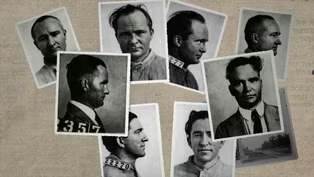
(dramatic music) - [Geoffrey] The robbers were part of the notorious Newton Gang, four brothers from Texas, plus a number of accomplices, including an explosives expert named Brent Glasscock.
- The rest of the group was waiting in stolen Cadillacs.
- Stolen Cadillacs.
- Stolen Cadillacs.
- [Geoffrey] Not just like a stolen Ford or something.
- No, and as soon as the train stopped, the rest of the group came out.
They knew exactly which car they wanted to target.
- The Newton boys clearly had inside information.
In less than 30 minutes, the gang had gathered a take with an estimated $2 million.
(cash register ka-chings) (bills rustling) (coins clinking) That would be worth more than $37 million today.
And it all would've gone great except for what?
- Well, during the course of this, one of the members of the group, Brent Glasscock, mistook another of their group as a train worker and he shot him five different times.
He didn't realize who he was hitting.
(dramatic music) - [Geoffrey] It was Doc Newton.
The gang piled the badly wounded Newton brother on top of some of the mail sacks in one of the Cadillacs and made their getaway.
- And at least part of the group went back into Chicago to try to treat the injured brother.
- [Geoffrey] While a large portion of the money was never found, police soon found the robbers.
(cow moos) - And it's still debated exactly who tipped them off, but somehow they were given an address to an apartment in Chicago, and when they got there, they found the injured brother with others in the group.
- Hmm.
Who's the insider in all of this?
- So the person who they eventually discovered was involved was William Fahy.
(dramatic music) - [Geoffrey] As in Chicago postal inspector William Fahy.
He'd been a rising star in his field and gained notoriety for solving train robberies.
- He maintains his innocence until his death though, and says that he was framed for this crime by others who were jealous of his skill at solving train robberies.
(metallic rattle) - [Geoffrey] Doc survived, and he and the rest of the Newtons received sentences from a year and a day to 12 years.
(chalk scratching) After being released, the Newtons returned to their lives of crime into their old age, and Joe Newton was interviewed on late night television.
(audience applauding) - Now when was the first time you went to jail?
- That Rondout train robbery?
- Yeah?
- Yeah.
- I thought you were gonna put that on to stick me up.
(audience laughing) - You thought I was gonna, you thought I was reaching for my pistol.
- I thought you were going... Yeah.
Old habits die hard, don't they?
(tense ominous music) (bills rustling) (train horn blowing) (wind whistling) (slow quirky music) (bell ringing) - Almost nothing elicits more feelings of nostalgia than a streetcar.
Those clattering contraptions once carried folks to every corner of Chicago and many suburbs.
Well, we don't have 'em in Chicago anymore, but they've still got one in Kenosha.
Hi.
(bell rings) These electric trolleys drew their power from an overhead wire, but Chicago's first streetcars were drawn by horses.
This is an actual wooden horse car that ran on the streets of Chicago before the Great Fire.
It was built in 1859, and it's the oldest artifact at the Illinois Railway Museum.
(bell rings) Prior to horse-drawn street rail, mass transit in Chicago meant the omnibus, basically just a 12-passenger wagon with large wooden wheels pulled by horses.
And Chicago was one muddy place.
It could be a slow process, (quirky music) slogging from one place to another.
Putting the horse drawn vehicle on rails was the first revolution.
It doubled or tripled your speed.
Now you could go up to six miles per hour.
But Chicago's horse cars were replaced in the late 1800s by a kind of street rail, (bell ringing) more typically associated with San Francisco, the cable car.
Cable cars predate electricity in most of Chicago.
So what made them go?
The answer was in this building on LaSalle Street built in 1887.
It was a powerhouse where a giant steam engine pulled a long cable made of steel and iron.
The cable ran continuously beneath the tracks embedded in the streets of Chicago.
Cable car drivers used a grip handle to latch onto the cable and pulled the car along.
To stop, they simply released the grip and applied the brakes.
Today the powerhouse is a steakhouse called Hawksmoor, formerly Michael Jordan's restaurant, where I bellied up to the bar with author and cable car expert Greg Borzo.
So what was the first day of cable car service like in Chicago?
- Chicagoans were real proud.
They came out in the tens of thousands to see the first cable car train go down State Street.
- And what must they have thought seeing this car?
- They were mystified because it made hardly any sound, there was no horse in front, there were no electric cables of any kind, and it seemed like this train was just floating down the street.
(dramatic music) - Within a handful of years, Chicago had 13 powerhouses, 80 miles of rails, and over 3,000 cable cars.
It was the largest cable car system in the nation.
So who rode cable cars?
- Everybody.
It mixed wealthy with poor people and working class people.
- [Geoffrey] By 1892, Chicago's cable car network reached from just south of Diversey Avenue on the North side all the way to 71st Street on the South side.
- They helped to take parts of the city that were not yet developed and make them accessible.
It helped to democratize, I think, Chicago.
- [Geoffrey] Sounds nice, but the man who built Chicago's cable car network really just wanted to make himself rich.
His name was Charles Tyson Yerkes.
- And he was a robber baron of great fame.
And he made a tremendous amount of money off of the cable car industry.
Through bribery, through kickbacks by watering down the stock of his companies.
- [Geoffrey] Yerkes moved from Philadelphia to Chicago after serving time in jail for shady business dealings out east.
He said, "I am in Chicago to make money, "and if it were not for what I expect to make out of it, "I would take the first train to New York "and never set eyes on the beastly place again."
Beyond corruption, Yerkes didn't win any points for customer service either.
- Many people complained that Yerkes overloaded his cars.
So those nickel fairs added up if you could cram enough people into the cars, even on the roof above the car.
So Yerkes became very, very unpopular.
- [Geoffrey] Not all the cable cars shortcomings were Yerkes fault.
There were accidents if a cable grip failed to release, crashing the car into the one ahead.
A cable could break.
And without electricity to heat and light the cars, the ride just wasn't that comfortable.
- What happened to the cable cars is they got leapfrogged by electric trolley cars.
Those were so much better.
(wheels squealing) - This is the way to travel.
- Makes all the right noises.
- Yeah, I love those sounds.
- Chicago's electric streetcars, also called trolleys, didn't travel as far as Kenosha, Wisconsin, but that's where you can go for a trip down memory lane.
My mom still talks about riding the Madison Street trolley, right?
I mean, is there something kind of magical about that?
- Oh, absolutely, absolutely.
- Author David Sadowski publishes a website called the Trolley Dodger, devoted to the history of transit.
Even the name is history.
Were people having to like literally dodge them like they were- - Oh, sure.
- in danger of being hit?
- Sure.
Those things did not slow down.
They were the kings of the street.
- [Geoffrey] In fact, this is how a certain baseball team got its name.
- The Brooklyn Dodgers later Los Angeles Dodgers originally called the Trolley Dodgers 'cause you had to cross busy streets dodging the trolleys in order to get to Ebbetts Field to watch them play.
- The streetcars in Kenosha, built in the 1950s, were the last generation of the streetcar age.
They're sort of cool looking, you know, they're like art- - So art deco.
Now these were designed to try to get people out of their cars at a time when everybody was giving up on public transportation.
- [Geoffrey] Retired streetcar technician Brad Preston says the cars' sleek lines were a big improvement over earlier streetcars.
- Rather than just a big box, you know, give it some style, give it some lines.
- Yeah.
It looked like they were going 100 miles an hour standing still.
- [Geoffrey] Brad loves the cars so much that in his retirement he still volunteers for the Kenosha Streetcar Society.
This car is painted in the colors, or livery as it's called, of the Chicago Surface Lines, a private company that predated the CTA.
These cars were nicknamed Green Hornets because of their sleek style and the buzzing noise they made.
(streetcar buzzing) (bell ringing) - There were no speed limits.
They weren't required to adhere to the speed limits that automobiles were, and the operators weren't even required to have driver's licenses for cars.
- But even the speedy Green Hornets couldn't catch up with the march of progress.
Chicago's last streetcar made its final run on June 22nd, 1958.
Why did the trolleys go out of business in Chicago?
- It was part of a national trend.
The streets became more congested after World War II.
It slowed traffic down.
- [Geoffrey] The city switched to buses which could weave around traffic, something streetcars couldn't do.
And for faster service, there was the L.
- With the L cars, you've got your own right of way.
There isn't a beer truck stopped in the street (Geoffrey laughs) making a delivery that's stopping all your forward progress.
- So when the CTA found that they were able to speed up service on the elevated and increase ridership that way, they decided to put more and more resources into the L and less into the surface system.
(bell ringing) (light quirky music) - For many people, the only evidence that Chicago ever had a streetcar system is when road resurfacing crews unearth long buried rails that their parents and grandparents remember fondly.
(upbeat music) (train whirring) The streetcars may be long gone in Chicago, but city transit by rail is still alive and well.
The L system.
You can take it to the south side.
(train whooshes) The southwest side.
It'll take you to the north side.
It takes you down the Eisenhower Expressway to the west side and up the middle of the Kennedy Expressway to the northwest side.
You can even ride it at street level through this quaint neighborhood.
Of course, the most famous part of the L system is our downtown Loop.
This is where nearly all the train lines come together.
It circles an area just five blocks wide by seven blocks long, and it's the creation of our old friend Charles Tyson Yerkes.
So, as you can imagine building it was hotly contested and involved more than a little graft.
(cheerful music) - So what Yerkes was very good at was not only underhanded business practices, (Geoffrey laughing) but figuring out which type of underhanded business practice was needed for each situation.
- [Geoffrey] CTA General Manager Graham Garfield is the agency's unofficial historian.
- When the L lines first opened, the big disadvantage they had compared to the streetcars was that they ended on the edge of downtown.
- [Geoffrey] In other words, there was no Loop.
Yerkes was determined to unite the lines and reap the rewards.
- Long before CTA, all of the L routes were all built by private companies.
They had to get what was called a franchise, in order to build the line.
Being in Chicago, it would usually involve a lot of behind-the-scenes negotiation.
Some of it for favors, maybe some of it financial.
- Bribes.
- Yeah.
But better known as bribes.
- In this case, Yerkes had to convince business owners along the planned route of the Loop structure to allow him to build it.
But no amount of palm greasing was enough to convince business owners on Van Buren Street to let him build the final leg.
So Yerkes really pulled a fast one there, right?
- Yes, you need the consent of half of the property owners along a public way for a private enterprise like the L. So he sought permission to build a line far longer than the Loop segment that he needed, all the way from Wabash to Halsted Street.
- Way west.
- Way west.
But really all he needed was from Wabash to Wells street.
- So weren't the people further west, you know, enraged when he never built the L line?
- They might have been a little annoyed, but they probably were in it more for the money they were paid for their consent signatures than for the actual transportation.
- Yerkes' business strategies made him a pariah and he soon left the city for points east and ultimately England, where he helped finance the London Underground.
But he left Chicago with the Loop.
Over the decades, there were calls to tear it down, but defenders of the Loop made their voices heard.
Turns out Chicago loves the Loop.
The American Institute of Architects called it our Eiffel Tower.
(quirky music) Here's a fact about the L that might surprise you.
The L once was part of a much larger rail system that extended way beyond Chicago, and you can still find remnants of it.
Far from the Loop, here at the northern end of the Red Line, you can transfer to a curious little train with a hidden history, the Yellow Line, aka the Skokie Swift.
It's a good bet most Yellow Line riders have no idea this is all that remains of a mostly forgotten high-speed rail line to Milwaukee that went into service way back in 1926.
(train horn blaring) This was the Skokie Valley branch of the North Shore Line.
An earlier branch that ran through the suburbs along the lakefront was just too slow of a way to get to Milwaukee.
It even ran as a streetcar in some places.
The railroad built Ravinia Park in Highland Park to encourage ridership, but the real solution was to build a whole new branch that ran up the sparsely populated Skokie Valley, where today's Edens Expressway follows the same route.
Electric railroads, like the North Shore Line were called interurbans.
They connected nearby cities in the days before good roads.
Riders on the Skokie Valley branch traveled at speeds up to 90 miles an hour on sleek futuristic trains called Electro-Liners.
The North Shore Line was one of three interurbans in the Chicago area.
The Chicago Aurora and Elgin ran to communities in the Fox Valley and the South Shore Line ran to Northwest Indiana.
They all came to be controlled by Commonwealth Edison President Samuel Insull, who saw interurbans as a way to expand his electricity empire beyond Chicago, supplying power to new communities built along the route.
Here's a place where you can still catch one of Samuel Insull's interurbans, Millennium Station!
It's the South Shore Line, and it takes you across Northwest Indiana all the way to South Bend.
(train whirring) Man, we are flying.
Samuel Insull would be happy about this.
The South Shore Line's Jason Glass describes what made interurban special in their heyday, and today.
- You know, growing up in Northwest Indiana, you don't feel like you're part of the big city, you know, like Chicago.
But you could just hop on the train and go there.
You don't have to fight traffic, you don't even have to have a driver's license.
So you could see the sights of Chicago.
- [Geoffrey] It was also a way for Chicagoans to see the sights of Northwest Indiana.
That was Samuel Insull's big idea when he bought the line in 1925 and launched a campaign with glamorous posters promoting the region.
- Come out and hike, come out and have picnics, and then ideally come live here and buy his power while you're at it.
- Right, 'cause he ran the electric utility.
(train horn blows) (train clickety-clacking) The South Shore Line's Nicole Barker met me at the Beverly Shores station in the Indiana Dunes.
He was pretty crafty about, you know, he wasn't just interested in transportation.
- Sam Insull was interested in making money and in developing this area to help him make money.
- [Geoffrey] He built stations in this charming Spanish Mediterranean style.
This is one of only two that survived, and the only one still used as a train station.
In Michigan City, Indiana, the train used to run right down the middle of the street.
Another quirk of the interurbans, which were sort of a cross between streetcars and trains.
- So the train had to go really slow through town so that we could make sure everybody could get out the way before we went through.
- [Geoffrey] The Great Depression ruined Samuel Insull and his investors.
But it was the automobile age that doomed the interurbans.
The Chicago Aurora and Elgin abruptly shut down for good in the middle of the day on July 3rd, 1957, stranding commuters who had taken the train downtown that morning.
- We're really the last interurban railroad across the country.
(cheerful music) - A little bit of pride in the history of it?
- Oh yeah, yeah, yeah.
You get that a lot when you work for the South Shore in this area.
You wear a South Shore shirt out somewhere to the grocery store somewhere, and then everybody recognizes it, everybody wants to talk to you, ask you questions.
(passengers chattering) - [Geoffrey] The only other place you can ride an interurban today is at a museum.
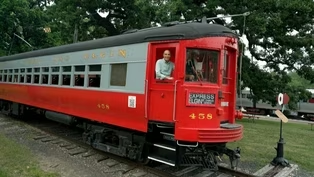
Some beautifully restored Chicago Aurora and Elgin cars still run on an actual remnant of the old line owned and operated by the Fox River Trolley Museum.
- Okay, I'd like to welcome everybody to the Fox River Trolley Museum.
It's a lovely day for a trolley ride.
Wouldn't everybody say so?
(all cheer and clap) - [Group] Yay!
- [Geoffrey] Although trains still run on this short stretch of historic rails, the rest of the abandoned Chicago Aurora and Elgin right-of-way sat decaying for years until a remarkable local woman had an idea that sparked a movement across the country.
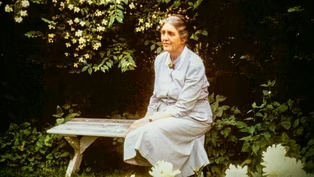
Her name was May Theilgaard Watts.
- May Watts is one of my heroes, really.
- Dr.
Anne Keller teaches junior high school science in Michigan.
Her doctoral dissertation tells the story of May Watts' revolutionary idea to transform the abandoned rail line into a trail for hikers and bikers called the Illinois Prairie Path.
- Well, when you look at pictures of her, she's got her hair braided and her bandana on and she's just ready to go.
(Geoffrey chuckles) She worked at the Morton Arboretum as their main educator there.
She wrote books and illustrated the works as well.
- [Geoffrey] Dr.
Keller's connection to May Watts started long before graduate school.
- I went to an environmental school just for sixth graders.
And one of the songs that we learned, I found out later, was penned by May Watts.
- Can you sing the song?
- I can sing the song.
- Go ahead.
- All right.
♪ Know, know, know your oaks, by the way they grow ♪ ♪ Red oak, white oak, burr oak, pin oak ♪ ♪ That's the way they grow ♪ - [Geoffrey] The origin of the Prairie Path can be traced to a trip May Watts took to England, where she marveled at the proliferation of footpaths.
She told Chicago's Studs Terkel about it in a 1969 radio interview.
- [May] I discovered footpaths and I went mad on footpaths and followed them, and then I came home.
I decided we need these footpaths, but I looked at our landscape, I decided, "It's hopeless.
There is no place."
And then one day I crossed the old abandoned right-of-way of the electric railroad.
- That's near here.
- Yeah.
- [Geoffrey] Watts used all her powers of persuasion to put her plan into action.
There was a lot of opposition.
- A lot of opposition.
May Watts talked about the drooling bulldozers waiting, you know, to take over the space.
- She would take people on hikes along this proposed trail, right?
- She did, to see the connections with all the forest preserves and the prairie remnants that were still here and to get all these people on board and invite them in.
(quirky music) - [May] Having people become familiar and interested with things outdoors, they will be conservationists.
You never need to say that word.
- Whatever May Watts was doing, you wanted to be involved.
She was that dynamic and that charismatic, and fun.
- In 1966, May Watts' dream became reality when the group secured a lease on 27 miles of the old line.
Other communities took notice, and soon the rails to trails movements spread across the country.
In the Chicago area, the former North Shore Line became the Green Bay Trail.
You can still spot remnants of former station platforms, pedestrian underpasses, and even the bases of the poles that supported the overhead wire.
On the south side, a stretch of the abandoned Wabash Railroad became the Major Taylor Trail.
And on the city's northwest side, a defunct elevated freight line became the 606 Trail.
Many more old lines remain abandoned waiting for conversion as they cut mysterious diagonals through neighborhoods and towns.
As many abandoned railroads have become trails, a lot of abandoned trains have been saved from the scrap heap by the Illinois Railway Museum in Union, Illinois, the largest railroad museum in the nation.
Virtually every kind of train we've learned about in this show is here for you to see, touch, and ride on.
And the biggest showstopper of them all here, year after year, is steam.
(steam hissing) Not only are they gonna let me ride in this steam engine, they tell me I'm gonna drive it.
Howdy.
- Hello.
Good morning.
- Good morning.
- Welcome to the Illinois Railway Museum.
- [Geoffrey] It's a little hot in here.
- So I'm the fireman.
- Okay.
Which doesn't mean you put out fires.
- No, I'm the kind that makes fire.
- Makes fire.
All right, if I'm gonna drive this thing, where's the gas pedal?
- The closest to the gas pedal is this lever.
This is the throttle.
And pull it back.
But before you even do that, you gotta put it in gear, right, like a car.
And that's what this bar is.
So when you wanna stop- - Which I will.
- you'll make a set with this brake stain.
(steam hissing loudly) - Whoa.
This is complicated.
- It's more to it than you would think.
Alright, you ready to do this?
- Ready as I'll ever be.
- Alright.
Trade spots with me.
- Oh, man.
Okay.
- Take a seat.
- I've been waiting to do this my whole life.
Okay, what do I do?
- First things first, take this bar and push it all the way forward.
- All right.
- Pull this twice.
(horn blows) (bell ringing) So pull it back a little bit.
- Oh!
(horn blows) Oh, we're moving!
- [Blake] The steam's starting to come out.
There you go.
- We're moving!
We're moving!
- We're moving.
- It's 120 degrees in here.
We're covered in soot and grease and breathing fumes.
And I'm having the time of my life.
I'm driving a steam train.
(bell continues ringing) (engine chugging) What was it we heard way back at the start of the show?
It's not about the destination, it's about the journey.
(train horn blowing) (bright upbeat music) (train horn blows) (bell ringing) There's just no denying the magical appeal of trains.
The nostalgia, the sheer power, the thrill of the journey.
And there's no place that captures that magic more than America's railroad capital, Chicago.
(horn blares) (bright jaunty music) ♪ Two miles ahead, three miles back ♪ ♪ Miles and miles of this railroad track ♪ ♪ We are walking down Chicago Northwestern line ♪ ♪ Look at Sammy, look at Jack ♪ ♪ Pounded them spikes and lying that track ♪ ♪ They are walking down Chicago Northwestern line ♪ ♪ We are rolling down Chicago Northwestern line ♪ - Let's get going, boys.
Here comes the train right now.
(jaunty music continues)
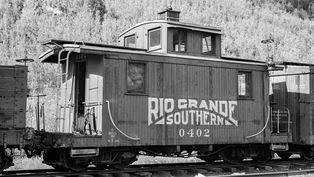
The Caboose: A Home Away from Home
Video has Closed Captions
Geoffrey Baer tours an old freight caboose at the Illinois Railway Museum. (5m 24s)
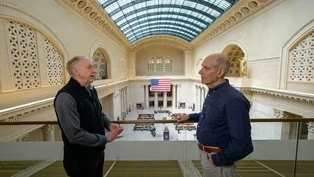
Chicago’s Bygone Downtown Train Stations
Video has Closed Captions
Chicago once had six majestic train stations downtown. (4m 46s)
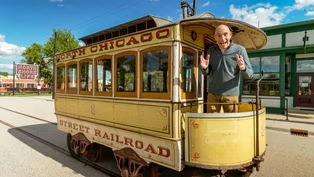
The Days of Cable Cars in Chicago
Video has Closed Captions
In the late 19th century, Chicago had the largest cable car network in the nation. (5m 3s)
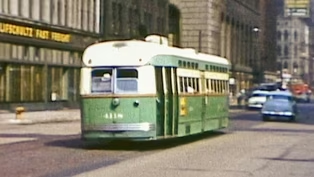
The Delightful Nostalgia of the Streetcar
Video has Closed Captions
Kenosha, Wisconsin, is home to a nostalgic array of streetcars. (3m 32s)
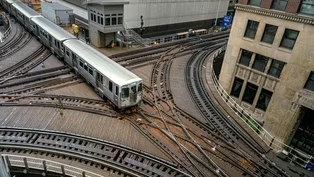
The Early Days of Chicago’s Loop
Video has Closed Captions
A little bit of Chicago-style palm-greasing went a long way in getting the Loop built. (3m 31s)
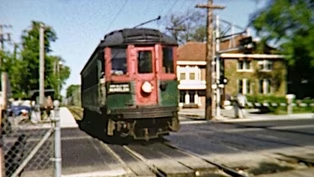
The Forgotten History of Chicago’s Yellow Line
Video has Closed Captions
Chicago’s Yellow Line is all that remains of an old high-speed rail line. (2m 9s)
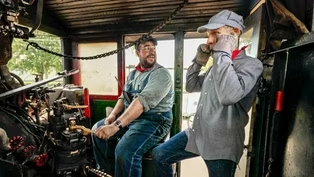
Geoffrey Baer Drives a Steam Train
Video has Closed Captions
At the Illinois Railway Museum, a dream comes true for Geoffrey Baer. (2m 15s)
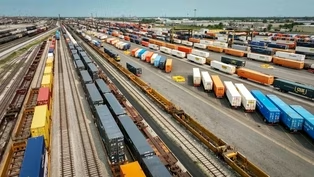
Go Inside an Intermodal Rail Container Yard
Video has Closed Captions
Visit the impressive CSX intermodal rail terminal near Midway Airport. (3m 25s)
How the Railroads Standardized Time
Video has Closed Captions
Once upon a time—time wasn’t standardized. And that was a problem for the booming railroad industry. (2m 59s)
How Trains Carried the Great Migration
Video has Closed Captions
Trains played a big role for Black Americans traveling north during the Great Migration. (2m 37s)
The Innovation and Invisible Labor of Pullman Railcars
Video has Closed Captions
As George Pullman expanded his rail car empire, he hired formerly enslaved men as porters. (3m 59s)
Video has Closed Captions
The South Shore Line is the sole survivor from the days of interurban railroads. (3m 4s)
May Theilgaard Watts and the Rails-to-Trails Movement
Video has Closed Captions
A Chicago naturalist helped propel the rails-to-trails movement. (3m 50s)
Riding in Style: The Golden Age of Rail Travel
Video has Closed Captions
In the first half of the 20th century, railroads exuded a sense of glamour. (4m 39s)
Riding the Rails with Geoffrey Baer – Trailer
Video has Closed Captions
Lifelong train enthusiast Geoffrey Baer explores how railroads shaped Chicago. (1m 1s)
Video has Closed Captions
It took a band of robbers only 30 minutes to pull off America’s biggest train heist. (4m 9s)
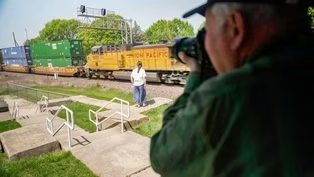
Video has Closed Captions
Rail enthusiasts gather at a busy railroad crossing in Rochelle, Illinois. (1m 50s)
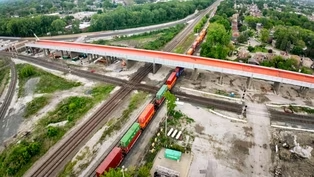
Untangling America’s Busiest Rail Intersection
Video has Closed Captions
Geoffrey Baer visits America’s busiest and most frustrating rail intersection near Chicago. (2m 49s)
Providing Support for PBS.org
Learn Moreabout PBS online sponsorship











Support for PBS provided by:
Chicago Tours with Geoffrey Baer is a local public television program presented by WTTW